The choice between mSOL vs JitoSOL vs bSOL is not a marginal preference call. These three Solana LST tokens are built on different yield models, different validator architectures, and different positions on the trade-off between maximum return and network decentralization. Over $8 billion in SOL is now held in liquid staking positions, representing roughly 14% of all staked Solana. That scale makes picking the right liquid staking token a decision with real compounding consequences over a multi-year horizon. JitoSOL from Jito adds MEV income on top of base staking rewards for a variable but higher APY. mSOL from Marinade Finance spreads stake across 100 or more validators for a stable, predictable return with the longest operating track record on Solana. bSOL from BlazeStake directs capital to community and independent validators, with a governance token layer through BLZE that adds a third yield stream for active participants. Each choice has a clear best-fit holder type. This guide breaks them all down with the specifics needed to make an informed decision.
What Is Liquid Staking and Why Does the Token Choice Matter?
Liquid staking solves one core problem with native staking on Solana: your capital is locked behind an unbonding delay of two to three days each time you want out. A liquid staking token removes that constraint. You deposit SOL into a stake pool and receive an LST in return. The pool delegates your SOL to validators, which earn rewards each epoch. Your LST appreciates in value against SOL over time, representing your staked position plus accumulated rewards. You can hold, trade, use as DeFi composability collateral, or swap back to SOL at any point without waiting for the 2-3 day deactivation cycle.
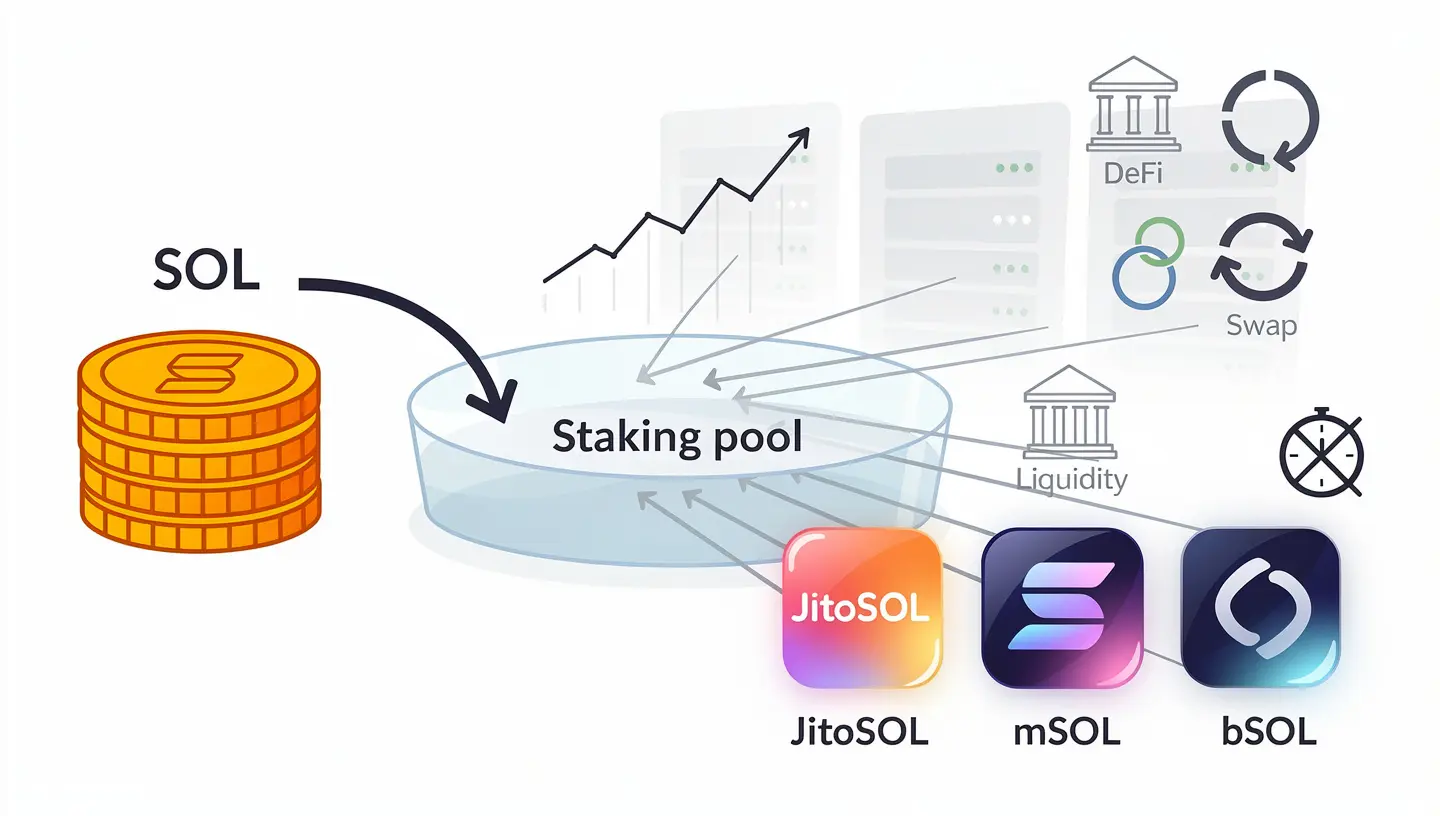
The four main reasons to use a Solana LST rather than native staking are: automated validator diversification without manual redelegation, liquidity to exit or deploy without waiting for epoch boundaries, DeFi access to deploy the token across lending and LP protocols, and automatic compounding without any action required each epoch. What differs between JitoSOL, mSOL, and bSOL is how each protocol generates yield on top of the same base staking return, and which trade-offs it accepts to do so.
The $8 billion figure and the 14% share of all staked SOL in liquid staking form matters as context because pool size directly affects liquidity depth for exits and DeFi integration breadth. A larger TVL pool supports deeper DEX pools for the LST and more lending market integrations for the same token. The TVL difference between the three tokens covered here is meaningful and covered in the comparison table below.
The Exchange Rate Model: How LSTs Grow in Value
All three tokens covered in this article use the exchange rate model, not a rebasing model. This distinction matters for how you track returns and for tax cost-basis tracking. In a rebasing model like Lido’s stETH on Ethereum, new tokens arrive in your wallet each time rewards accrue. In the exchange rate model, your token balance stays the same but each token becomes redeemable for more SOL each epoch. You hold 10 JitoSOL, it still reads 10 JitoSOL in your wallet, but its redemption value in SOL rises continuously as staking rewards accumulate.
This model is simpler for auto-compounding: rewards compound inside the exchange rate without any action from you. It also simplifies cost-basis accounting because you are not receiving new taxable income with each epoch the way a rebasing token can imply. You have one entry price, one position, and one exit. The gain is the difference in SOL value between when you deposited and when you redeemed or sold, which may still be taxable depending on jurisdiction, but the tracking is more straightforward than managing hundreds of micro-reward events.
JitoSOL: MEV-Boosted Yield and How It Works
JitoSOL is the liquid staking token issued by the Jito stake pool. What separates it from mSOL and bSOL is a second yield layer built directly on top of base staking rewards: MEV, or maximal extractable value, captured by validators running the Jito-Solana client. This is not a marginal addition. During periods of high Solana network activity, MEV yield from JitoSOL can push total APY 1% to 2% above what mSOL delivers in the same epoch. Across multiple years, that gap compounds into a real difference in accumulated SOL for larger positions.
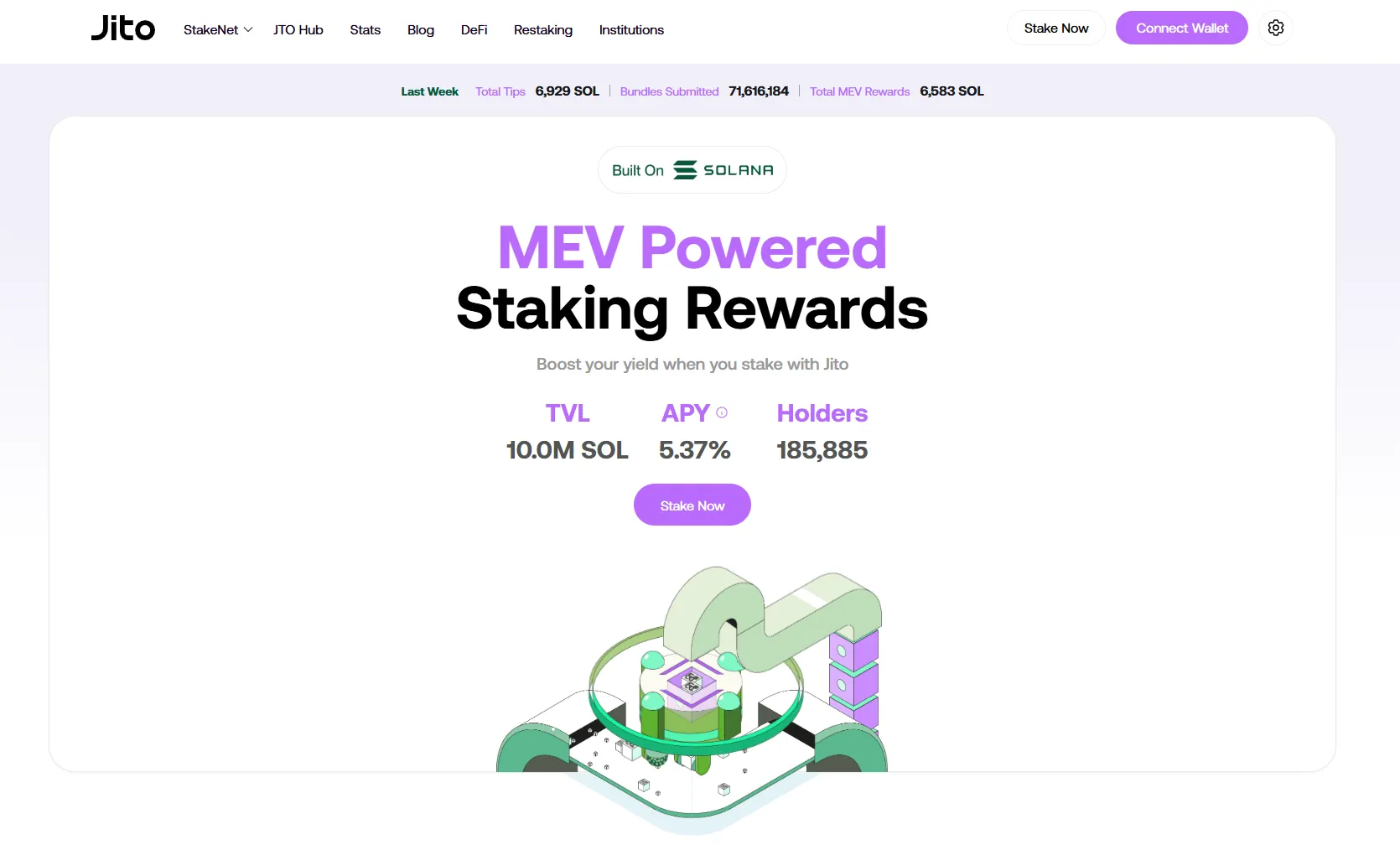
As of mid-2026, JitoSOL holds the largest TVL of any Solana liquid staking token, with more than 14.3 million SOL in the pool. The DeFi integration footprint is the broadest of the three: accepted as collateral in Kamino Finance, Marginfi, and Drift Protocol, with deep liquidity in JitoSOL/SOL pools on both Orca and Raydium. For holders who plan to deploy their LST beyond just holding, JitoSOL’s integration coverage is currently ahead of mSOL and bSOL.
How MEV Yield Actually Works in JitoSOL
MEV on Solana flows through the Jito protocol’s block engine. Searchers, traders who identify profitable transaction ordering opportunities, pay MEV tips to validators in a tip auction system to have their transaction bundles placed at specific positions within a block. Validators running the Jito validator client participate in this auction. The tips they collect flow into the JitoSOL stake pool and are distributed to stakers through the pool’s exchange rate mechanism. Every epoch, the JitoSOL-to-SOL exchange rate rises from both inflation rewards and accumulated MEV tips. More on-chain activity, more tip auctions, more MEV contribution to that exchange rate rise.
JitoSOL APY Range and What Drives It
JitoSOL total APY typically falls in a 7% to 9% range. The upper end occurs during high-activity market conditions: major token launches, large liquidation events, elevated DeFi volumes. During quiet markets, the MEV component contracts and effective yield compresses closer to 6.5% to 7.5%. This MEV variability is the defining characteristic of JitoSOL’s yield model. It is not a fixed premium over mSOL at all times. The gap between JitoSOL and mSOL runs to roughly 100 to 150 basis points in favor of JitoSOL during active market periods and narrows significantly during low-activity stretches. For holders who are long-term optimistic on Solana’s trading volume growth, JitoSOL’s yield model is structurally positioned to benefit as that activity increases.
JitoSOL DeFi Integration and Risks
Beyond base holding, JitoSOL has the deepest DeFi integration depth of the three tokens. Kamino Finance, Marginfi, and Drift Protocol all accept it as collateral with competitive loan-to-value ratios. Concentrated liquidity pools on Orca and standard pools on Raydium maintain substantial JitoSOL/SOL depth for low-slippage exits on large positions.
The primary risks are two. First, smart contract risk at the Jito stake pool program level, which has operated for several years without a significant exploit but carries the non-zero risk that applies to all DeFi smart contracts. Second, MEV variability: the yield advantage of JitoSOL over mSOL is not guaranteed and can narrow or disappear temporarily during low-activity market conditions. Holders who need a stable, predictable return should understand this variability before choosing JitoSOL as their primary staking vehicle. There is also a philosophical concern that a large fraction of Solana’s validator stake running the same Jito-Solana client creates a degree of client-level concentration in the network’s validator set.
Our guide on Marinade vs Jito vs Coinbase staking covers the full economic comparison between these protocols including fee structures, break-even calculations, and how each performs across different market conditions.
mSOL: Marinade Finance and Diversified Validator Staking
mSOL is issued by Marinade Finance, which launched in 2021 as Solana’s first liquid staking protocol. That founding date matters: Marinade has the longest operating history and the most audit cycles completed of any Solana LST protocol. The smart contract behind mSOL has been reviewed, updated, and stress-tested through multiple Solana market cycles, including periods of significant network stress. For holders who weight protocol track record heavily, Marinade’s position is genuinely differentiated from newer alternatives.

Marinade uses an algorithmic rebalancer to distribute SOL across 100 or more validators, weighted by performance metrics including vote credits, uptime, commission rates, and decentralization criteria. No single validator holds a disproportionate share of the pool. This design produces a more stable and predictable APY than JitoSOL’s MEV-dependent model. Current mSOL APY runs in the 6% to 7.5% range. During active market conditions, this trails JitoSOL by 1% to 2%. During quiet conditions, the gap narrows and in some epochs mSOL can match or slightly exceed JitoSOL’s effective yield because there is no MEV component to compress. mSOL has 148,663 holders, the largest holder base of the three tokens, reflecting its status as the longest-established Solana LST.
Marinade’s Stake Auction Marketplace and Validator Selection
Marinade’s Stake Auction Marketplace, or SAM, is a structural differentiator that most competing protocols do not offer. Under SAM, validators bid competitively for stake from the Marinade pool by offering to return a portion of their commission back to mSOL holders. This creates a market mechanism where validators compete on terms rather than simply receiving allocation from a central committee. The algorithmic rebalancer continuously updates delegation based on current performance metrics, redirecting stake away from underperforming validators and toward those offering better returns and reliability. mSOL holders capture the outcome of that competition in their exchange rate appreciation each epoch.
Marinade Native: Liquid Staking Without Smart Contract Risk
Marinade Native is a separate product that runs alongside mSOL and addresses a concern specific to institutional capital: smart contract exposure. With Marinade Native, you receive the benefits of Marinade’s validator selection and rebalancing logic without your SOL ever passing through the mSOL stake pool program. It operates as direct validator delegation through Marinade’s strategy rather than as a tokenized pool share. There is no smart contract between your SOL and the validators. Institutional stakers who cannot accept DeFi smart contract risk in their risk framework can access Marinade’s diversified delegation approach while maintaining full self-custody of their delegation without wrapping it into a token.
The trade-off is that Marinade Native does not produce an LST. You cannot use it as DeFi collateral or swap it on a DEX. It is a staking product, not a liquidity product. For holders whose primary goal is yield and custody rather than DeFi composability, this distinction does not matter. For those who want both, the standard mSOL route applies.
MNDE Governance and SOC 2 Certification
MNDE is Marinade’s governance token. MNDE holders can vote on how Marinade allocates delegation weight across its validator set and on other protocol parameters. Staking MNDE through Marinade’s MNDE governance mechanisms generates additional rewards on top of base mSOL yield for those who engage. Participation is entirely optional. Passive mSOL holders who simply want staking yield do not need to interact with MNDE at all.
Marinade holds both SOC 2 Type I and SOC 2 Type II certifications, a meaningful distinction for institutional adoption. SOC 2 Type II covers operational security controls over an extended time period and is not common among DeFi protocols. It signals a level of operational rigor that purely on-chain alternatives cannot demonstrate through the same framework. For institutional buyers who require this kind of third-party operational verification before allocating significant capital, Marinade’s SOC 2 status removes a barrier that most liquid staking alternatives cannot address.
Understanding how the underlying Solana transaction fee mechanism affects staking yields, including priority fees that contribute to block leader rewards for validators in the mSOL pool, is covered in our guide on Solana transaction fees.
bSOL: BlazeStake’s Community Validator LST
bSOL is issued by BlazeStake with a delegation strategy that explicitly prioritizes community validators: smaller, geographically distributed, independent validators that would not receive meaningful delegation from yield-optimized protocols like Jito or from Marinade’s performance-weighted algorithm. BlazeStake’s view is that supporting this category of validator produces a healthier and more decentralized Solana network over the long run, and that stakers who care about that outcome should be able to direct their capital accordingly.
The base staking mechanics are identical to JitoSOL and mSOL. You deposit SOL, receive bSOL, and the exchange rate between bSOL and SOL rises each epoch as the underlying stake earns rewards. There is no MEV capture layer because the validators prioritized by BlazeStake are not running the Jito-Solana client. The base staking APY for bSOL runs in the 6% to 7% range, comparable to mSOL’s stable tier. Validator decentralization is the core differentiation, not yield maximization. bSOL’s TVL is the third largest of the three tokens, reflecting both its younger age and its narrower appeal compared to JitoSOL’s yield-first model or mSOL’s stability-and-track-record positioning.
BLZE Rewards: The Extra Yield Layer for Active Participants
BLZE is BlazeStake’s governance and incentive token. bSOL holders earn BLZE rewards on top of their base staking APY. Active participants who engage with the BLZE token layer use it to direct delegation weight toward specific validators, participate in governance votes on protocol parameters, or stake BLZE for additional returns. For engaged participants, total effective yield from bSOL plus BLZE can push into the 6% to 8% range or higher depending on current BLZE reward rates and market value.
For passive holders who accumulate bSOL without engaging with BLZE mechanics, the return profile sits in the base 6% to 7% staking APY range. The BLZE layer is optional participation. Stakers who are attracted to BlazeStake for its validator decentralization focus but not interested in active governance participation get that alignment without needing to manage the governance token side at all.
bSOL DeFi Integrations and Liquidity Depth
bSOL is accepted in Kamino Finance and a select set of other Solana DeFi protocols. Its integration footprint is narrower than JitoSOL or mSOL, which matters for holders planning large lending deployments or high-volume LP positions. For holders focused on straight yield accumulation through holding, this constraint is not practically relevant. For those planning complex yield stacking strategies with significant capital, verify current pool depth and available lending markets before committing a large position to bSOL.
The primary risk specific to bSOL beyond standard smart contract and depeg risk is BLZE price risk. The additional yield from BLZE participation is real but depends on BLZE’s market value. A sustained decline in BLZE price reduces the total return picture for holders who are counting that component as part of their expected yield. Liquidity depth in bSOL/SOL pools is shallower than the equivalent JitoSOL or mSOL pools, which can cause meaningful slippage for large position exits. BlazeStake’s full delegation philosophy and BLZE governance mechanics are documented at blazestake.com.
mSOL vs JitoSOL vs bSOL: Full Comparison Table
| Feature | JitoSOL | mSOL | bSOL |
|---|---|---|---|
| Base staking APY | ~6-7% | ~6-7.5% | ~6-7% |
| MEV or bonus yield | Yes (variable MEV tips) | No | BLZE governance rewards |
| Total APY range | ~7-9% (active markets) | ~6-7.5% | ~6-8% (with BLZE) |
| TVL | Largest (14.3M+ SOL) | Second (3.4M+ SOL) | Third |
| Validator strategy | Jito client validators | 100+ diversified (SAM) | Community-weighted |
| DeFi integrations | Kamino, Marginfi, Drift, Orca | Kamino, Marginfi, Orca | Kamino, select pools |
| Governance token | None (JTO separate) | MNDE | BLZE |
| Protocol launch | 2021 | 2021 (oldest) | 2022 |
| Decentralization focus | Medium | High | Highest |
| SOC 2 certification | No | Type I and Type II | No |
| Primary risk | MEV variability, client concentration | Smart contract, liquidity depth | BLZE price, liquidity depth |
The core trade-off is visible in the table. JitoSOL leads on raw APY potential and DeFi breadth. mSOL leads on stability, audit history, validator diversification, and institutional credentials. bSOL leads on decentralization alignment and governance participation, with a growing but narrower DeFi presence. APY figures and TVL rankings shift with market conditions and are worth verifying against live data before a large allocation decision.
Sanctum INF and JupSOL: Other Solana LSTs Worth Knowing
Three tokens dominate the mSOL vs JitoSOL vs bSOL conversation, but two additional options appear consistently in the broader Solana liquid staking landscape and are worth understanding before committing to any single protocol.
Sanctum INF: Unified Liquidity Across All LSTs
Sanctum takes a different approach from the three primary tokens above. Rather than running a single staking pool, Sanctum built an Infinity pool that aggregates liquidity across all Solana LSTs simultaneously, including JitoSOL, mSOL, bSOL, and dozens of smaller tokens. The INF token represents a basket position across this pool. When you want to exit any LST through Sanctum, the protocol routes your swap through whichever liquidity source offers the best price at that moment, rather than limiting you to a single pool’s depth.
Sanctum reports INF at an effective APY of around 8.5%, reflecting the aggregate yield of the underlying LST basket. The LST aggregator model also supports instant unstaking for individual LSTs without the standard epoch wait, at a small fee. The complexity cost is real: INF holders are exposed to the underlying LST mix, routing assumptions, and multiple smart contracts simultaneously. Understanding the exit route before depositing is necessary. For holders who move between JitoSOL, mSOL, bSOL, and other LSTs frequently, Sanctum functions as the liquidity layer connecting all of them rather than a standalone staking product.
JupSOL and PSOL: Wallet-Native Liquid Staking
JupSOL is Jupiter’s liquid staking token. Jupiter operates the second largest Solana validator by stake weight, which means JupSOL benefits from both base staking rewards and a degree of MEV capture through the Jupiter validator’s block production activity. The yield structure is competitive with JitoSOL in active market conditions. JupSOL integrates naturally with Jupiter’s swap aggregator, which provides convenient exit liquidity for token holders already active in Jupiter’s DeFi interface.
PSOL, Phantom’s liquid staking token, operates on the same exchange rate model as the other tokens covered here. It has completed nine audits of its underlying stake pool program, an unusually high audit count for any DeFi product. PSOL adds MEV tips and priority fees to base staking yield and is accessible directly within Phantom Wallet without visiting an external protocol. For holders who keep their SOL in Phantom and want yield without leaving the wallet environment, PSOL is the path of least friction. Its DeFi integration is narrower than JitoSOL or mSOL at this stage.
Our guide on the best Solana wallets covers Phantom, Solflare, Backpack, and hardware options in full, including which wallets support which liquid staking tokens directly from their interface.
Yield Stacking: Earning More on Top of Your LST
Holding any LST in your wallet is the baseline position. Deploying that LST into Solana DeFi protocols adds a second yield layer that runs simultaneously with the base staking return. The core mechanic: the staking yield continues accruing through the exchange rate regardless of where the token sits. A JitoSOL deposited into Kamino’s lending market still appreciates in SOL value each epoch. The lending protocol pays a supply APY on top. Both streams run at the same time on the same capital.
This is yield stacking: two return layers on one position with the base staking layer running underneath the DeFi layer continuously. The combined return can meaningfully exceed what either layer alone delivers. This is why DeFi composability is the most cited advantage of liquid staking tokens over native staking, where your capital is locked and cannot be deployed simultaneously.
For a full guide on how to stake SOL across native and liquid staking options, our walkthrough at how to stake Solana covers the complete setup from wallet connection to first reward.
Lending Markets: Kamino and Marginfi
Kamino Finance accepts JitoSOL and mSOL as lending market deposits with competitive loan-to-value ratios. You supply your LST as a lender, the protocol pays supply APY from borrowers who post it as collateral, and your base staking yield continues through the exchange rate simultaneously. Combined yield through Kamino for JitoSOL or mSOL positions typically runs in the 10% to 14% range depending on current utilization, market conditions, and the split between MEV yield on the JitoSOL side and lending supply APY from the Kamino layer.
Marginfi works on the same principle. You deposit your LST, earn supply APY, and retain the embedded staking return. Marginfi additionally supports borrowing against LST deposits. Holders who want leveraged staking exposure can use this feature, but it introduces risks that straightforward yield stacking does not carry. This approach is covered in the next section. For holders who want the additional return from lending without leverage, the deposit-and-earn approach in Kamino or Marginfi is the simpler and lower-risk implementation of yield stacking.
Leveraged Staking: How to Loop Your Position
Leveraged staking is a more advanced implementation of the yield stacking concept. The looping strategy works as follows: deposit JitoSOL or mSOL into Marginfi as collateral, borrow SOL against that collateral at a safe loan-to-value ratio, restake the borrowed SOL to receive more JitoSOL or mSOL, deposit the new LST back into Marginfi, and repeat. Each loop amplifies yield exposure on the same initial capital. A two-loop position on a JitoSOL deposit might convert a 7% effective yield to 12% to 14% on the original capital, depending on borrowing costs and MEV conditions.
The trade-off is real and important to understand before implementing it. Each loop adds liquidation risk: if the JitoSOL price diverges significantly from SOL at the wrong moment, the loan-to-value ratio can be breached and the position liquidated. The loan-to-value ratio you maintain across all loops determines how close or far you are from that threshold. Experienced DeFi users running this strategy typically stay at least 20% below the liquidation LTV threshold at each loop level and monitor the position regularly.
Impermanent Loss in LST/SOL Pools: Why It Is Different
Providing liquidity in JitoSOL/SOL or mSOL/SOL pairs on Orca or Raydium adds LP trading fees on top of the embedded staking yield in the LST side of the pair. The reason this works well specifically for LST/SOL pairs is the nature of impermanent loss in these pools. Normally, IL is the largest practical risk for LP providers: if the price ratio between your two tokens shifts significantly, your position ends up worth less than simply holding both.
For LST/SOL pairs, the price ratio is bounded by the economics of the relationship. JitoSOL and SOL are the same underlying asset in two forms, with JitoSOL simply appreciating against SOL at the staking yield rate each epoch. The price divergence that causes IL in normal LP pairs is structurally limited here because the ratio between the two tokens can only drift slowly in one direction, at the rate of staking rewards. This makes LST/SOL LP positions more suitable for yield stacking than most non-correlated pairs, while still carrying the standard liquidity provider smart contract and pool risk. The LP fees from trading activity in these pools, typically 2% to 5% annualized, add on top of the embedded staking yield in the LST position.
Our guide on the best DEX on Solana covers Orca, Raydium, Jupiter, and Meteora, including how concentrated liquidity positions work on these pools for LP strategies involving LSTs.
How to Choose: Decision Framework by Holder Type
The right choice between mSOL vs JitoSOL vs bSOL depends on your priorities as a holder. There is no single correct answer, but there is a correct answer for your specific situation.
- Maximum APY in active markets: JitoSOL. MEV yield spikes during high-activity periods and delivers the largest yield advantage over the other two tokens. Best for yield-maximizers who are comfortable with variable income and plan to deploy the token in DeFi for additional stacking.
- Stable, predictable yield without complexity: mSOL. Diversified validator delegation, the longest track record, stable return without MEV variability, and clean compounding without governance token mechanics to manage. Right for holders who want staking yield to run itself.
- Validator decentralization as a priority: bSOL. If your values include supporting smaller, independent validators and contributing to Solana’s network health, bSOL is the aligned choice. The BLZE layer adds yield for engaged participants. The strongest philosophical differentiator bSOL holds over the other two.
- Institutional staking without smart contract exposure: Marinade Native (not mSOL itself). Marinade’s SOC 2 Type I and Type II certification and its native direct-delegation product address institutional risk management requirements that liquid staking tokens cannot satisfy.
- Deep DeFi deployment with broadest integration coverage: JitoSOL first, mSOL as a strong alternative. Verify current Kamino and Marginfi pool depths before committing. Both support lending, collateral, and LP strategies at scale.
- Risk-averse holders prioritizing audit history above yield: mSOL. Marinade has the longest operating history and the most complete audit record of any Solana LST protocol. The lowest-risk option in this group for holders who weight battle-tested contracts above yield optimization.
Split Allocation: Running JitoSOL and mSOL Together
A split allocation between JitoSOL and mSOL is a common and sensible approach for larger positions. The logic is simple: JitoSOL provides MEV upside during active markets, mSOL provides stable returns and acts as the lower-volatility leg of the position. Running both simultaneously reduces single-protocol smart contract concentration while maintaining exposure to both yield profiles. A 60/40 or 50/50 portfolio split between the two is a straightforward implementation that most experienced Solana stakers land on when they have enough capital to justify the added complexity of managing two tokens.
bSOL can be added as a third leg for holders who want explicit validator decentralization exposure in addition to the JitoSOL/mSOL yield pairing. This three-way portfolio split across all three major Solana liquid staking tokens represents a fully diversified position across all three yield strategies: MEV-enhanced, diversified-stable, and community-governance-weighted.
To understand how liquid staking returns compare to native validator delegation and exchange staking, and how to calculate the expected yield across each approach, our guide on Solana staking rewards covers the full return model including inflation schedule, validator commission, and MEV contribution.
Risks That Apply to All Three LSTs
Each protocol has its own specific risk profile covered above, but four risk categories apply to all three tokens regardless of which you choose.
- Smart contract risk: All three protocols depend on on-chain stake pool programs. Audits reduce the probability of known bug classes reaching production but do not eliminate risk entirely. Operating history is the best available proxy for this risk: the longer a contract has run without exploit, the stronger the empirical evidence of its robustness.
- Depeg risk: In extreme market stress conditions, the trading price of an LST on a DEX can temporarily diverge below its fundamental redemption value in SOL. This has affected various LSTs across Solana’s history during periods of sharp market moves and thin liquidity. Depeg events are typically short-lived but can cause losses for holders who exit at the wrong moment during the dislocation.
- Liquidity depth risk for large exits: All three tokens can be swapped back to SOL on a DEX, but pool depth determines slippage on large exits. JitoSOL has the deepest pools, followed by mSOL, then bSOL. For positions in the tens or hundreds of thousands of SOL, the instantaneous exit route through a DEX may carry meaningful slippage. Native redemption through the protocol avoids this at the cost of waiting for epoch boundaries.
- Governance token price risk: MNDE and BLZE add yield potential for active participants in mSOL and bSOL respectively but also add exposure to the price of those tokens. A sustained decline in governance token value reduces total return for holders who are factoring MNDE or BLZE rewards into their expected APY.
Security habits around how you store and manage an LST position are the same as for any Solana token. Our guide on how to keep Solana safe covers approval management, seed phrase security, and the specific attack patterns targeting active DeFi users holding LST positions.
mSOL vs JitoSOL vs bSOL: FAQs
Which Solana LST Has the Highest APY?
JitoSOL typically leads in total APY during active market conditions because of the MEV component on top of base staking rewards. The effective range is 7% to 9% with the upper end occurring during high-activity periods. mSOL currently sits in a 6% to 7.5% range. During quiet markets, the gap between the two can narrow to under 1%. Sanctum’s INF token has reported higher effective APY by aggregating across all LSTs, but it introduces additional complexity. APY figures shift every epoch and should be verified against live data before making allocation decisions.
What Is the Difference Between JitoSOL and mSOL?
JitoSOL captures MEV income on top of base staking rewards, producing higher but variable APY. The yield advantage over mSOL runs to 100 to 150 basis points in active markets. mSOL distributes stake across 100 or more validators with no MEV layer, producing more stable and predictable returns. mSOL has a longer operating history, the most audit cycles, and SOC 2 certification. JitoSOL has larger TVL and deeper DeFi integration coverage. The choice is yield upside versus stability, weighted against your intended use and risk tolerance.
Is JitoSOL Safe?
JitoSOL carries smart contract risk at the Jito stake pool program level. The program has operated for several years without a significant exploit and holds a meaningful audit history. The primary practical risk for most holders is not a catastrophic smart contract failure but rather MEV variability: the yield advantage JitoSOL holds over mSOL is not guaranteed and can contract during low-activity market conditions. No DeFi protocol is without risk, but JitoSOL’s operating track record is solid for a protocol of its age.
Can I Use mSOL and JitoSOL as DeFi Collateral?
Yes. Both mSOL and JitoSOL are accepted as collateral in Kamino Finance and Marginfi, Solana’s two largest lending protocols, with competitive loan-to-value ratios. bSOL is accepted in Kamino and a smaller set of protocols. DeFi integration depth varies between the tokens, with JitoSOL currently having the broadest coverage across lending markets, DEX pools, and derivatives protocols. Always check current pool depth and available LTV ratios before committing a large collateral position to any of the three.
What Is the Exchange Rate Model vs Rebasing?
The exchange rate model means your LST token balance stays constant while the token’s redemption value in SOL rises each epoch as rewards accumulate. You hold the same number of tokens but they are worth more SOL over time. In a rebasing model like Lido’s stETH on Ethereum, new tokens are minted and sent to your wallet as rewards arrive. The exchange rate model used by JitoSOL, mSOL, and bSOL simplifies cost-basis tracking and auto-compounds rewards without generating new taxable events at each distribution, though tax treatment varies by jurisdiction.
What Is BLZE and How Does It Work?
BLZE is BlazeStake’s governance and incentive token. bSOL holders earn BLZE rewards on top of their base staking APY. BLZE can be used to direct delegation toward specific validators in the BlazeStake pool, participate in governance votes on protocol parameters, or be staked for additional returns. The yield contribution from BLZE depends on current reward rates and BLZE’s market value. For governance rewards to add meaningfully to total return, you need to be an active participant in the governance mechanics rather than a passive bSOL holder.
Can I Hold More Than One Solana LST at the Same Time?
Yes. There is no protocol restriction on holding multiple LSTs simultaneously and many experienced stakers do exactly that. A split allocation between JitoSOL and mSOL, for example, balances MEV upside against stable returns while reducing single-protocol smart contract concentration. The main consideration is position size: for smaller positions below a few thousand dollars, the added complexity of managing two tokens may not be worth the marginal diversification benefit. For larger positions, a portfolio split between two or three LSTs is a common and sensible approach.
What Is Yield Stacking With Solana LSTs?
Yield stacking is the practice of deploying an LST into a DeFi protocol to earn a second return layer on top of the base staking yield. The base staking yield continues accruing through the exchange rate regardless of where the token is deployed. Depositing JitoSOL into Kamino earns a lending supply APY from borrowers while the embedded staking yield inside JitoSOL continues running simultaneously. Combined yield in Kamino for JitoSOL positions typically reaches 10% to 14%, depending on current lending utilization and market conditions.