If you want to know how to stake Solana, the process is simpler than most people expect. You pick a wallet, choose a validator, delegate your SOL, and start collecting staking rewards at the end of every epoch. Current yields sit between 6% and 8% APY depending on the validator and method you choose. This guide covers every approach, from native staking with Phantom Wallet to liquid staking with protocols like Jito and Marinade, so you can pick the one that fits how you plan to hold SOL and earn passive income.
What Is Solana Staking?
Solana staking is the process of delegating your SOL tokens to a validator who processes transactions and adds new blocks to the network. In exchange for that delegation, you receive a share of the block rewards the validator earns. Your tokens do not leave your wallet at any point. You are lending your stake weight, not transferring ownership.

Solana runs on a Proof of Stake consensus mechanism combined with Proof of History, which is what allows the network to confirm thousands of transactions per second at a fraction of a cent per transaction. Validators are ranked by how much SOL has been delegated to them. More stake means more chances to validate blocks, which means more rewards distributed to delegators.
Because Phantom, Solflare, and other non-custodial wallets handle delegation directly, you keep full control of your keys throughout. This is different from leaving SOL on an exchange where a third party controls the staking process. Network security improves the more SOL is staked across a diverse set of validators, which is why spreading your stake across several validators rather than one large one is generally a sound approach.
Staking is one of the most straightforward ways to earn passive income from crypto without selling your position. You hold SOL anyway, the staking rewards compound every two to three days, and your tokens remain under your control the whole time.
To understand the network that makes this possible, read our overview of what Solana is and how it differs from other blockchains.
How Does Solana Staking Work?
Solana staking works through a delegated Proof of Stake system. When you stake, your SOL moves into a stake account tied to your wallet address. You assign that account to a validator of your choice. The validator uses the combined stake weight of all their delegators to participate in block voting. Every time they successfully validate a block, rewards are distributed back to delegators in proportion to how much SOL each person staked.
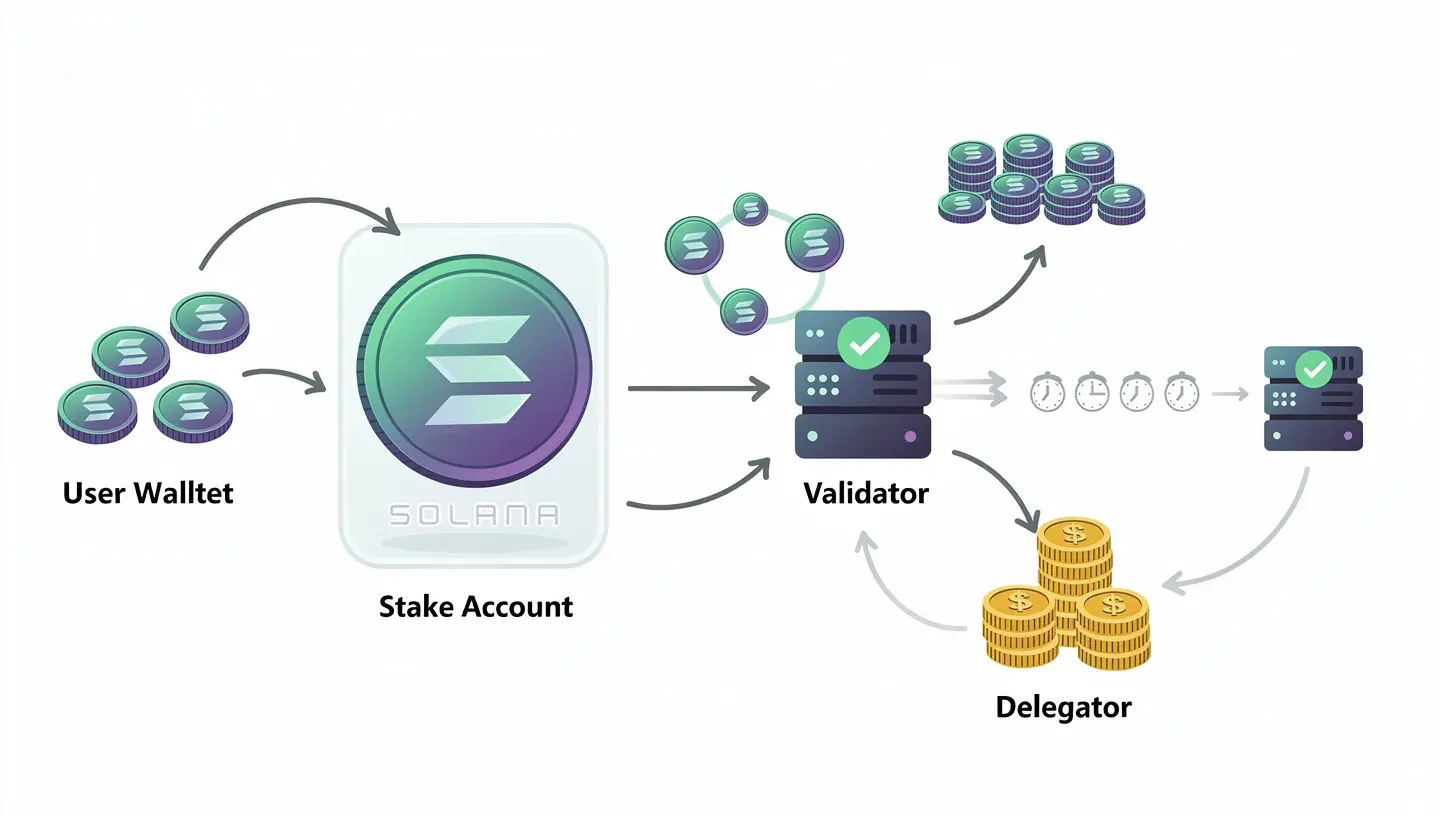
The rewards come from two sources: Solana’s inflation rate, which started at 8% annually and decreases by 15% each year until it reaches a long-term floor of 1.5%, and a share of transaction fees collected on the network. Validators take a commission from these rewards before distributing the rest to delegators. A validator charging 5% commission keeps 5% of what they earn and passes the remaining 95% to their delegators.
Epochs, Rewards, and How They Are Calculated
Solana time is divided into epochs, each lasting approximately two to three days. Rewards are calculated and distributed at the end of every epoch. When you start staking, your stake activates at the beginning of the next epoch, not immediately. This means there is a short waiting period before your first staking rewards appear.
Your actual APY depends on three things: how much SOL you have staked, the validator commission rate, and the current inflation rate. If you restake your rewards at the end of each epoch rather than withdrawing them, the compound effect builds up meaningfully over time. Liquid staking protocols like Jito and Marinade handle this automatically.
What Happens to Your SOL When You Stake It?
Your SOL moves into a stake account linked to your wallet. You delegate that account to a validator. The validator cannot access, move, or spend your SOL. During the lock-up period, your tokens are not available for transfers or swaps, but they remain yours and they are earning rewards every epoch.
This is what makes Solana staking through a non-custodial wallet fundamentally different from staking on an exchange. The phrase used consistently across the space holds: tokens never leave your wallet. The validator has voting power, not custody.
To understand the architecture behind how Solana reaches consensus, our guide on Solana Proof of History explains the mechanism in detail.
Native Staking vs Liquid Staking: Which One Is Right for You?
Native staking and liquid staking are the two main methods for earning staking rewards on Solana. The core difference is what happens to your SOL during the staking period.
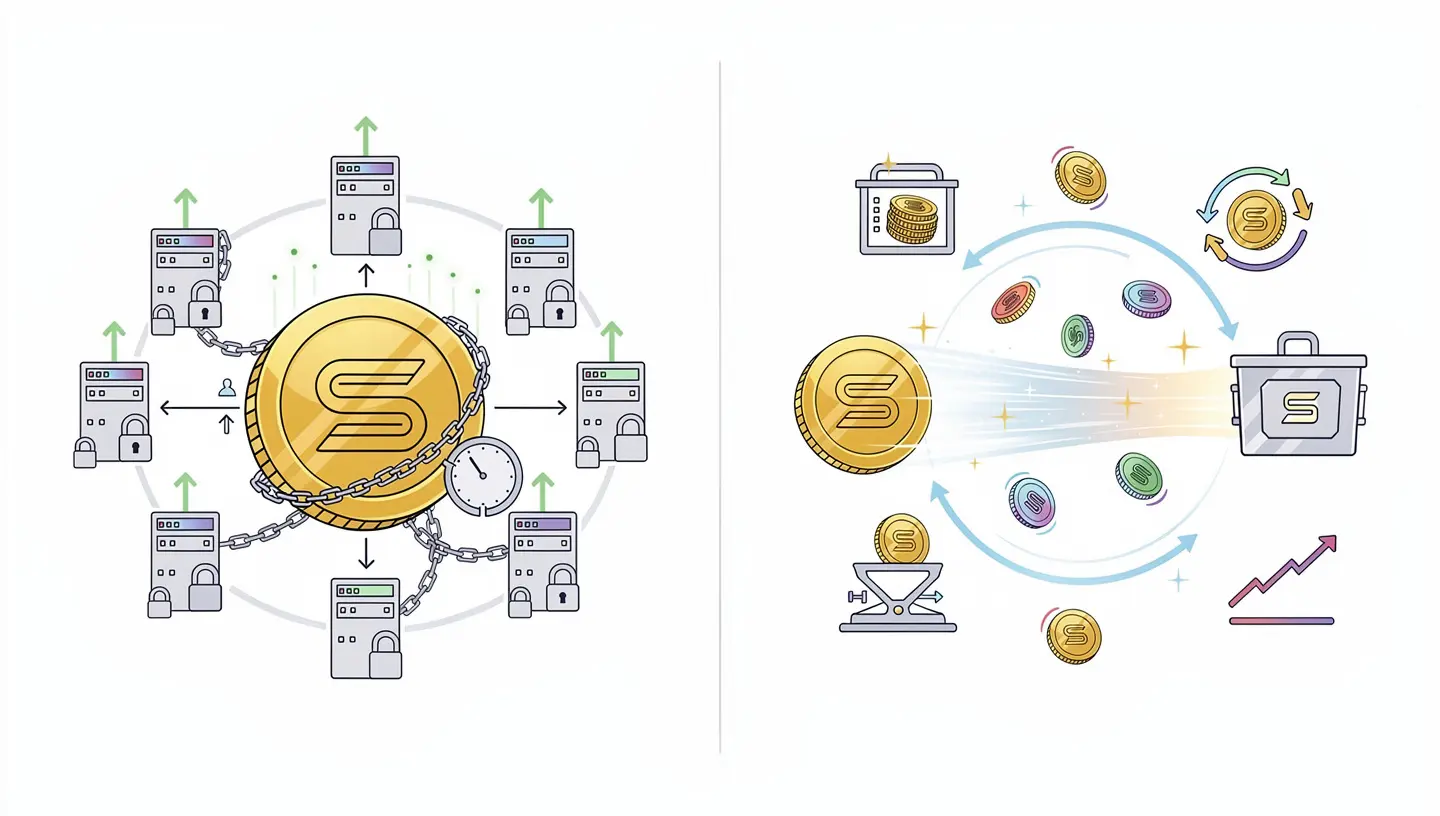
With native staking, you delegate directly to a validator. Your SOL is locked until you initiate unstaking and wait out the cooldown period of roughly two to three days. You cannot use your staked SOL in DeFi protocols or trade it while it is locked.
With liquid staking, you deposit your SOL into a stake pool smart contract and receive a liquid staking token (LST) in return, such as mSOL, JitoSOL, or bSOL. That token represents your staked position plus accumulated rewards. You can trade it, use it as collateral, or swap it back to SOL at any time on a DEX. The staking rewards still accrue.
| Feature | Native Staking | Liquid Staking |
|---|---|---|
| Flexibility | Low — SOL is locked | High — LST is tradable |
| Lock-up period | ~2-3 days to unstake | Instant via DEX swap |
| DeFi usage | No | Yes — as collateral or in pools |
| Smart contract risk | None | Yes — protocol risk |
| Best for | Long-term holders | Active DeFi users |
| Auto-compound | Manual | Automatic |
For most beginners who plan to hold SOL long-term and want no complexity, native staking through Phantom or Solflare is the right starting point. For users who want their staked SOL to keep working across DeFi while earning rewards, liquid staking through Jito or Marinade is the better fit.
How to Stake Solana With Phantom Wallet
Staking through Phantom Wallet is the most common starting point for new Solana users. The steps take a few minutes and you never leave the wallet. Phantom supports both native staking and liquid staking via its own PSOL token, which captures MEV tips and priority fees on top of standard staking rewards. If you do not have Phantom set up yet, our guide on how to buy Solana covers getting SOL into your wallet.
Step 1: Open Your SOL Balance in Phantom
Open your Phantom Wallet and tap or click on your SOL balance. This opens the token detail page. You will see recent transactions and a set of action buttons at the top.

Step 2: Choose Between Native and Liquid Staking
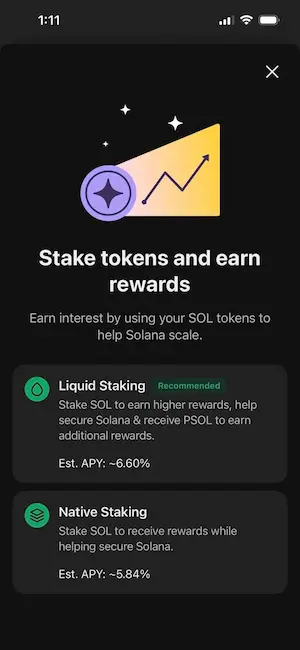
Tap Start Earning SOL. Phantom will show you two options: native staking, which locks your SOL with a validator, and liquid staking, which converts your SOL into PSOL, a yield-bearing token you can use elsewhere. Choose based on whether you want full liquidity or simplicity.
Step 3: Select a Validator
If you chose native staking, Phantom shows a list of validators with their commission rates and performance data. Look for validators with high uptime, a commission under 10%, and a stake weight that is not already at the top of the network. Concentrating too much SOL in the largest validators works against decentralization and can reduce your rewards over time. Phantom’s own validator is listed and is a reliable choice if you are not sure where to start.
Step 4: Enter the Amount and Confirm
Enter how much SOL you want to stake. Keep at least 0.05 SOL unstaked to cover transaction fees on future actions. Review the confirmation screen, which shows the validator, amount, and fee. Confirm the transaction. Your stake activates at the start of the next epoch, which begins within two to three days.
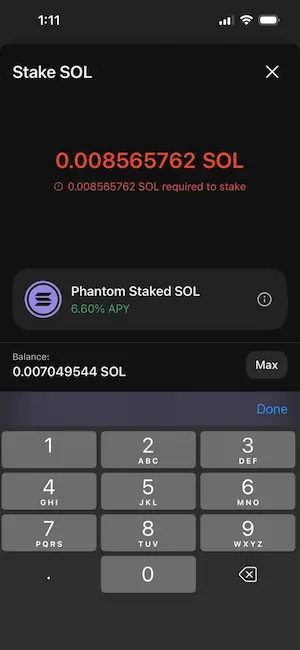
Step 5: Track Your Staking Rewards
Once active, your staking rewards appear in the staking section of Phantom Wallet after each epoch. You can see your accumulated rewards, the validator you are delegating to, and the current APY. There is no action required to keep earning. Rewards accumulate automatically until you choose to unstake.
How to Stake Solana With Solflare
Solflare is built specifically for Solana and gives you more granular control over delegation than most other wallets. It shows detailed validator metrics, performance history, and lets you manage multiple stake accounts from one dashboard. The staking process on Solflare follows the same logic as Phantom with a slightly more detailed interface.
Step 1: Set Up or Log In to Solflare
Go to solflare.com or install the browser extension. Create a new wallet or import an existing one using your recovery phrase. If you use a Ledger hardware wallet, Solflare connects to it directly, which keeps your private keys offline throughout the staking process. Write down your recovery phrase on paper and never store it digitally.
Step 2: Fund Your Wallet and Open the Staking Tab
Send SOL to your Solflare address from an exchange or another wallet. Once your balance shows, click the Staking tab in the main navigation. The staking dashboard loads a list of available validators along with their APY estimates, commission rates, and total delegated stake. Keep a small amount of SOL available for the transaction fee when you submit your delegation, usually under 0.001 SOL.
Step 3: Choose a Validator and Delegate
Review the validator list. Sort by uptime and commission to find candidates. A good validator has 99%+ uptime, a stable commission of 5% to 10%, and a track record of consistent block production. Avoid the very top validators by stake weight to support decentralization. Solana Compass is a reliable external tool for comparing validators before you commit. Enter your delegation amount and click Stake.
Step 4: Confirm and Monitor Rewards
Solflare shows a confirmation screen with the full transaction breakdown. Approve it. Your stake activates at the next epoch boundary. From the staking dashboard you can monitor your staking rewards in real time, see each Solflare stake account, and redelegate or unstake from the same screen whenever you want.
How to Stake Solana on a Centralized Exchange
If you prefer not to manage a wallet or pick validators yourself, several centralized exchanges let you stake Solana directly on their platforms. You deposit SOL, click stake, and the exchange handles everything. The trade-off is custodial risk: the exchange controls your keys, and if the platform has security or financial problems, your staked SOL is exposed.
There is also no technical setup required, which is why this route suits people who are new to crypto and not yet comfortable managing private keys.
| Exchange | APY | Min. Stake | Instant Unstake | Custodial |
|---|---|---|---|---|
| Binance | ~7.3% | None | Yes (flexible) | Yes |
| Kraken | 2% – 4% | None | Yes | Yes |
| Coinbase | ~5% | None | No | Yes |
Binance offers the highest yield of the three through its Earn program. Kraken pays rewards twice a week with no penalty for early unstaking. Coinbase offers a straightforward staking product for users already on that platform.
For users who want to move SOL off an exchange to a self-custody wallet before staking, our guide on how to transfer Solana walks through the withdrawal process step by step.
Best Liquid Staking Protocols on Solana
Liquid staking lets you earn staking rewards while keeping your SOL usable. When you deposit SOL into a liquid staking protocol, you receive a liquid staking token that accumulates value as rewards build up.
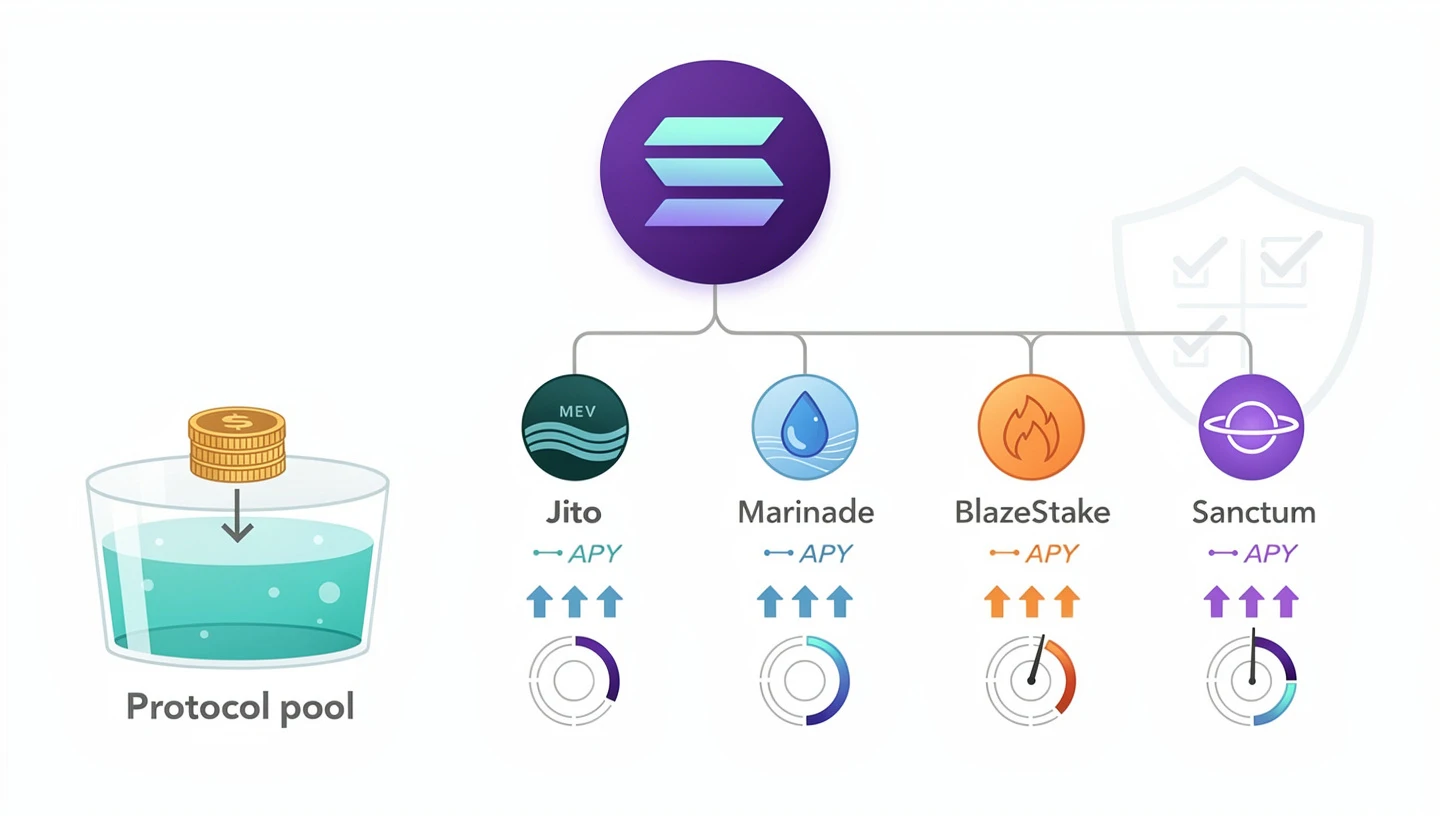
These LSTs can be used as collateral in DeFi protocols, swapped on DEXes, or simply held while they appreciate. The main protocols on Solana each take a different approach.
| Protocol | Token | APY | Fee | Audits |
|---|---|---|---|---|
| Jito | JitoSOL | ~6.96% | 4% on rewards | Yes |
| Marinade | mSOL | ~7% | 6% on rewards | Yes |
| BlazeStake | bSOL | ~6.23% | 5% per epoch | 7 audits |
| Sanctum | Various LSTs | Varies | Varies by LST | Yes |
Jito
Jito is the largest liquid staking platform on Solana by total value locked. When you deposit SOL, you receive JitoSOL, which earns both standard staking yield and a share of MEV rewards. MEV stands for Maximal Extractable Value, which is additional profit validators capture by reordering transactions in a block. Jito redirects a portion of these profits back to stakers, which is why its yield tends to run 0.5% to 1% higher than standard native staking. Jito exclusively delegates to validators running the Jito-Solana client, which helps reduce spam transactions and failed orders on the network.
Marinade
Marinade was Solana’s first liquid staking protocol, launched in March 2021. Depositing SOL gives you mSOL, which can be used as collateral across Solana DeFi protocols including Kamino and Drift. Marinade also offers a native staking option called Marinade Native, which uses an automated delegation strategy without any smart contract exposure. For users who want the yield benefits of a stake pool but are cautious about protocol risk, Marinade Native is a middle ground worth considering.
BlazeStake
BlazeStake is a fully non-custodial stake pool protocol endorsed by the Solana Foundation. It spreads stake across more than 200 validators, which gives it the largest validator set of any Solana stake pool. When you stake with BlazeStake, you receive bSOL. The platform uses official stake pool smart contracts from Solana Labs, which have been audited seven times by three independent firms. You can withdraw instantly for a 0.3% fee or use the delayed withdrawal option at 0.1%.
Sanctum
Sanctum operates as a router and infrastructure layer for custom LSTs on Solana. It allows any validator to create their own validator LST, combining the zero-fee benefits of direct native staking with the instant liquidity of liquid staking. Sanctum also built a swap router that lets users move between any Solana LSTs instantly with minimal slippage, regardless of how obscure the token is. For users who want to stake directly with a specific validator while keeping their position liquid, Sanctum is the only protocol that offers this.
Understanding the smart contract layer that powers these protocols helps when assessing their risk profiles. Our guide on Solana smart contracts covers how they work and what audit standards mean in practice.
How to Choose a Validator for Solana Staking
Choosing the right validator directly affects how much you earn and how reliably you earn it. A validator with frequent downtime earns fewer rewards, which reduces what flows to delegators. A validator with a high commission takes a larger cut before passing rewards to you. And concentrating too much SOL in a handful of large validators weakens the network’s decentralization.
Here is what to look for when evaluating validators:
- Uptime: Aim for validators with 99%+ uptime over a rolling 30-day period. Missed blocks mean missed rewards for you.
- Commission rate: A commission of 5% to 10% is a reasonable range. Be cautious of validators offering 0% fees as these can change without warning.
- Stake weight: Avoid delegating to the top five or ten validators by stake weight. Spreading delegation across mid-sized validators supports network health and can produce more consistent rewards.
- MEV sharing: Validators running the Jito-Solana client pass a share of MEV profits to delegators, which boosts effective yield.
- Track record: Check whether the validator has a history of commission increases or periods of extended downtime. A single slashing event on Solana is rare but worth checking for in the validator’s history.
- Transparency: Validators with active communities, published performance reports, or endorsements from the Solana Foundation tend to be more accountable.
Solana Compass shows live uptime, commission, and APY estimates for every active validator on the network and is the most useful free tool for making this comparison.
The mechanics of how validators process transactions and why their performance matters is explained in our guide on how Solana works.
How Much Can You Earn Staking Solana?
Current solana staking yields sit between 5% and 8% APY depending on which validator or protocol you use. The exact figure shifts with Solana’s inflation rate, total network stake, and your validator’s commission.
Here is a simple example. If you stake 100 SOL at 6% APY, you earn roughly 6 SOL per year before commission. If your validator charges a 5% commission, your net return drops to approximately 5.7 SOL. That number grows if you compound by restaking rewards at the end of each epoch rather than letting them sit idle.
Several factors determine your actual staking rewards:
- Inflation rate: Solana’s current annual inflation is around 5% to 6% and decreases by 15% each year. As it falls, base staking yields gradually compress.
- Validator commission: Lower commission means more reward flows to you. A difference of 5% commission versus 10% is meaningful over a year.
- Total staked SOL: The more SOL staked network-wide, the more the fixed reward pool is divided. This dilutes individual returns slightly as participation grows.
- Validator uptime: A validator missing blocks during an epoch earns less. That loss passes through to delegators.
- Compounding: Restaking rewards each epoch accelerates growth. Protocols like Jito and Marinade do this automatically. With Phantom Wallet native staking, you restake manually.
The combined effect of compounding at 6% APY over three years on 100 SOL produces roughly 19 SOL in rewards, assuming a stable price and no commission changes. The number shifts with SOL’s market price, but the reward in token terms is straightforward to estimate.
The passive income from staking is treated as ordinary income for tax purposes in most jurisdictions, based on the fair market value of each reward at the time you receive it. More on that in the taxes section below.
How to Unstake Solana
Knowing how to unstake Solana before you start is important because the timing affects when your SOL becomes usable again.
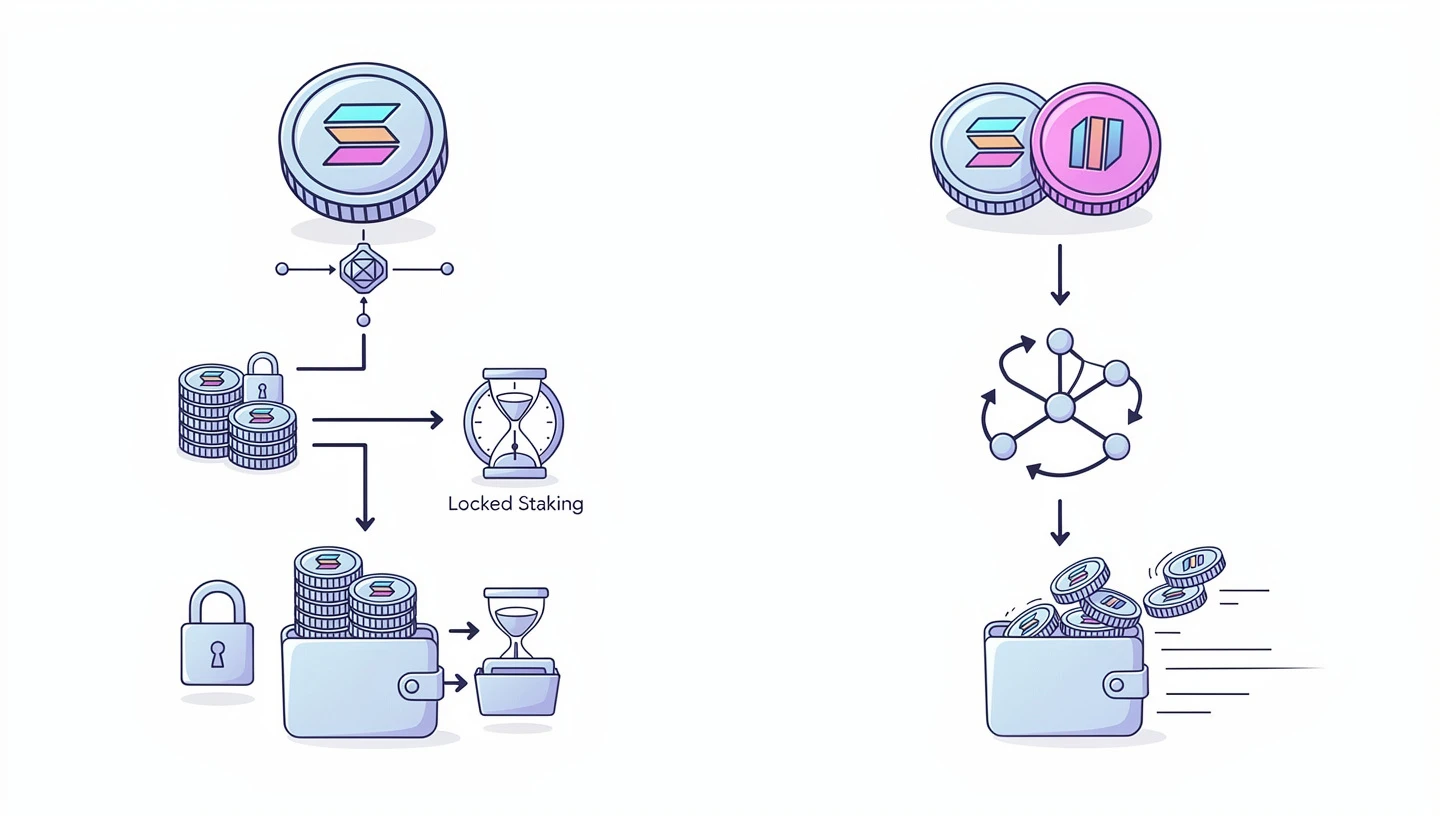
The process differs depending on whether you used native or liquid staking.
Unstaking With Native Staking
In Phantom or Solflare, go to your staking dashboard and click Deactivate Stake on the validator you want to exit. Your SOL stops earning rewards immediately, but it remains locked until the current epoch ends and the cooldown period completes. This takes approximately two to three days in total. Once the cooldown finishes, you can withdraw the SOL back to your main wallet balance and use it freely.
You can unstake a partial amount if you want to keep some SOL delegated while freeing up the rest. There is no penalty for initiating early unstaking, only the time delay of the epoch cycle.
Unstaking With Liquid Staking Tokens
If you hold mSOL, JitoSOL, or another LST, unstaking is instant. Swap the LST back to SOL on a DEX like Jupiter, which aggregates liquidity across Solana and typically offers the best rates. The swap settles in seconds. There is no cooldown. The trade-off is a small swap fee and potential slippage if liquidity is thin at the time you sell.
Some protocols also offer a native redemption route. Marinade, for example, lets you submit a withdrawal request and receive your SOL after the standard epoch delay, which avoids any swap fee.
Risks of Staking Solana
Staking on Solana is generally lower risk than most other crypto strategies, but the risks of staking Solana are real and worth understanding before you commit funds.
- Slashing risk: Solana does not currently slash validators automatically, but a validator caught acting maliciously can be slashed upon network restart. This is rare and has not affected regular delegators historically, but it remains a possibility worth noting.
- Validator downtime: If your validator goes offline for an extended period, your rewards drop or stop entirely for that epoch. You will not lose principal, but you miss the yield. Monitoring your validator’s uptime and being willing to redelegate fixes this.
- Market volatility: Staked SOL is locked during the unstaking period. If SOL’s price drops sharply while you are waiting out the cooldown, your position loses value in fiat terms. Earning 7% APY on a token that loses 50% of its price still leaves you at a significant net loss.
- Smart contract risk: Liquid staking protocols run on smart contracts. Bugs or exploits in those contracts could lead to loss of funds. Using audited protocols with long track records reduces but does not eliminate this risk.
- De-pegging: Liquid staking tokens like mSOL or JitoSOL are designed to track the value of SOL. During periods of extreme market stress or low liquidity, these tokens can trade below their expected value. If you need to exit quickly, you may receive less SOL than expected.
- Custodial risk: Staking on a centralized exchange means trusting that platform with your SOL. Exchange hacks, insolvencies, or withdrawal freezes can prevent you from accessing your staked assets.
- Commission changes: Validators can increase their commission without notice. Check your validator’s fee periodically and redelegate if it changes to an unfavorable level.
- Phishing: Fake staking websites that mimic Phantom, Solflare, or liquid staking protocols exist. Always verify the URL before connecting your wallet or approving any transaction.
Solana Staking Taxes
In most jurisdictions, Solana staking taxes apply to rewards as ordinary income at the time you receive them. The taxable amount is based on the fair market value of each SOL reward on the day it lands in your wallet. When you later sell those rewarded tokens, you also owe capital gains tax on any increase in value between the day you received them and the day you sell.
This means staking rewards create two taxable events: income tax when received, and a potential capital gain or loss when disposed of. Some jurisdictions treat staking differently, so checking your local rules before starting is worth doing. The fair market value calculation requires you to track the SOL price at the time each reward epoch settles, which is why crypto tax software that monitors on-chain activity is useful for active stakers.
Nothing in this guide is tax advice. Consult a qualified professional for guidance specific to your situation.
Our guide on how to sell Solana covers the steps involved once you decide to exit a staked position and convert rewards to fiat.
Solana Staking FAQs
Is Staking Solana Safe?
Staking Solana through a non-custodial wallet like Phantom or Solflare is generally considered safe for the amounts most retail users stake. Your SOL stays in your own wallet, and the validator cannot access your funds. The main risks are validator downtime, which reduces rewards but does not affect your principal, and market volatility, which affects the fiat value of your staked position. Using an audited protocol and a reputable validator keeps your exposure manageable.
What Is the Minimum Amount to Stake Solana?
There is no official minimum staking amount on Solana. In practice, most wallets require at least 0.01 SOL for delegation, and Solflare notes this as its practical floor. Keep at least 0.05 SOL outside of your staked position to cover future transaction fees. Even small amounts earn proportional rewards, so there is no minimum that makes staking worthwhile in percentage terms.
How Long Does It Take to Unstake Solana?
With native staking, unstaking Solana takes approximately two to three days from the time you initiate the deactivation. This delay corresponds to the length of one Solana epoch plus a cooldown window. With liquid staking, you can exit your position instantly by swapping your LST back to SOL on a DEX. There is no waiting period.
What Is the Best Wallet to Stake Solana?
Phantom Wallet is the most widely used option for beginners because of its clean interface and support for both native and liquid staking in a few taps. Solflare gives more detailed validator analytics and is preferred by users who want greater control over their delegation. For users who want maximum security, connecting a Ledger hardware wallet to either Phantom or Solflare keeps private keys offline throughout the staking process.
Native Staking or Liquid Staking — Which Is Better?
It depends on what you plan to do with your SOL. Native staking is simpler, carries no smart contract risk, and suits holders who do not need access to their tokens between epochs. Liquid staking is better for users who want to use their staked position in DeFi, need the flexibility to exit instantly, or want auto-compounding handled by the protocol. Neither method is objectively better. The right choice depends on your goals and how actively you manage your holdings.
Do Staking Rewards Compound Automatically?
With native staking on Phantom or Solflare, rewards do not compound automatically. They accumulate in your stake account at the end of each epoch, but you need to manually restake them to put them back to work. Protocols like Jito and Marinade compound automatically because the LST token price rises with each epoch rather than distributing separate rewards.
What Happens if My Validator Goes Offline?
If your validator experiences downtime during an epoch, it earns fewer rewards for that cycle, and your share drops proportionally. You do not lose your staked SOL. Solana does not apply automatic slashing for simple downtime. If your validator shows repeated poor performance, the practical response is to redelegate to a different validator from your staking dashboard. The redelegation itself takes one epoch to activate.
Our guide on what SOL is covers the token mechanics that underpin the entire staking reward system if you want a deeper background on how the economics work.
Wrapping Up
Learning how to stake Solana takes less than an hour from start to first active delegation. Pick a wallet, fund it with SOL, choose a validator with solid uptime and reasonable fees, and confirm your delegation. Your first staking rewards arrive within two to three days. From that point, your SOL works for you every epoch without any further action required.
The choice between native staking and liquid staking comes down to whether you want simplicity or flexibility. Both are legitimate ways to earn passive income from SOL you plan to hold anyway. Start with native staking through Phantom if you are new, and move into liquid staking protocols once you understand how each one manages your delegation and handles rewards.