If you have staked SOL and now want it back, the first question on your mind is probably timing. Unstaking on Solana is not instant by default, and the wait catches a lot of people off guard, especially if they are used to simply selling a token whenever they want. The good news is that the process is predictable once you understand how it works, and there are ways to skip the wait entirely if you need your SOL sooner.
In short, unstaking SOL through the standard method takes about 2 to 3 days. That number comes from how Solana’s network is built, not from any single wallet or app. Below we will break down exactly why that timeframe exists, what happens during the wait, how to speed things up with instant unstaking, and what changes if you are using a liquid staking token instead of staking directly.
What Happens When You Unstake SOL
When you stake SOL, your tokens are not sent anywhere physically. Instead, you delegate them to a validator through a stake account, and that validator uses your balance to help secure the network and process transactions. In return, you earn staking rewards. Your SOL is still yours the whole time, but while it is staked it cannot be sent, swapped, or spent.
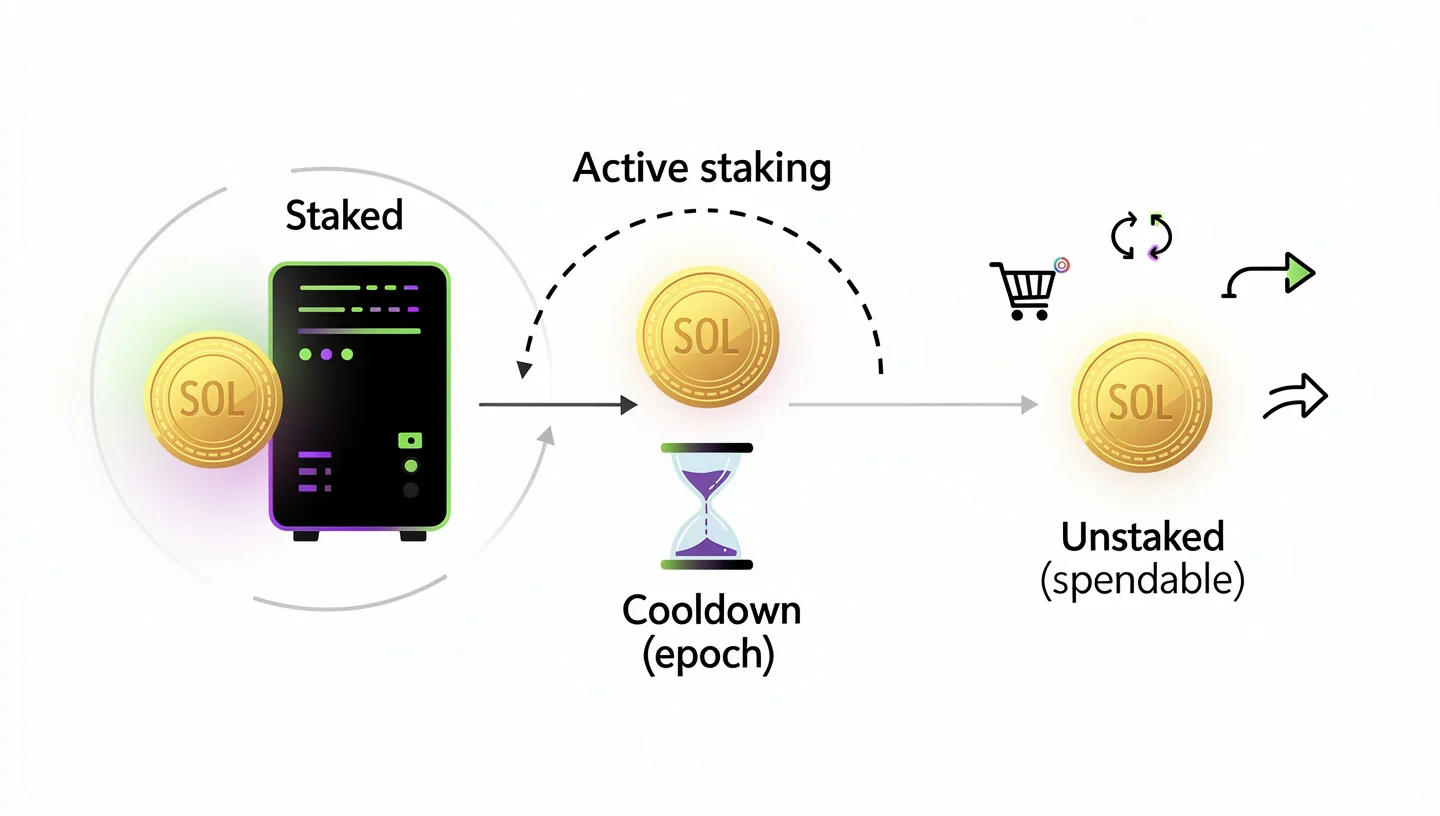
Unstaking reverses that delegation. You are telling the network you want your balance moved out of the active staking pool and back into a spendable state. This is not a single click that finishes instantly. It has to pass through a cooldown period first, and that cooldown is tied to something called an epoch.
The Short Answer: How Long Solana Unstaking Actually Takes
For a native, standard unstake, plan on one full epoch, which on Solana usually lasts between two and three days. If you unstake right at the start of an epoch, you could be waiting closer to the full three days. If you unstake near the end of one, your wait might only be a few hours. There is no way to unstake faster than the current epoch boundary unless you use a separate instant unstaking service, which we cover further down.
Understanding the Solana Epoch
An epoch is the basic unit of time Solana uses to organize network activity. Instead of running on a fixed clock like “every 24 hours,” an epoch is defined by a set number of slots, roughly 432,000 of them, and each slot corresponds to a small window where a block can be produced. Because block production speed can shift slightly depending on network conditions, epoch length is not perfectly fixed either, but it typically lands somewhere between two and three days.
Epochs matter for unstaking because staking changes on Solana are only finalized at epoch boundaries. This exists for a reason: if unstaking were instant, large holders could pull enormous amounts of SOL out of the validator pool in a single moment, which could destabilize the network’s security model. The delay is a deliberate safeguard, not a bug or a slow app. If you want the fuller picture of how the network processes activity behind the scenes, our guide on how Solana works goes into more detail on blocks, slots, and validators.
The Native Unstaking Process, Step by Step
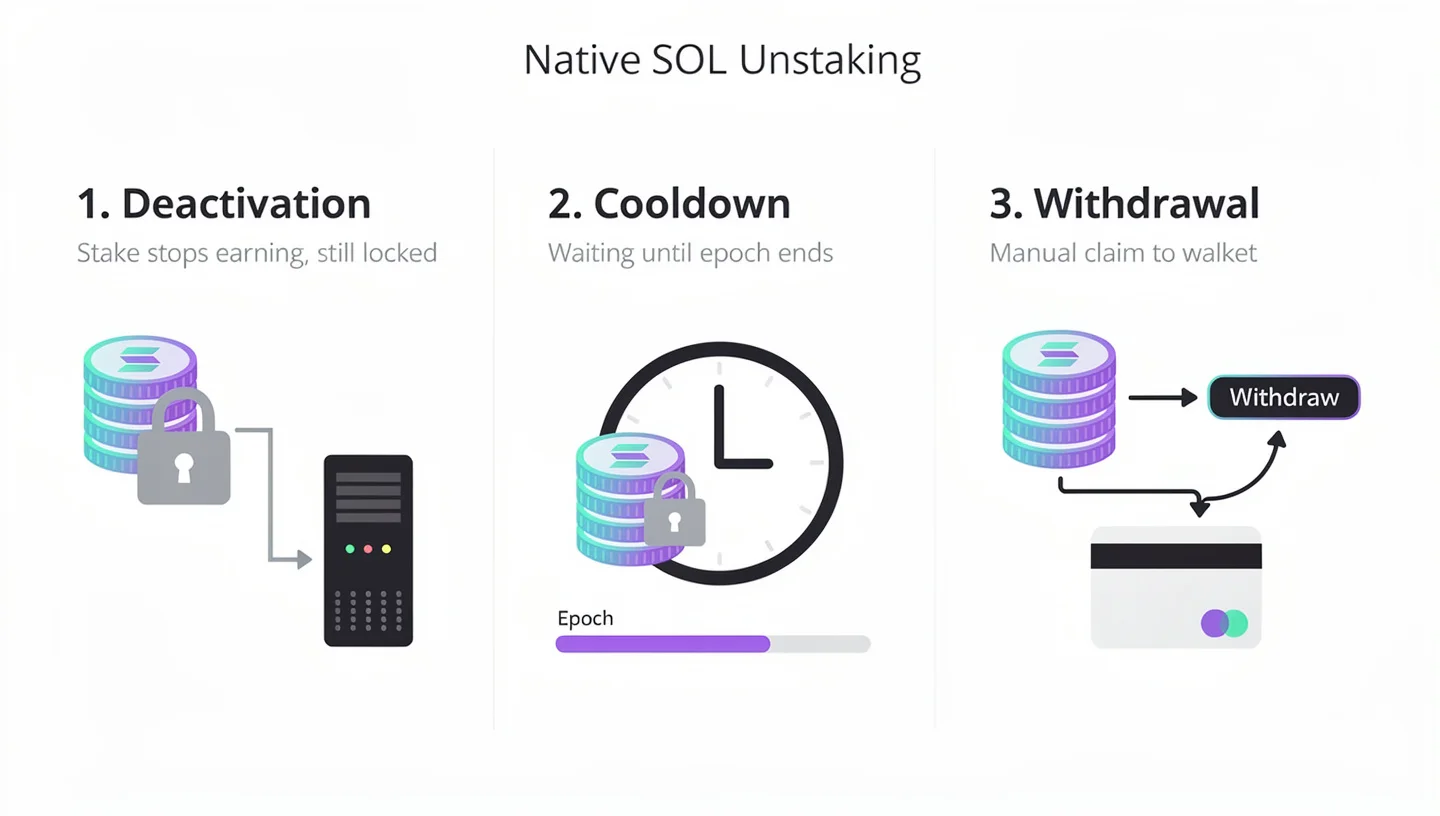
Native unstaking, meaning unstaking SOL you delegated directly to a validator rather than through a liquid staking token, happens in three distinct phases. Understanding each one helps explain why people sometimes think their SOL is “stuck” when it is really just moving through a normal sequence.
Phase One: Deactivation
The moment you submit an unstake transaction, your stake account switches from active to deactivating. Your SOL is still locked at this point, and it stops earning rewards going forward. Nothing else changes yet. You cannot withdraw, send, or swap it while it sits in this state.
Phase Two: The Cooldown Period
This is the waiting stretch tied to the current epoch. If you deactivate your stake halfway through an epoch, you wait out the remaining time until that epoch ends. Once the epoch boundary is crossed, your stake account status flips from deactivating to inactive, which means it is finally unlocked.
Phase Three: Manual Withdrawal
Here is the part people forget most often. Even after your stake becomes inactive, the SOL does not automatically land back in your spendable balance. You need to submit one more transaction, usually a simple “withdraw” or “claim” button in your wallet, to move the funds from the stake account into your main wallet address. This step is quick and only costs a small network fee, but skipping it is the main reason people think their unstaking is taking longer than it actually is.
How to Unstake Solana by Wallet
The core mechanics above apply no matter which wallet you use, but the buttons and menus look a little different depending on the app. If you are still choosing between wallets, our comparison of Phantom versus Solflare can help you decide which interface suits you before you even get to the staking stage.
Unstaking on Phantom
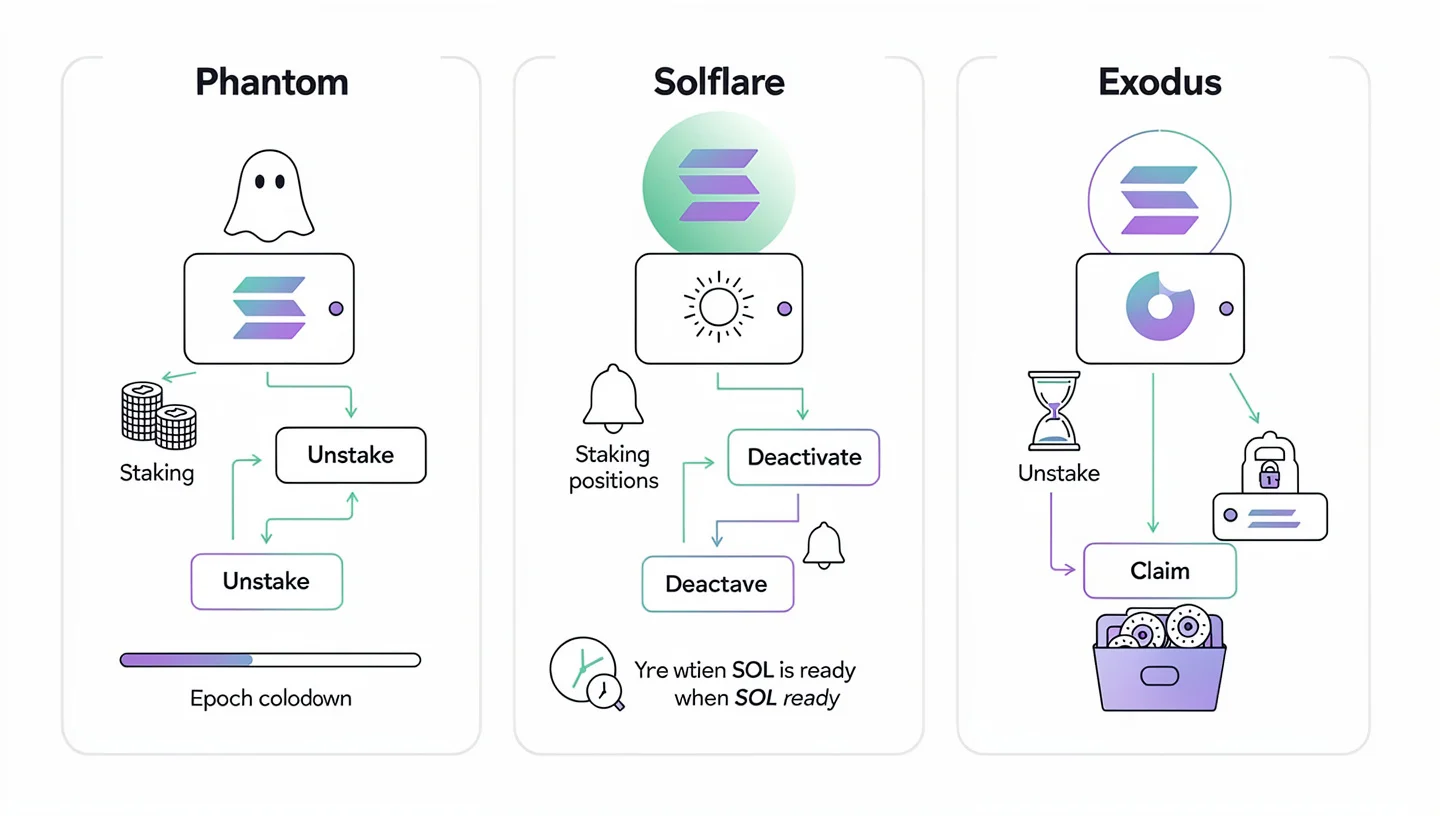
In Phantom, open your Solana wallet, go to the staking section, select the validator you delegated to, and choose the unstake option. Phantom will show you the estimated time remaining in the current epoch so you know roughly when your funds will be ready to claim.
Unstaking on Solflare
Solflare works in a similar way. You navigate to your staking positions, select the account you want to unwind, and confirm the deactivation. Solflare typically sends a notification once your SOL is inactive and ready to withdraw.
Unstaking on Exodus
Exodus separates the process into unstake and claim as two distinct actions. After you unstake, you need to check back once the cooldown finishes and manually tap claim to move the SOL into your spendable balance.
If you have not set up a wallet yet and are starting from scratch, our walkthrough on setting up a Phantom wallet covers everything from installation to securing your seed phrase before you ever touch staking.
Instant Unstaking: Getting Your SOL Back in Seconds
If waiting two to three days does not work for you, there is an alternative. Third party liquidity providers such as Sanctum and unstake.it let you convert your staked position back into liquid SOL almost immediately, usually in under a minute, in exchange for a small fee.
Here is how it works under the hood. These providers hold a pool of liquid SOL contributed by liquidity providers. When you use their instant unstake feature, they hand you SOL from that pool right away and take your stake account in exchange. They then wait out the normal cooldown period themselves and refill the pool once the stake account fully deactivates. You skip the wait, and they absorb it on your behalf in return for a fee, which is typically a small fraction of a percent.
| Method | Time to Receive SOL | Typical Fee |
|---|---|---|
| Native unstake (standard) | 1 epoch, roughly 2 to 3 days | Network fee only, no service fee |
| Instant unstake (Sanctum, unstake.it) | Seconds to a couple of minutes | Around 0.1 percent to 0.3 percent |
Which route makes sense depends on your situation. If you are not in a rush and want to avoid paying any extra fee, the standard route is fine. If you need liquidity right away, whether to trade, cover an expense, or simply move your position elsewhere, instant unstaking is worth the small cost.
Unstaking Liquid Staking Tokens
A growing number of SOL holders skip native staking entirely and instead hold a liquid staking token, or LST, such as JitoSOL, mSOL, or bSOL. When you stake through one of these protocols, you receive a token that represents your staked SOL plus accumulated rewards, and that token is freely tradable.
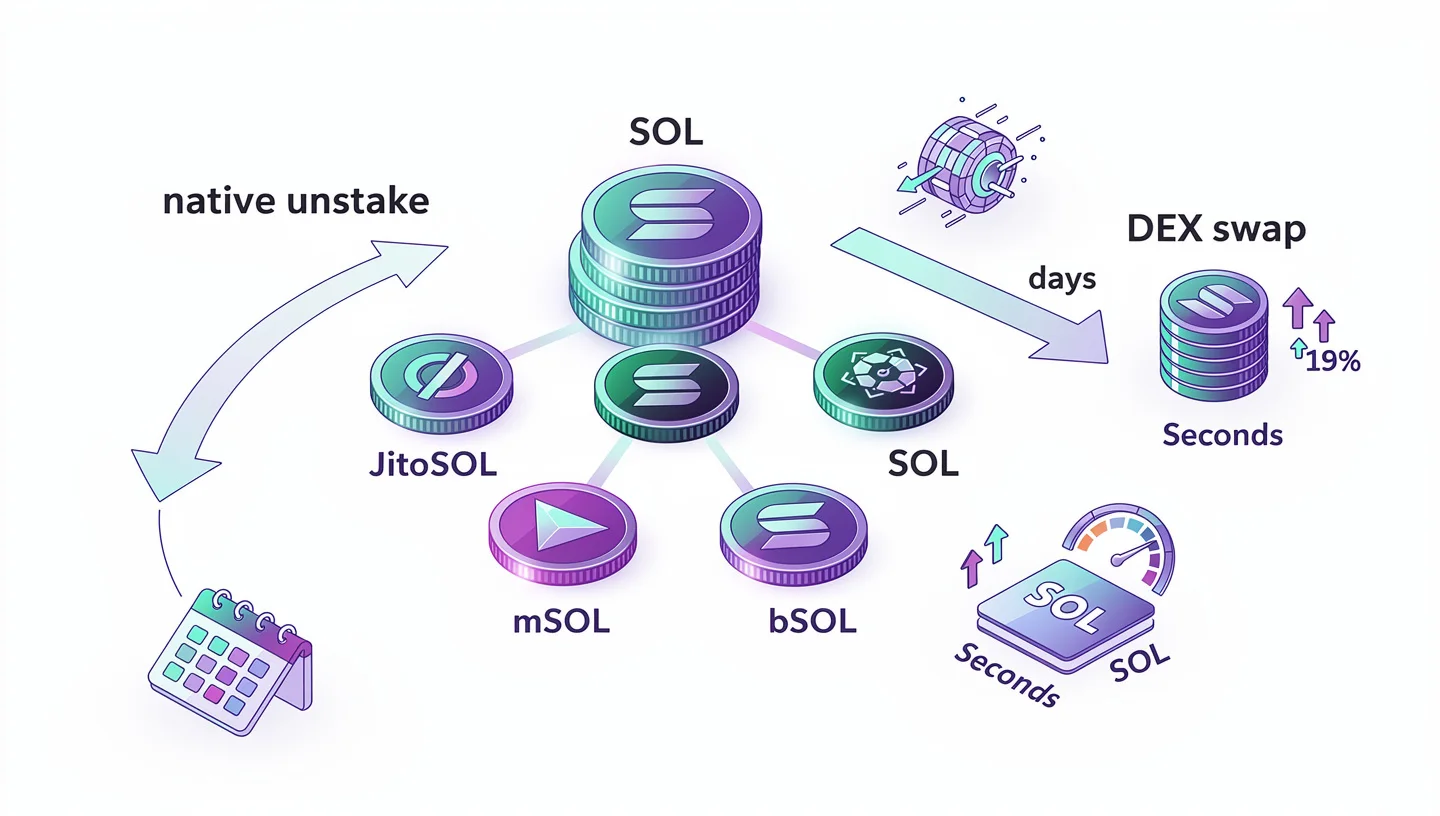
This changes the unstaking picture in an important way. Because the LST itself can be swapped on a decentralized exchange, you are not limited to the native unstake path at all. You can simply trade your JitoSOL or mSOL for SOL directly, and if there is enough liquidity available, that swap settles in seconds rather than days. The tradeoff is that swap prices can shift slightly depending on demand, so during unusually busy periods you might get marginally less SOL than the token’s stated redemption value.
If you want to compare how JitoSOL, mSOL, and bSOL differ before choosing one, we cover that in detail in mSOL versus JitoSOL versus bSOL. And if you are deciding between liquid staking providers more broadly, our comparison of Marinade versus Jito versus Coinbase lays out the differences in fees, decentralization, and reward rates.
What Happens If You Are Using a Restaking Protocol
Restaking adds another layer to consider. Protocols that let you restake your already staked SOL to secure additional services, such as oracle networks, sometimes impose their own cooldown requirements on top of the standard Solana epoch wait. These extra cooling off periods exist because the restaking protocol needs to guarantee security for the services it supports, not just for the base Solana network.
If you are participating in one of these advanced strategies, always check the specific protocol’s withdrawal terms before assuming the standard two to three day estimate applies. Some restaking vaults extend the total wait to five days or longer.
A Practical Example
Say you have 200 SOL staked directly with a validator and you decide to unstake on a Tuesday morning, right as the current epoch is about 60 percent complete. Your wallet shows roughly 20 hours remaining before the epoch ends. You submit the unstake transaction, and your SOL enters the deactivating state. Twenty hours later, once the epoch rolls over, your stake becomes inactive. You open your wallet, tap claim or withdraw, pay a tiny network fee, and your 200 SOL, plus whatever rewards you earned up until deactivation, lands back in your spendable balance.
Now compare that to someone holding 200 JitoSOL instead. If that person wants SOL immediately, they can swap it on a decentralized exchange the moment they decide, without touching the epoch cycle at all. The difference in convenience is the entire reason liquid staking has become so popular.
Factors That Can Affect Your Unstaking Time
A few conditions can stretch your wait beyond the typical estimate:
- Network congestion: during periods of heavy demand, transactions including your final withdrawal step can take slightly longer to confirm.
- Staking or unstaking limits: Solana caps how much SOL can move in or out of staking during a single epoch to prevent sudden shocks. If the network hits that cap, part of your balance may carry over into a second epoch before it fully deactivates.
- Validator issues: if your chosen validator goes offline or becomes delinquent, it will not change your unstaking timeline directly, but it does mean you stop earning rewards while the validator is down.
- Restaking commitments: as noted above, restaking vaults can add extra time beyond the base epoch cycle.
None of these situations are common, but they explain the rare cases where someone reports waiting longer than three days.
Do You Still Earn Rewards While Unstaking
Yes, but only until your stake fully deactivates. Rewards accrue for the portion of the epoch your SOL was still active, so you are not losing out entirely by unstaking mid epoch. Once your account moves into the deactivating state, reward accumulation stops for that balance. This is part of why the exact reward rate you see advertised matters, and our breakdown of Solana staking APY explains how those numbers are calculated and what affects them over time.
How to Check Your Unstaking Progress
If you want to see exactly how much time is left before your stake deactivates, most wallets display the current epoch’s progress directly in the staking screen. You can also check the Solana Explorer, which shows epoch time remaining in real time, so you are never guessing how much longer the cooldown will last.
Tips to Avoid the Wait Next Time
If you know in advance that you might need quick access to your funds, a few habits can save you from being caught off guard:
- Keep a portion of your holdings in a liquid staking token rather than staking everything natively.
- If you anticipate needing SOL by a specific date, start the unstaking process a few days early to account for where you land in the current epoch.
- Compare validator performance before you delegate in the first place, since switching validators later also involves the same cooldown. Our guide on how a Solana validator node works explains what to look for when picking one.
If you have not started staking yet and are weighing whether it is worth it, our walkthrough on how to stake Solana covers the setup process from picking a validator to confirming your first delegation, and our overview of Solana staking rewards breaks down what kind of returns you can realistically expect.
Bottom Line
Unstaking Solana through the standard method takes about two to three days because it is tied to the network’s epoch cycle, and that delay exists to keep the network stable rather than to slow you down unnecessarily. If timing matters to you, instant unstaking services or holding a liquid staking token instead of native SOL can get you your funds back in seconds rather than days, usually for a small fee. Either way, once you understand the deactivation, cooldown, and withdrawal sequence, the process stops feeling mysterious and just becomes another routine part of managing your SOL.
Frequently Asked Questions
How long does it take to unstake Solana?
Standard unstaking takes about one epoch, which is roughly two to three days. The exact wait depends on how much time is left in the current epoch when you submit your unstake transaction.
Can you unstake Solana instantly?
Yes, through third party services such as Sanctum or unstake.it, which give you SOL immediately in exchange for a small fee, or by swapping a liquid staking token like JitoSOL directly for SOL on a decentralized exchange.
Do you lose rewards when you unstake Solana?
You keep any rewards earned up to the point your stake enters the deactivating state. You simply stop earning new rewards on that balance once deactivation begins.
Why do I need to claim my SOL after unstaking?
Deactivating your stake and withdrawing it are two separate steps. Once your stake account becomes inactive, you still need to submit a withdrawal or claim transaction to move the SOL back into your regular spendable wallet balance.
What is the difference between deactivating and inactive stake?
Deactivating means your unstake request has been submitted but the current epoch has not ended yet, so your SOL is still locked. Inactive means the epoch has ended and your SOL is unlocked and ready to withdraw.
Is there a fee to unstake Solana?
Native unstaking only costs the standard small network transaction fee. Instant unstaking services charge an additional fee, typically around 0.1 to 0.3 percent, for skipping the cooldown period.
Can unstaking take longer than three days?
It can in rare cases, usually if the network hits its staking or unstaking limit for that epoch, or if you are using a restaking protocol with an extended cooldown requirement.