If you stake SOL and watch small reward payments land in your wallet every couple of days, the tax question sneaks up fast. The short answer is yes, in almost every country that has issued guidance on the topic, staking rewards count as taxable income the moment you receive them, and you can owe a second round of tax later when you sell. This is not tax advice, just a plain walkthrough of how the rules generally work, so you know what to expect before tax season arrives.
Below we break down when the tax bill actually hits, how native staking differs from liquid staking tokens, what happens when you unstake, and where to report everything once the year wraps up.
The Short Answer: Yes, Solana Staking Rewards Are Taxable
In the United States, the United Kingdom, Australia, and most other countries with published crypto guidance, staking rewards are treated as ordinary income at the moment you gain control over them. That means the value of your SOL rewards on the day they arrive gets added to your taxable income for the year, on top of your salary or other earnings. Later, if you sell, swap, or spend that same SOL, you may owe a separate capital gains tax based on how the price moved since you received it.
There is no minimum amount that lets you skip reporting. Whether your rewards added up to twenty dollars or twenty thousand, the obligation to report is the same.
How Solana Staking Rewards Work (A Quick Refresher)
When you stake SOL, your tokens move into a stake account tied to a validator you choose. The validator uses that balance to help confirm transactions, and in exchange your account earns a small reward at the end of each epoch, the two to three day cycle Solana uses to organize network activity. These rewards compound automatically. You never press a claim button, the new SOL is simply added to your stake and starts earning on its own.
If you want the full mechanics of how staking actually works before diving into the tax side, our guide on how to stake Solana walks through picking a validator and delegating your first batch of SOL.
When Exactly Do You Owe Tax on Staking Rewards
Dominion and Control: The Legal Concept Behind the Timing
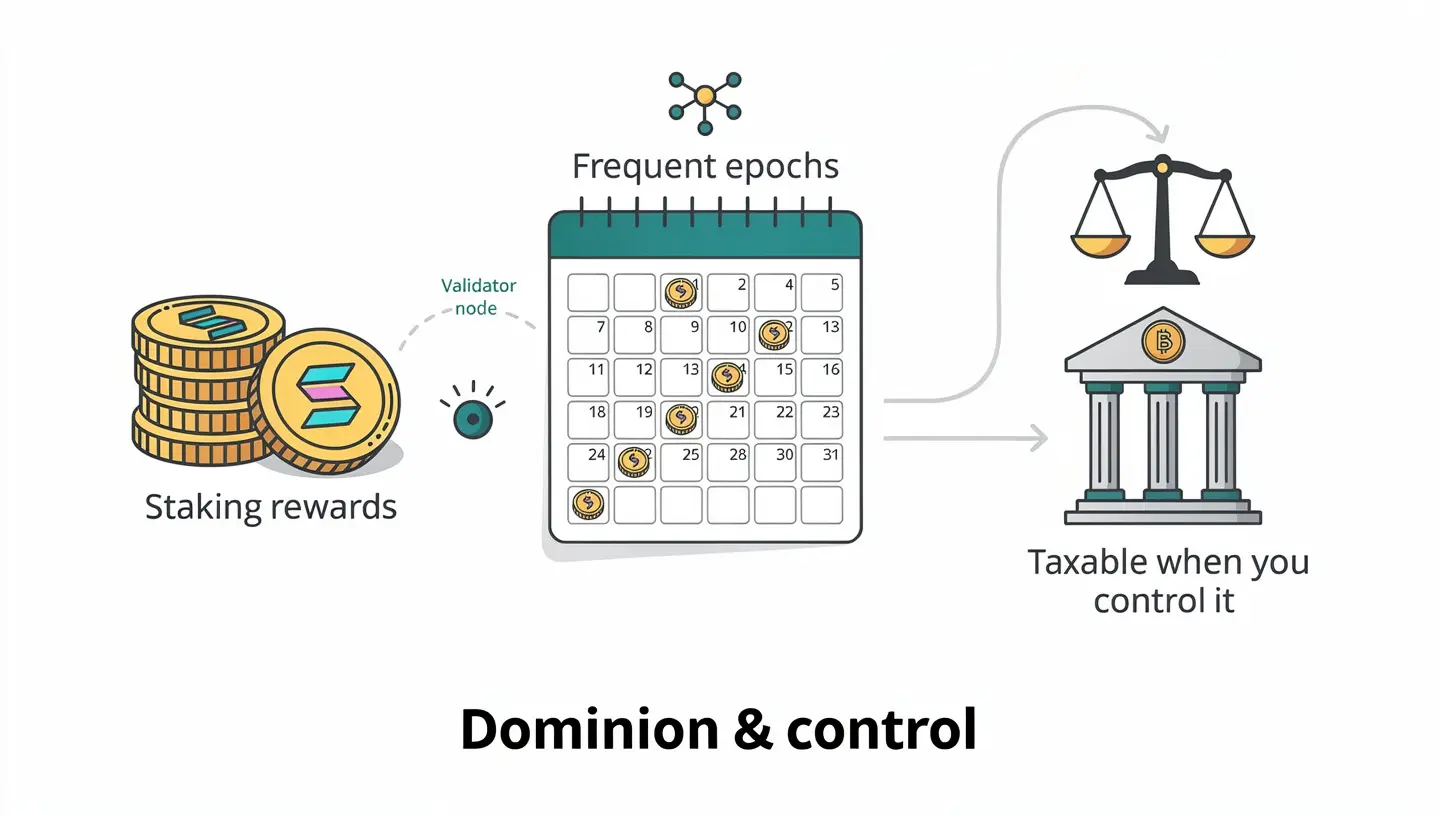
Tax authorities use a phrase called dominion and control to decide when income counts as received. In simple terms, you owe tax the moment you are free to sell, transfer, or otherwise use the reward, whether or not you actually do anything with it. In the US, this standard was confirmed through IRS Revenue Ruling 2023-14, which found that staking rewards are includible in gross income at fair market value once the taxpayer has that ability to dispose of them.
Because Solana lets you move or trade your rewards as soon as they land in your stake account, the standard position among tax professionals and crypto tax platforms is that each reward is income right away, not later when you eventually cash out.
Why Solana’s Epoch Schedule Makes This More Complicated
This is where Solana creates more work than a blockchain that pays rewards once a month. Because rewards post roughly every two to three days, a year of staking can produce well over a hundred separate income events, each one valued at whatever SOL was trading at on that specific day. Auto-compounding does not change this. Each time new SOL is credited to your account, that is a fresh receipt of income under the standard reading of the rules, even though you never touched the coins yourself.
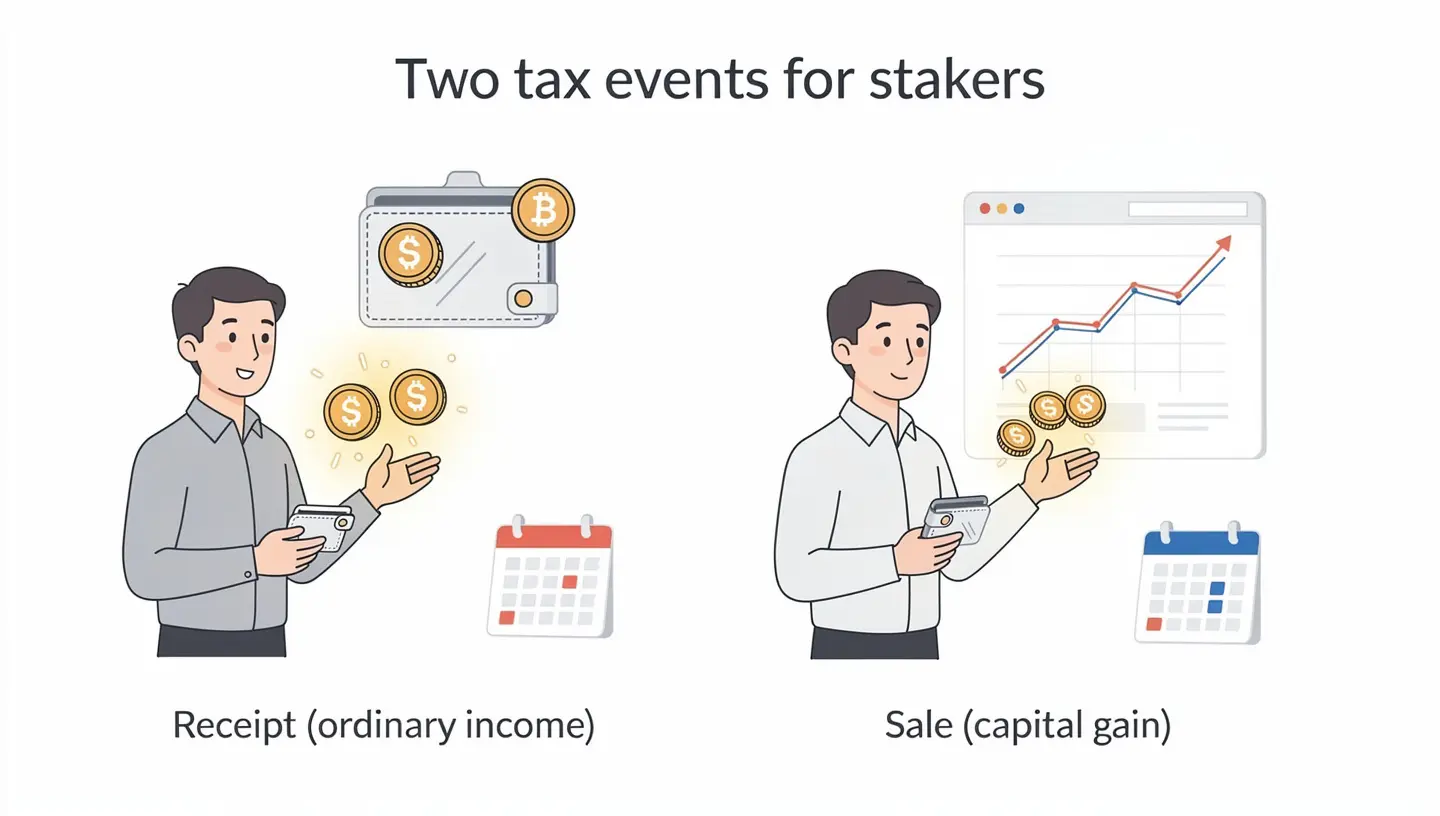
The Two Tax Events Every Staker Should Understand
Ordinary Income Tax on Receipt
You pay ordinary income tax based on the value of your staking rewards at the moment you receive them. This rate matches whatever tax bracket your total income falls into, the same bracket that applies to a paycheck.
Capital Gains Tax on Disposal
Later, when you sell, swap, or spend that reward SOL, you owe capital gains tax on the difference between its value when you received it and its value when you disposed of it. If you held it for under a year, the gain is usually taxed at the same rate as ordinary income. Hold it longer than a year and many countries apply a reduced long-term rate instead.
| Step | What Happens | Tax Owed |
|---|---|---|
| You stake 100 SOL | No taxable event, you still own the same coins | None |
| You earn 5 SOL in rewards over the year, worth $100 each when received | Reward income recognized at receipt | Ordinary income tax on $500 |
| SOL rises to $150 and you sell those 5 reward tokens | Disposal of an asset already taxed once as income | Capital gains tax on the $250 gain |
Are You Taxed Twice on the Same Rewards
This is one of the most common points of confusion, and the honest answer is no, even though it can look that way at first glance. You are taxed once when the reward arrives, based on its value that day. That value then becomes the cost basis of the reward SOL. When you later sell, you are only taxed on the change in value from that point forward, not on the original amount a second time. In the earlier example, the $500 of income and the $250 of gains are two separate dollar amounts covering two separate periods, not double taxation on the same $500.
Is Unstaking Solana a Taxable Event
No. Deactivating your stake and waiting through the cooldown period, then withdrawing your SOL back into your main wallet, does not by itself trigger any tax. You still own the exact same coins you started with, you are simply moving them out of a locked state. The taxable moments are the reward credits that happened along the way, and any later sale or swap. If you are unsure how long that cooldown actually takes before your SOL becomes spendable again, our breakdown of how long it takes to unstake Solana covers the full timeline.
Native Staking vs Liquid Staking: Different Tax Treatment
How Native Staking Rewards Are Taxed
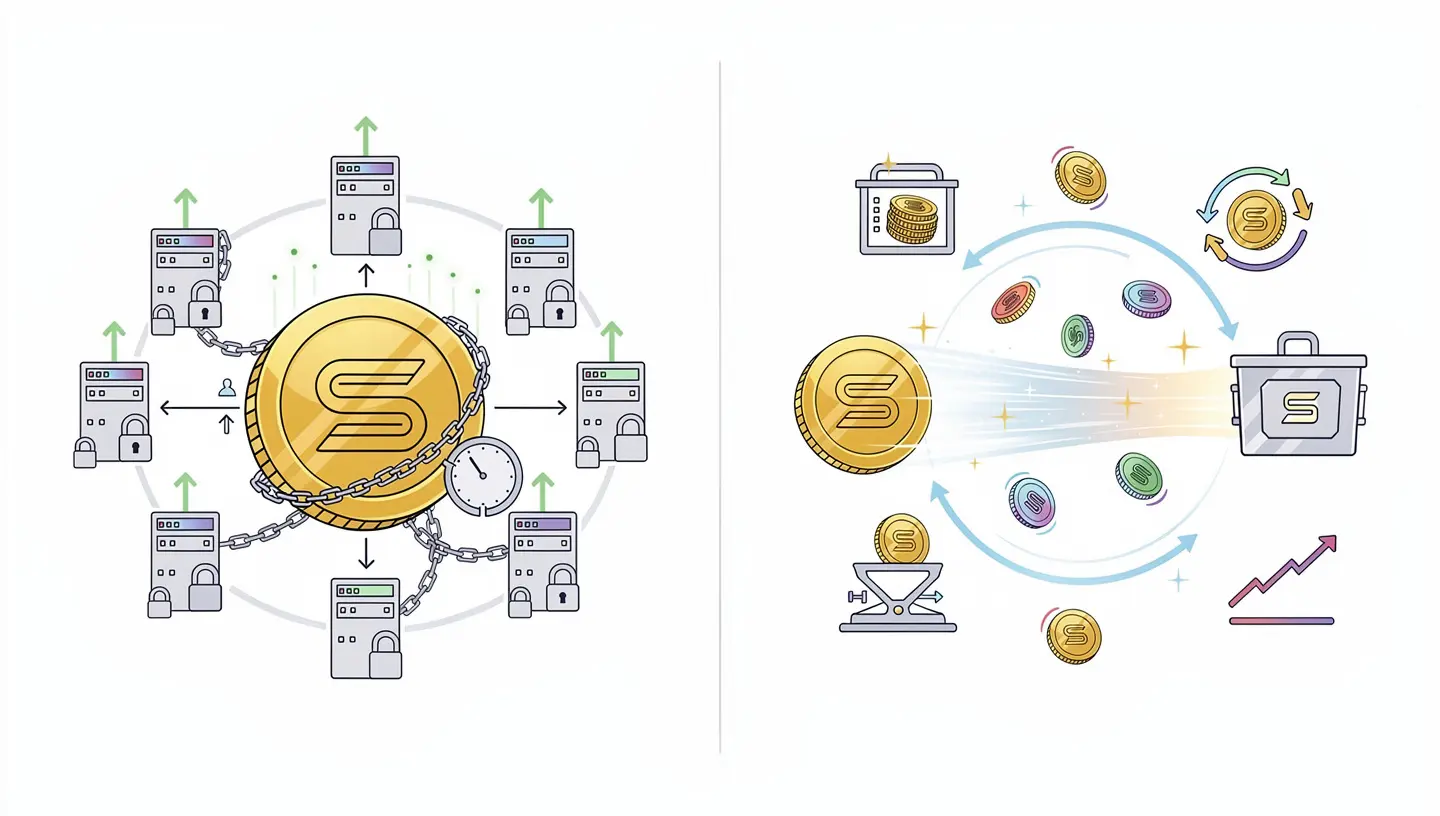
Native staking, where you delegate SOL directly to a validator through your own wallet, is the clearest case. Each epoch’s reward is a separate income event valued at that day’s price, and the total across the year gets reported as income.
How Liquid Staking Tokens Like mSOL and JitoSOL Are Taxed
Liquid staking works differently. Instead of receiving individual reward transactions, you hold a token such as mSOL or JitoSOL that represents your staked SOL plus whatever rewards have accrued. The value of that token grows over time relative to plain SOL, but you are not collecting hundreds of small taxable events the way a native staker does.
Two approaches show up among tax professionals here. The conservative approach treats the growing redemption value of your liquid staking token as income as it accrues, similar to native staking. The more aggressive approach only recognizes income when you eventually redeem the token back into SOL. Most accountants lean toward the conservative reading, but neither the IRS nor most other tax authorities have issued clear, specific guidance on liquid staking tokens yet, which leaves this area genuinely unsettled. If you want a deeper comparison of how these tokens differ beyond the tax question, our guide to liquid staking on Solana covers the mechanics, and our side by side look at mSOL versus JitoSOL versus bSOL breaks down how each one works.
The Legal Gray Area Worth Knowing About
Some legal analyses commissioned by liquid staking protocols argue that minting and redeeming these tokens should not be taxable events at all, and that rewards embedded in the token should only be taxed on final disposal, treating them more like newly created property than ordinary income. These arguments have not been tested in court, so treat them as one side of an open debate rather than settled law.
Staking Through an Exchange vs Your Own Wallet
If you delegate SOL yourself through a wallet like Phantom or Solflare, no third party sends you a tax form. You are entirely responsible for tracking the value of each reward and reporting it. If you have not set up a self-custody wallet yet, our walkthrough on setting up a Phantom wallet covers the basics.
Staking through an exchange such as Coinbase or Kraken works under the same underlying rule, rewards are income when credited, but the exchange handles the delegation for you and may issue a tax form once your reward income crosses a set threshold, commonly $600 in the US. Not receiving a form does not mean the income is exempt. A $400 year of rewards with no form is still $400 you need to report yourself.
Running a Solana Validator Is a Different Tax Picture
Operating your own validator, rather than simply delegating, often crosses into business territory for tax purposes. Commission earned from other people’s delegated stake, plus rewards on your own stake, generally gets reported as business income rather than passive investment income. That comes with a tradeoff. Business treatment can mean paying self-employment tax on top of income tax, but it also opens the door to deducting real costs, including server hardware, hosting, and the network’s vote transaction fees, which can add up to a meaningful expense over a year. If you are weighing whether to delegate or run infrastructure yourself, our overview of how a Solana validator node works lays out what is involved.
What If I Only Earned a Small Amount From Staking
There is no minimum threshold that excuses you from reporting. Tax authorities expect every dollar of staking income to appear on your return, regardless of whether it came from twenty dollars of rewards or twenty thousand. Small amounts are still worth tracking carefully, since they add up across a full year of epoch payouts.
How to Work Out the Fair Market Value of Your Rewards
Fair market value is simply the price of SOL, in your local currency, at the exact time each reward was credited. Multiply the amount of SOL received by that day’s price to get the dollar or local currency value for that specific reward. Doing this by hand for a year of epoch payouts is tedious, since a single stake account can generate well over a hundred separate entries, so most stakers lean on crypto tax software that reads wallet addresses directly from the chain and calculates each value automatically.
Where to Report Solana Staking Rewards on Your Tax Return
In the US, the general flow looks like this for most individual stakers:
- Reward income is reported as other income on Schedule 1 of Form 1040, using the total fair market value of everything received during the year.
- Sales of reward SOL go on Form 8949 and Schedule D, using the reward’s original fair market value as its cost basis and the sale price as the proceeds.
- If you operate a validator as a business rather than simply delegating, income instead flows onto Schedule C, along with any deductible expenses.
Other countries follow a similar two-step pattern, income tax at receipt and capital gains tax at disposal, though the specific forms differ.
Common Mistakes When Reporting Solana Staking Taxes
- Only reporting rewards when they are sold. This understates income for the years the rewards were actually earned.
- Letting reward SOL sit with zero cost basis because the income step was skipped, which then overstates your gain when you sell it later.
- Forgetting stake accounts when importing wallet data into tax software, leaving reward history out of the calculation entirely.
- Valuing an entire year’s rewards at the December price instead of each reward’s own date. Every credit needs its own valuation.
- Treating unstaking itself as a taxable sale, when it is really just moving your own coins out of a locked state.
How Solana Staking Taxes Work Outside the United States
United Kingdom
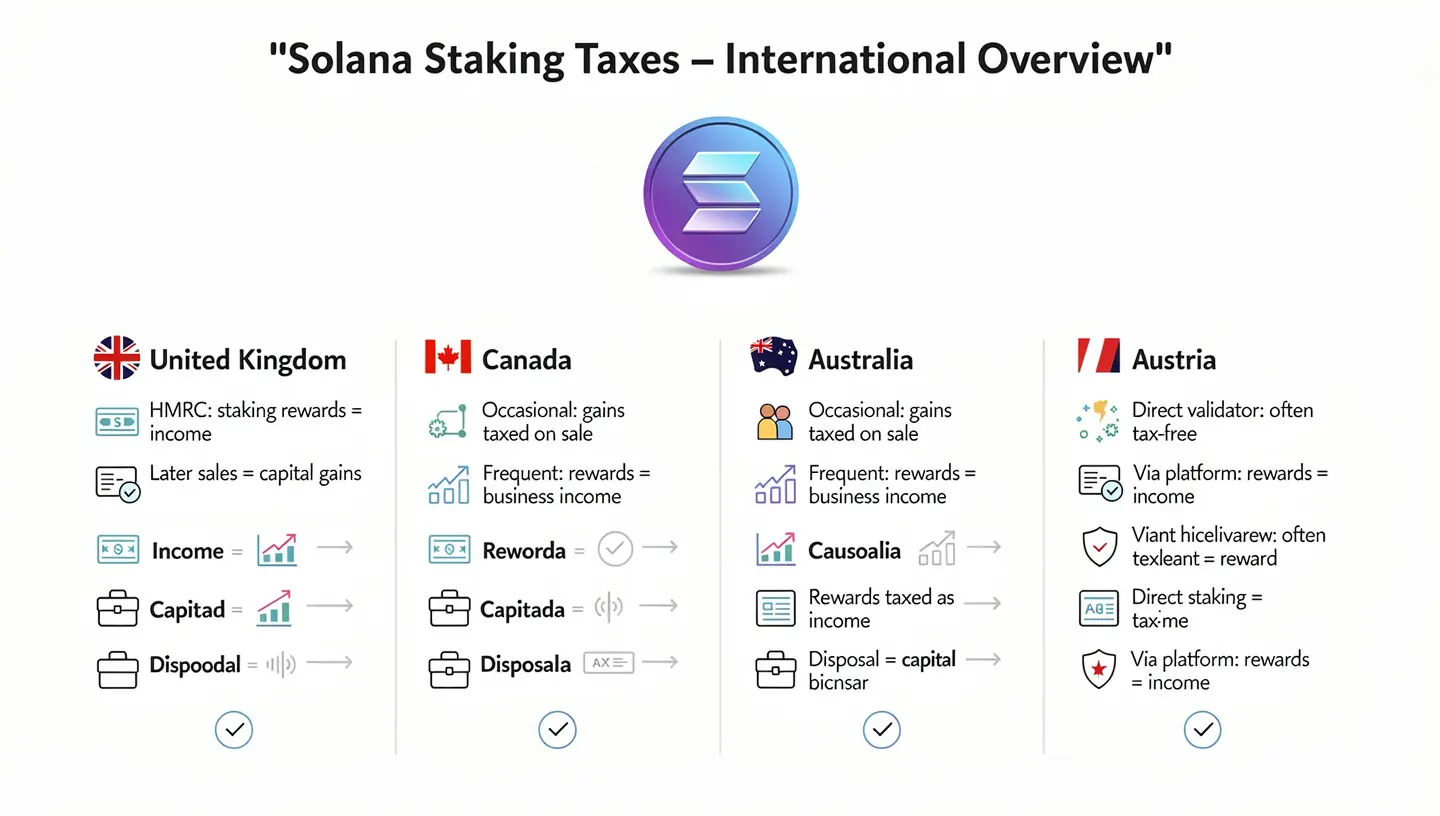
HMRC treats staking rewards as miscellaneous income, taxed at their value when received. Selling or swapping the tokens afterward triggers a separate capital gains calculation, following the same two-step pattern used in the US.
Canada
The CRA has not issued detailed guidance specific to staking, so treatment often depends on the facts. Occasional stakers are generally treated as investors, with rewards taxed as capital gains when eventually sold. Frequent, large-scale staking can instead be viewed as business activity, with rewards taxed as income upon receipt and related expenses becoming deductible.
Australia
The ATO treats crypto staking rewards similarly to the US approach, taxed as ordinary income upon receipt and subject to capital gains tax upon disposal.
A Notable Exception: Austria
Austria stands out because it draws a distinction based on how the staking happens. Staking directly with a validator can be treated as tax-free, while staking through a third-party platform is treated as ordinary income. This kind of country-specific nuance is exactly why checking your own jurisdiction matters before assuming any of the general rules above apply to you.
Tools That Can Help You Track Solana Staking Taxes
Given how many small reward events a year of native staking can generate, most stakers use dedicated crypto tax software rather than tracking everything by hand. These tools connect to your public wallet address, pull reward history directly from the chain, calculate fair market value for each credit, and generate the reports needed for filing. You only ever need to provide a public address, never your seed phrase, so treat any tool asking for your private keys as a red flag.
Will Solana Staking Tax Rules Change in the Future
The current approach, taxing rewards as income at receipt, is the settled position for now, but it has drawn criticism from parts of the industry that argue rewards should only be taxed once sold. In the US, legislation has been proposed in Congress to shift staking income recognition to the point of sale rather than receipt, though nothing along those lines has passed as of the most recent tax year. Until a change like that actually becomes law, the current receipt-based rule remains the standard to follow.
Bottom Line
Solana staking rewards are taxable income in most jurisdictions the moment you receive them, and any later sale can trigger a second, separate capital gains calculation on top of that. Unstaking itself is not a taxable event, liquid staking tokens sit in a genuinely unsettled area of the rules, and running your own validator changes the picture further by pulling your income into business territory. None of this is a substitute for advice from a qualified tax professional who knows your specific situation and country, but understanding the basic shape of the rules makes tax season a lot less stressful when those epoch rewards start piling up.
Frequently Asked Questions
Are Solana staking rewards taxable income?
Yes, in the US, UK, Australia, and most other countries with published guidance, staking rewards are taxed as ordinary income at their fair market value when you receive them.
How much tax do I pay on Solana staking rewards?
Reward income is taxed at your ordinary income tax rate, the same bracket that applies to your other earnings for the year. Any later sale of that reward SOL is taxed separately under capital gains rules.
Is unstaking Solana a taxable event?
No. Deactivating your stake and withdrawing it back to your wallet is not a disposal, since you still own the same coins. The taxable moments are the reward credits and any later sale or swap.
Do I owe tax if I never sell my staking rewards?
Yes, under the standard reading of the rules. You owe income tax when the reward is credited to your stake account, regardless of whether you sell it right away or hold it indefinitely.
Are mSOL and JitoSOL taxed the same as regular staking?
Not exactly. Liquid staking tokens accrue value inside the token rather than through separate reward payments, and there is no clear official guidance yet on exactly when that value becomes taxable. Some professionals recommend treating the growing value as income over time, while others only recognize income upon redemption.
What happens if I only earned a small amount from staking?
There is no minimum amount that exempts you from reporting. Whether you earned twenty dollars or twenty thousand, the rewards are reportable income.
Do Solana validators pay self-employment tax?
Often yes. Running a validator with regularity and a profit motive is usually treated as a business, which can mean self-employment tax on top of income tax, though it also allows real costs like hardware and hosting to be deducted.
Does Coinbase report my Solana staking rewards to the IRS?
Coinbase and similar exchanges may issue a tax form once your reward income crosses a set threshold, commonly $600 in the US. The rewards are taxable income either way, whether or not a form is issued.
Is Solana staking taxed the same way outside the US?
The general pattern, income tax at receipt and capital gains tax at disposal, shows up in the UK, Australia, and several other countries, though the details differ. Canada’s approach depends heavily on the facts of your situation, and Austria treats direct validator staking differently from third-party staking. Always check the specific rules where you live.