Is Solana halal? It is one of the first questions Muslim investors ask before buying SOL, and the honest answer is that it depends on who you ask and how you plan to use the token. Several screening platforms rate Solana as halal under certain conditions, a couple of them treat it as doubtful, and some well known scholars advise against cryptocurrency as a whole, which would include SOL. No single body has issued a final ruling.
This guide goes through what each source actually says, how Solana scores on riba, gharar and maysir, and where staking, trading, meme coins, NFTs and DeFi change the picture. Nothing here is a fatwa. Think of it as a map of the opinions, so you can bring clear questions to a scholar you trust. If you are asking is Solana haram, the short version is that most screeners do not call the base token haram, but some of the things people do with it are another story.
Is Solana Halal or Haram? The Short Answer
Most platforms that publish a verdict on SOL place it in the halal group, usually with conditions attached. A smaller group calls it doubtful, and a few scholars reject all cryptocurrency, so SOL is not an option for anyone who follows that view. The table shows who says what. These are screening results from the sites listed, not fatwas, and every one of them uses its own method.
| Source | Verdict on SOL | Main condition |
|---|---|---|
| HalalScreener | Halal, 85 out of 100 | Hold spot, avoid leverage and lending products |
| CryptoUmmah | Halal with light purification, 79.9 out of 100 | Avoid interest based DeFi, purify a small share of profits |
| Islamic Finance Guru | Halal, in line with most scholars | Avoid riba |
| Sharlife | Passed | Trade spot, no leverage or futures |
| Shariyah Review Bureau | Digital infrastructure, token utility does not breach Shariah principles | Report dates from 2022 |
| HalalWallet | Scholars differ, doubtful on its AAOIFI based rating | Spot only, careful with staking |
| ZakatInvest | Doubtful | Avoid meme coins, leverage and DeFi lending |
| Mufti Taqi Usmani, Egyptian Dar al-Ifta | Against or cautious on crypto in general | The same view extends to SOL |
So, is Solana halal or haram? If you want one line, it is this: the token itself is widely treated as permissible by the screeners that rate it, while the way you use it decides most of the risk. Holding SOL in a wallet is one thing. Using it for margin trades, fixed yield products or meme coin gambling is something else entirely.
What Makes a Crypto Halal or Haram
Islamic finance judges any asset or deal against a short list of rules. Three of them come up in almost every crypto discussion:
- Riba: interest, meaning a guaranteed extra return paid on a loan.
- Gharar: excessive uncertainty, where the terms or the outcome of a deal are too unclear.
- Maysir: gambling, or profit that depends mostly on chance rather than on real economic activity.
On top of those, the asset must not be tied to a forbidden business such as alcohol or gambling. The harder question for crypto is whether it counts as property at all. Islamic Finance Guru describes three positions.
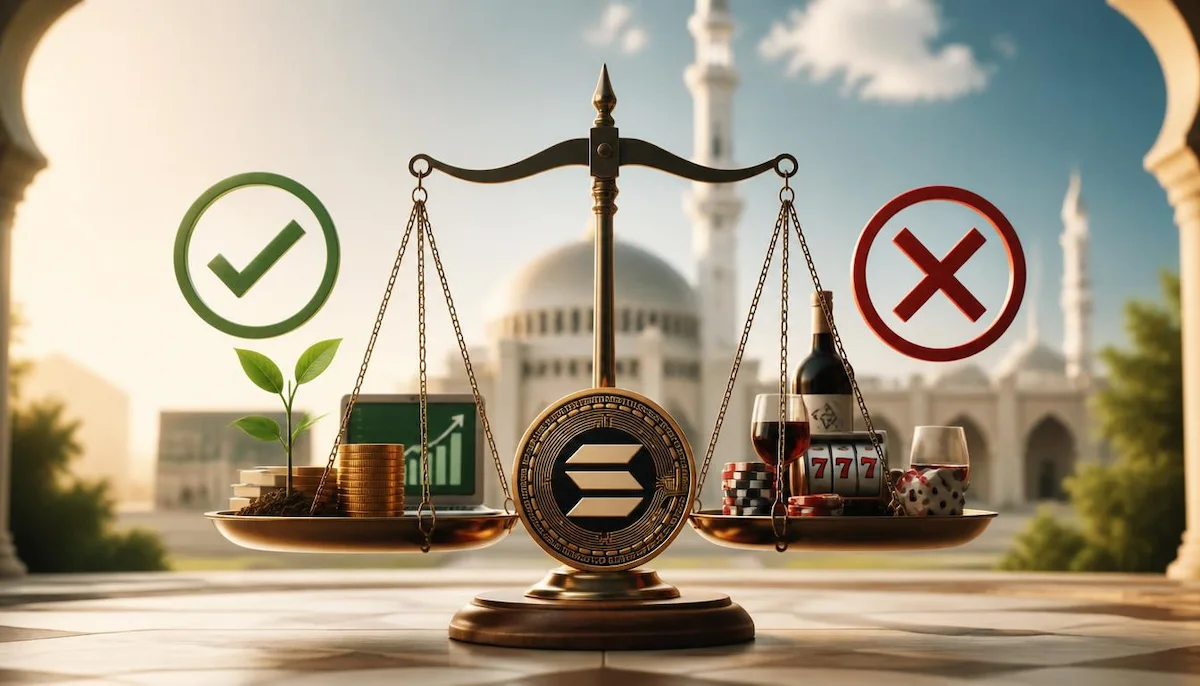
The first says crypto is not property and is just speculation. The second says it is a digital asset but not a currency. The third says it is a digital currency. The site finds the second view the most realistic, and notes that for ordinary users the second and third lead to the same result, which is that trading is allowed.
Scholars who permit crypto usually do so on a conditional basis. They look at what the coin does, how it is used, and whether the product built on top of it brings interest or heavy speculation. Those who forbid it point mainly to gharar and to the lack of state backing. That split is the reason you will see opposite answers to the same question about Solana.
What Is Solana and What Is SOL Used For
Solana is a proof of stake blockchain built for fast, cheap transactions and smart contracts. SOL is its native token. People use it to pay network fees, and holders can delegate it to validators, the computers that confirm transactions, in exchange for staking rewards. Apps built on the network cover trading, lending, NFTs, payments and meme coins.
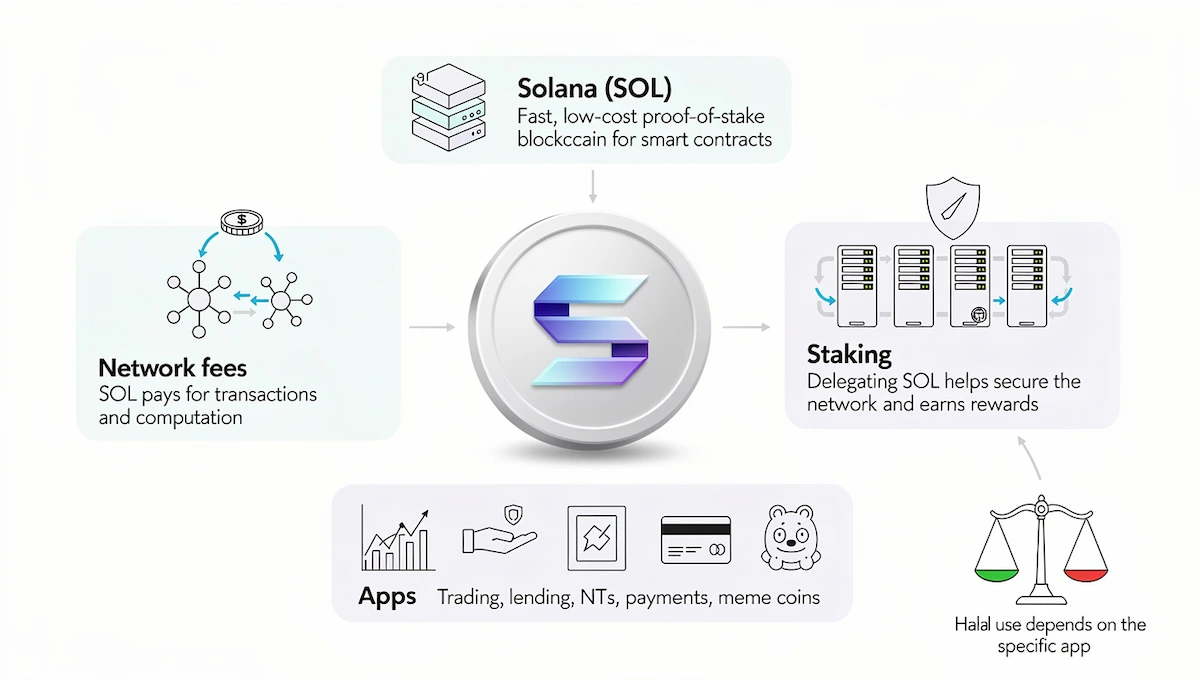
For the halal question, three facts matter. SOL has a real job on the network, since it pays for computation and helps secure it. The base protocol does not pay or charge interest. And the network hosts apps that range from clearly permissible to clearly not. If you want the technical background first, our explainer on what Solana is covers how the chain works and why it is fast.
How Solana Measures Up on Riba, Gharar and Maysir
Does Solana Involve Riba?
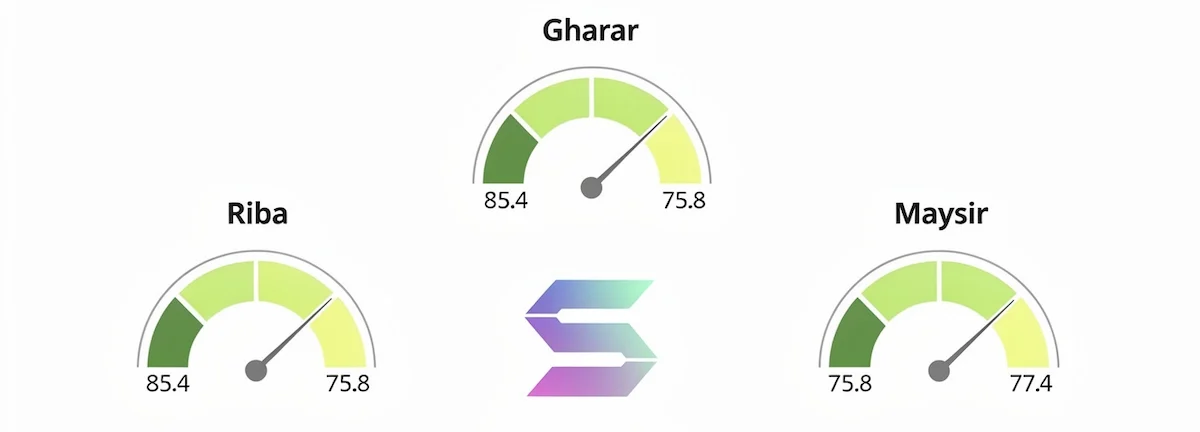
At the protocol level, no. Validators earn transaction fees and newly issued SOL as payment for processing and confirming blocks, which scholars compare to a service fee rather than interest on a loan. Lending platforms do exist on Solana, but they are separate apps run by other teams. CryptoUmmah makes the point that their existence no more makes the base layer a riba system than a bank account makes the internet one. It gave Solana a riba score of 85.4 out of 100.
Does Solana Involve Gharar?
Some, though less than for many other coins. The code is open source, the founding team is public, and network data such as stake distribution and throughput can be checked by anyone. Against that, Solana has had several outages in its history, early token holdings were concentrated among insiders, and day to day governance is led mostly by validators and the core developers. CryptoUmmah scored gharar at 75.8 out of 100 and described the uncertainty as minor. Price volatility is a separate matter and applies to every crypto asset.
Does Solana Involve Maysir?
The design of SOL is not a gambling design. It pays for network use, and the chain handles real activity every day. The speculation around it comes from the wider crypto market. CryptoUmmah gave maysir 77.4 out of 100 and pointed out that buying SOL only to chase short term price swings, especially with leveraged derivatives, raises its own concerns that are separate from whether the asset is permissible. That is why nearly every platform tells you to keep it to spot holdings.
What Scholars and Screening Platforms Say About Solana
Platforms That Rate SOL as Halal
HalalScreener rates Solana halal with a score of 85 out of 100, using what it calls a conditional permissibility approach. It treats SOL as network infrastructure with no interest, gambling or forbidden industry behind it, and it states clearly that AAOIFI has not published a standard for cryptocurrency. CryptoUmmah lands at 79.9 out of 100 and recommends light purification. Sharlife, a Shariah advisor registered in Malaysia, marks SOL as passed in its Q3 2025 screening and notes that the token is traded on exchanges approved by the Securities Commission Malaysia. Islamic Finance Guru says most scholars hold Solana to be halal and shares that view.
The Shariyah Review Bureau, a Shariah advisory firm that also certifies products for providers such as Wahed Invest, published a report on Solana in 2022. Its opinion is that Solana is digital infrastructure and that the utility of the SOL token does not conflict with Shariah principles. You can read the original in the Shariyah Review Bureau report on Solana. Bybit Learn, writing for general readers, reaches a similar view: SOL is likely to be seen as halal unless it is used in interest generating or highly speculative products.
Sources That Call SOL Doubtful
HalalWallet lists the case as one where scholars differ. Its own rating, based on AAOIFI standards, is doubtful, and it explains that under the permissive view SOL is lawful digital property, while under the prohibitive view it carries excessive gharar. ZakatInvest also files Solana under doubtful and treats it much like Ethereum, with one extra worry. Its argument is that the technology is neutral but the apps around it include interest based lending, speculative NFT trading, derivatives and a large meme coin market, which makes Solana more contested than Ethereum for strict investors.
Scholars Who Advise Against All Crypto
Some of the best known voices reject cryptocurrency in general, and that position covers SOL too. Mufti Taqi Usmani considers crypto trading impermissible in its current speculative form. The Egyptian Dar al-Ifta, under Grand Mufti Shawki Allam, prohibited dealing in Bitcoin in 2017 on gharar grounds. The religious affairs authority of Turkey, the Diyanet, said in 2017 that crypto is not compatible with Islam because of speculation. The office of Grand Ayatollah Sayyid Ali al-Sistani does not give a ruling on virtual currencies and sends followers to the next most learned jurist. If you follow one of these positions, a high screening score on a website will not change the answer for you.
Why Halal Screeners Disagree on Solana
The gap between a halal grade and a doubtful grade is mostly about method, not about facts. The standard most platforms lean on, AAOIFI Shariah Standard No. 21, was written for shares and bonds. It checks a company for forbidden business activity and then applies limits on debt, interest bearing holdings and impure income. A token has no balance sheet, no debt schedule and no revenue statement, so those ratio tests cannot be run. ZakatInvest spells this out and lists several index methods, from MSCI to FTSE Yasaar and the Malaysian Securities Commission rules, as not applicable to a network token.
What is left is a qualitative judgment, and that is where opinions part ways. A Shariah screening of Solana can focus on the protocol, which has no interest and a real purpose, or on everything built on top of it, where some apps clearly fail. HalalWallet notes that impermissible uses on a network are generally ruled not to taint the base asset, while staking and DeFi yield are treated as separate questions. HalalScreener adds that its verdict would be revisited if the staking mechanics ever picked up interest like features. A rating is a snapshot with a date on it, so check how recent it is before relying on it.
Is Staking Solana Halal?
Native Staking and Delegating to a Validator
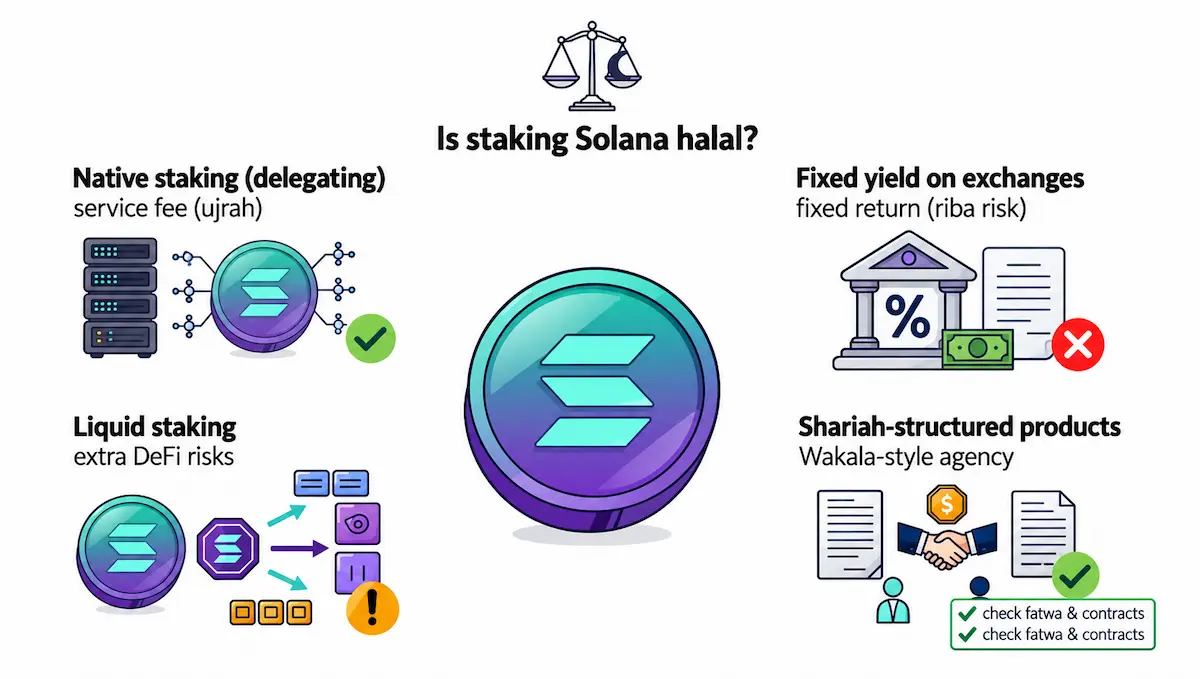
This is the part of the question that gets the most searches. In native staking you delegate SOL to a validator and receive rewards that come from new issuance and network fees. The amount changes with network activity and validator performance, it is not a fixed rate, and you never hand your coins to another party as a loan. The mechanics are laid out in the official Solana staking documentation.
Scholars who permit crypto generally treat this as pay for a real service rather than interest. HalalWallet cites Mufti Faraz Adam as classing genuine protocol validation as ujrah, which means a fee for work done, and as allowed. HalalScreener reaches a similar conclusion for delegated staking on halal coins. Scholars who forbid crypto in general extend that ban to staking, so the permission depends on first accepting the coin itself. If you want the steps, our guide on how to stake Solana walks through choosing a validator and delegating.
Fixed Yield Staking on Exchanges
Many exchanges sell products called staking or earn that pay a set rate on deposited SOL. These work differently from delegating. You hand your coins to the platform, which uses them as it sees fit and promises a guaranteed return. HalalWallet says this is widely treated as impermissible lending, and HalalScreener says such products are structured like interest bearing loans and fail its screening. The test most scholars apply is simple: if the return is fixed and does not depend on any real work or shared risk, it looks like riba.
Is Liquid Staking Halal?
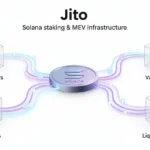
Liquid staking tokens such as JitoSOL and mSOL add another layer. You deposit SOL with a protocol, receive a token that grows in value as rewards build up, and can then use that token elsewhere. HalalScreener reports that some Shariah boards accept liquid staking with conditions while others advise sticking to direct or delegated staking. The extra uses are where trouble can start, because a liquid token that is posted as collateral in a lending app or placed in a pool brings the DeFi questions covered below. Our explainer on liquid staking on Solana shows how these tokens work.
Certified Shariah Staking Products
There is also a middle route. According to HalalWallet, Binance launched a Sharia Earn product for SOL in 2025, certified by Amanie Advisors and built on a Wakala structure, where the platform acts as an agent for the investor. Its point is that proof of stake rewards can be packaged in a compliant way. If you are searching for a halal way to stake Solana and do not want to delegate on your own, a certified structure like this is worth bringing to your scholar, together with the contract terms.
Is Trading Solana Halal?
The platforms that rate SOL as halal almost all attach the same condition: buy and sell on the spot market. Sharlife says Muslims should trade Solana on spot markets without leverage or futures. HalalScreener recommends buying spot and avoiding leverage and lending products. ZakatInvest tells readers to avoid leveraged trading outright.
The reasoning is straightforward. A spot purchase gives you ownership of the token, while margin and futures involve borrowing, which brings interest, and trading contracts on price movement, which many scholars see as gambling. Frequent day trading driven only by price swings also sits closer to maysir than a longer holding does, and Bybit Learn warns that heavy volatility can add uncertainty. Whether short term spot trading is acceptable is a point on which scholars differ, so this is a good question to put to your own. When you decide to sell, our guide on how to sell Solana explains the options.
Are Solana Meme Coins Halal?
This is the part of the Solana network where the most scholars and screeners get uneasy. ZakatInvest describes the meme token market as built on pure speculation, a maysir and gharar problem, and advises Muslim investors to stay out of it even when they hold SOL. The Shariyah Review Bureau, as summarized by Bybit Learn, gives a haram classification to meme coins with no utility, using Dogecoin as its example.
There is a technical side too. A fatwa on Seekers Guidance by Shaykh Muhammad Carr says that whether a meme coin counts as a currency depends on factors such as sovereign issue or social acceptance, which means the question is about definition before it is about profit. That answer is not a ruling on any particular Solana token. In practice, most coins launched in a day with no product and no team are hard to defend under any approach, and they are also where scams cluster. Our guide on Solana scams shows the usual tricks, which is a separate reason to be careful.
Are Solana NFTs Halal?
NFTs are treated case by case. ZakatInvest says an NFT can be permissible as a digital certificate of ownership, and impermissible when it is bought purely for speculative flipping with nothing of value behind it. The content matters as well: an NFT that shows forbidden imagery is a problem regardless of price. Random mint sales and rapid flipping lean toward gharar, since buyers often cannot tell what they will get or what it will be worth. If you hold NFTs on Solana, the cleaner position is to look at what the item is, why you are buying it and whether the sale terms are clear.
Is Solana DeFi Halal?
Decentralized finance on Solana is not one thing, so it cannot get one answer. CryptoUmmah says using Solana DeFi protocols is conditionally permissible as long as you avoid those that involve riba, such as lending platforms that charge or pay fixed interest, and those that deal in forbidden assets. Each protocol has to be checked on its own, because a halal verdict for the network does not carry over to every app on it. Bybit Learn reports that the Shariyah Review Bureau generally classes lending and borrowing DeFi projects such as AAVE as haram.
A simple swap on a decentralized exchange is the least troublesome use, since it is an exchange of one asset for another. Lending and borrowing against interest, leveraged perpetual contracts and yield farming with stacked rewards are where the doubt grows. Providing liquidity needs a look at the pool, since CryptoUmmah advises screening each one for interest bearing assets and excessive uncertainty, and purifying doubtful income. Our guide to Solana DeFi explains each type of app, so you know what you are looking at before you ask a scholar.
Is Solana Halal to Invest In? ETFs, Stocks and Direct Holdings
Whether Solana is halal to invest in depends on the route you choose. Direct ownership of SOL is what most of the verdicts above refer to. Funds and shares are different products with their own screens.
Solana ETFs hold the token and some of them also stake it. HalalScreener graded the Canary Marinade Solana ETF with a C+ and applies a rule that a basket is halal when the haram weight stays below 5 percent. The fund describes a secondary aim of earning extra SOL through staking, which adds the staking question to the fund itself.
Shares of companies that hold SOL are screened as ordinary companies, with financial ratios. Musaffa classified Sol Strategies, SOL Global Investments and Solana Co as not halal in 2026. That says something about those businesses and their balance sheets, not about the token, so do not mix the two. If a fund or a listed company is on your list, ask for its latest screening and compare it with a scholar you rely on.
Is Solana More or Less Halal Than Ethereum?
Most sources put the two in the same class. HalalWallet says Solana sits in the same place as Ethereum in the halal debate, with the staking question added on top. Bybit Learn says SOL does the same job on Solana that ETH does on Ethereum. In the CryptoUmmah scoring, Ethereum comes out slightly higher, 81.5 against 79.9, with small gaps in all three pillars of riba, gharar and maysir. ZakatInvest thinks Solana is more contested because of its meme coin culture. For most readers the practical result is the same: if you accept Ethereum on a conditional basis, you will probably accept Solana on the same conditions, and if you reject one you will reject both.
Zakat and Purification on Solana Holdings
Zakat is a separate question from whether the coin is halal. According to CryptoUmmah, the usual method is 2.5 percent of the market value of your holdings, due if the total reaches the nisab threshold and you have held it for a full lunar year, using the price on your zakat date. Other scholars have their own views on how digital assets are counted, so confirm the method with yours.
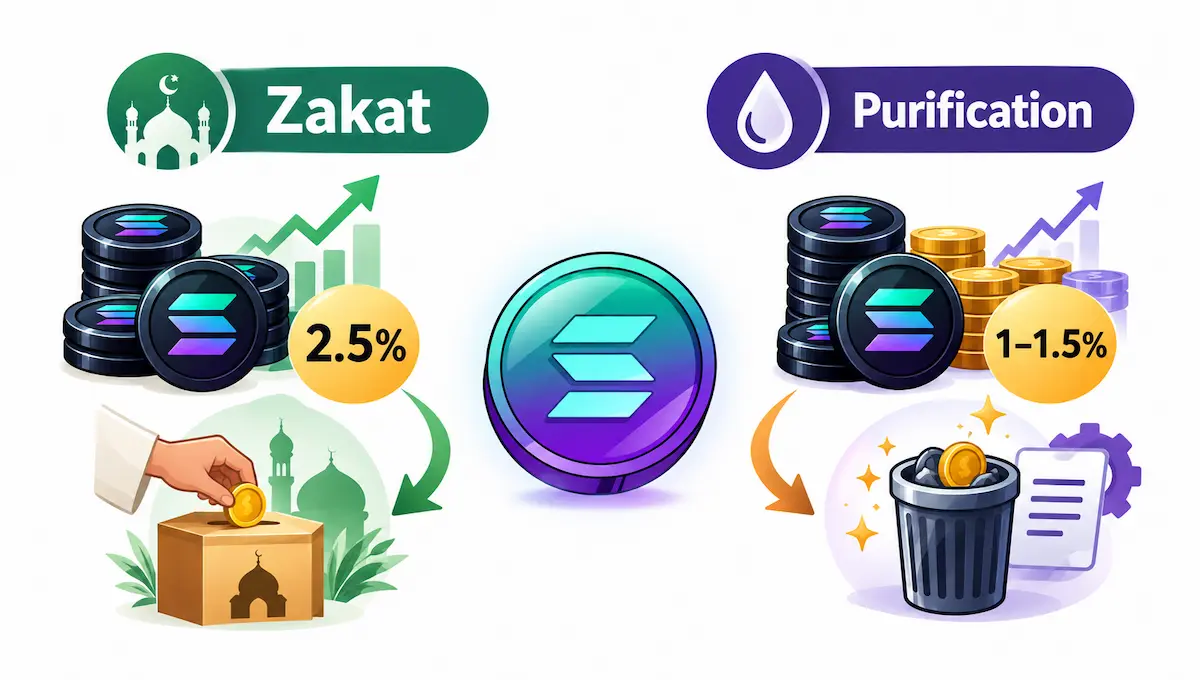
Purification is not the same as zakat. It means returning a small share of profit that may have picked up impure income along the way. CryptoUmmah suggests 1.0 to 1.5 percent of profits for Solana and says this is not zakat and is not tax deductible. ZakatInvest says no standard purification formula exists for a token and that staking proceeds need a scholar. Do not mix any of this up with tax either. For the legal side, see our Solana tax guide.
How to Hold Solana More Carefully
If you decide that SOL fits your own scholar guidance, these habits come up again and again across the sources:
- Stay on spot. No margin, no futures, no leveraged tokens.
- Skip fixed yield products. Delegating to a validator is a different thing from lending coins to a platform for a promised rate.
- Check each DeFi app separately. Look for interest, forbidden assets and unclear terms before you connect a wallet.
- Stay away from meme coins and from anything that depends only on price swings.
- Re-check the verdict now and then. Screening results are dated and can change.
- Ask a scholar for larger amounts, and bring the specific product and its terms.
Custody is the practical side. Owning the coins in your own wallet keeps you away from platforms that might lend them out without telling you, and our guide on how to store SOL long term explains the safest ways to do it.
Bottom Line
Is Solana halal? Depending on the source, yes with conditions, doubtful, or not at all if you follow a scholar who rules out crypto entirely. The platforms that publish a verdict mostly agree that the SOL token has real use, no built in interest and no link to a forbidden industry. They also agree that staking structure, leverage, meme coins and DeFi lending can turn a permissible holding into a problem. No major authority has published a final ruling, so the safest step is to take this information to a scholar you trust and decide with them. This article is educational and is not a fatwa or financial advice.
Frequently Asked Questions
Is Solana halal or haram?
There is no final ruling. Several screeners such as HalalScreener, CryptoUmmah and Sharlife rate SOL as halal under conditions, HalalWallet and ZakatInvest call it doubtful, and scholars who reject all crypto would say it is not permitted.
Is Solana halal to invest in?
Buying and holding SOL on the spot market is the form that most halal verdicts accept. Leveraged trading, fixed yield products and meme coins are where most sources draw the line. Funds and company shares have their own screening results.
Is staking Solana halal?
Many scholars who allow crypto treat native staking, where you delegate to a validator, as payment for a real service. Fixed rate earn products on exchanges are widely seen as interest like. Ask your scholar about your exact method.
Can I trade Solana with leverage as a Muslim?
Most platforms advise against it. Sharlife says to trade spot without leverage or futures, and HalalScreener says to avoid leverage and lending products. Borrowing brings interest, and futures are seen by many scholars as speculation.
Are Solana meme coins halal?
Most sources say to avoid them. ZakatInvest describes them as pure speculation, and the Shariyah Review Bureau, as reported by Bybit Learn, classes coins with no utility as haram. Holding SOL is treated separately from trading meme coins.
Is Solana halal compared to Bitcoin and Ethereum?
Most sources place them in the same class. CryptoUmmah scores Ethereum slightly higher than Solana, and ZakatInvest sees Solana as a little more contested because of its meme coins.
Do I pay zakat on Solana?
The common method is 2.5 percent of the market value if your total wealth reaches the nisab and you have held it for a lunar year. Scholars differ on details, so confirm with yours.
Why do some scholars say all cryptocurrency is haram?
The main reasons are gharar, meaning excessive uncertainty, and the lack of state backing or real output behind price. Mufti Taqi Usmani and the Egyptian Dar al-Ifta have taken this position, and it extends to Solana.
Can the halal status of Solana change?
Yes. Screening results are dated and can be revised. HalalScreener says it would revisit its verdict if staking took on interest like features or if governance changed what the network does, so check how recent a rating is.