If you’ve staked SOL before, you already know the tradeoff: your tokens earn rewards, but they’re locked up and useless for anything else while they’re staked. Liquid staking solana solves that problem, and mSOL was the token that started it. When you stake SOL through Marinade, you get mSOL back in return, a token that keeps earning your staking rewards while staying fully usable across Solana’s DeFi apps. This guide walks through exactly what mSOL is, how its price actually works behind the scenes, how to get it and unstake it, and how it stacks up against JitoSOL and bSOL. By the end you should have a clear picture of whether liquid staking Solana through mSOL fits how you actually want to use your SOL.
What Is Liquid Staking on Solana
Native staking on Solana means locking your SOL to a validator. You earn rewards, but if you want that SOL back, you have to unstake and wait for the current epoch to end, typically two to three days. During that window, your tokens are just sitting there, unusable for trading, lending, or anything else.
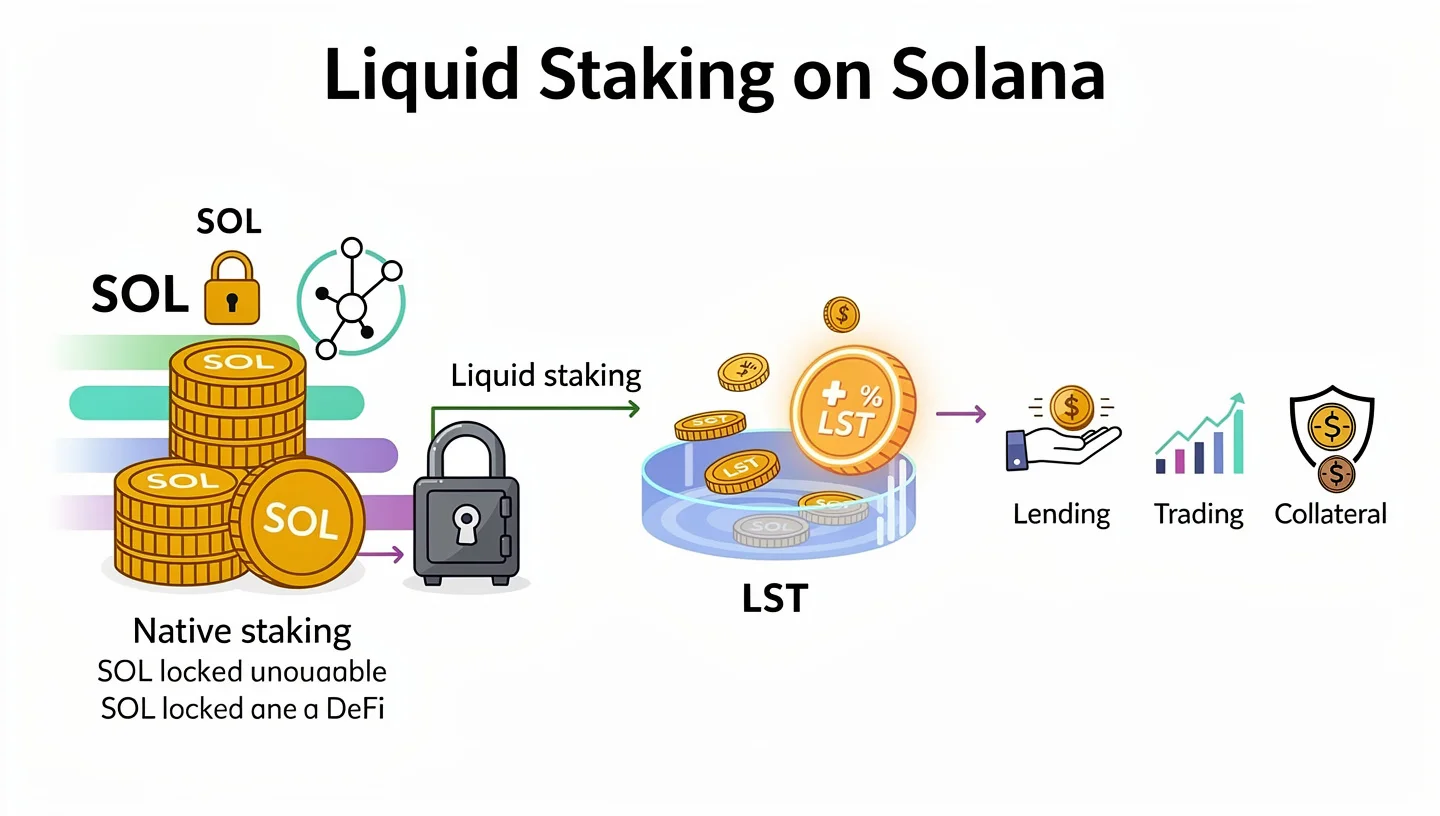
Liquid staking fixes that. Instead of locking your SOL directly, you deposit it into a staking pool and receive a liquid staking token, often shortened to LST, in return. That token represents your staked SOL plus whatever rewards it’s earning, and unlike a locked stake account, you can trade it, lend it out, or use it as collateral whenever you want. You’re still contributing to network security behind the scenes, you just aren’t giving up flexibility to do it.
The reason liquid staking Solana has grown so much comes down to how Solana’s DeFi apps are built. Because SOL processes transactions cheaply and quickly, protocols on the network can afford to treat a token like mSOL as a first-class asset rather than something exotic. That’s part of why liquid staking tokens on Solana ended up so deeply woven into lending markets, liquidity pools, and collateral systems compared to similar products on other chains, where fees and speed make that kind of composability harder to pull off.
What Is mSOL
mSOL is the liquid staking token you receive from Marinade Finance, the protocol that pioneered liquid staking on Solana back in August 2021. It was the first LST on the network, and it’s still one of the largest, with a total value locked sitting around $273 million and a market cap in the range of $268 million as of mid 2026.
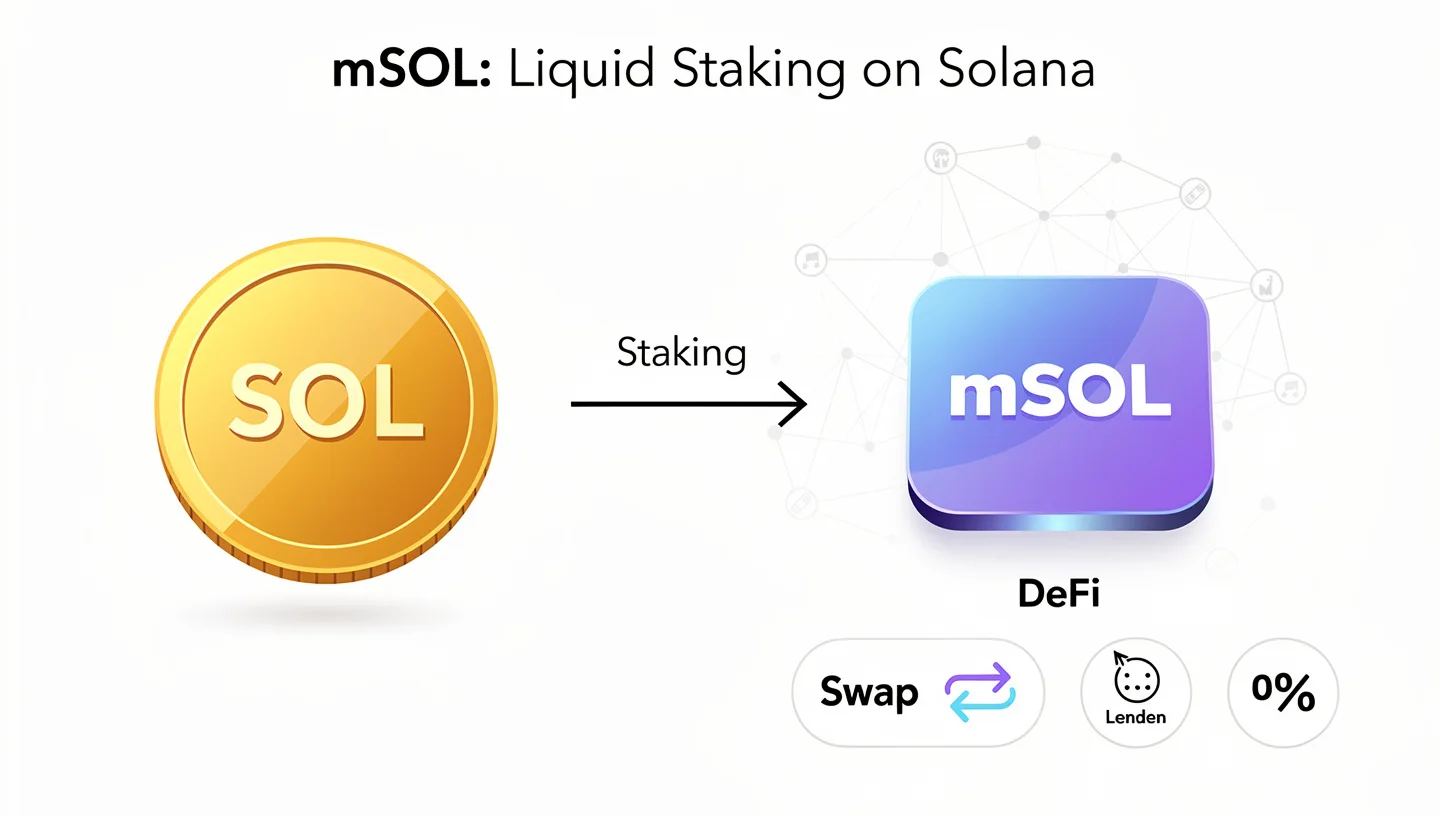
Think of mSOL as a receipt. When you stake SOL through Marinade, that SOL gets delegated across a large set of validators, and you get mSOL back as proof of your position. You can hold it, trade it, use it in DeFi, or eventually redeem it for your original SOL plus rewards. The number of mSOL tokens you hold never changes. What changes is the value of each one relative to SOL.
Marinade built mSOL specifically so it could plug into the rest of Solana’s DeFi apps without friction. It follows the standard SPL token format, the same one SOL itself and most other Solana assets use, which means any wallet, exchange, or protocol that already supports SPL tokens can support mSOL with little extra work. That standardization is a big part of why mSOL ended up so widely adopted rather than staying siloed to Marinade’s own app.
How mSOL Actually Works
The mSOL Price Formula
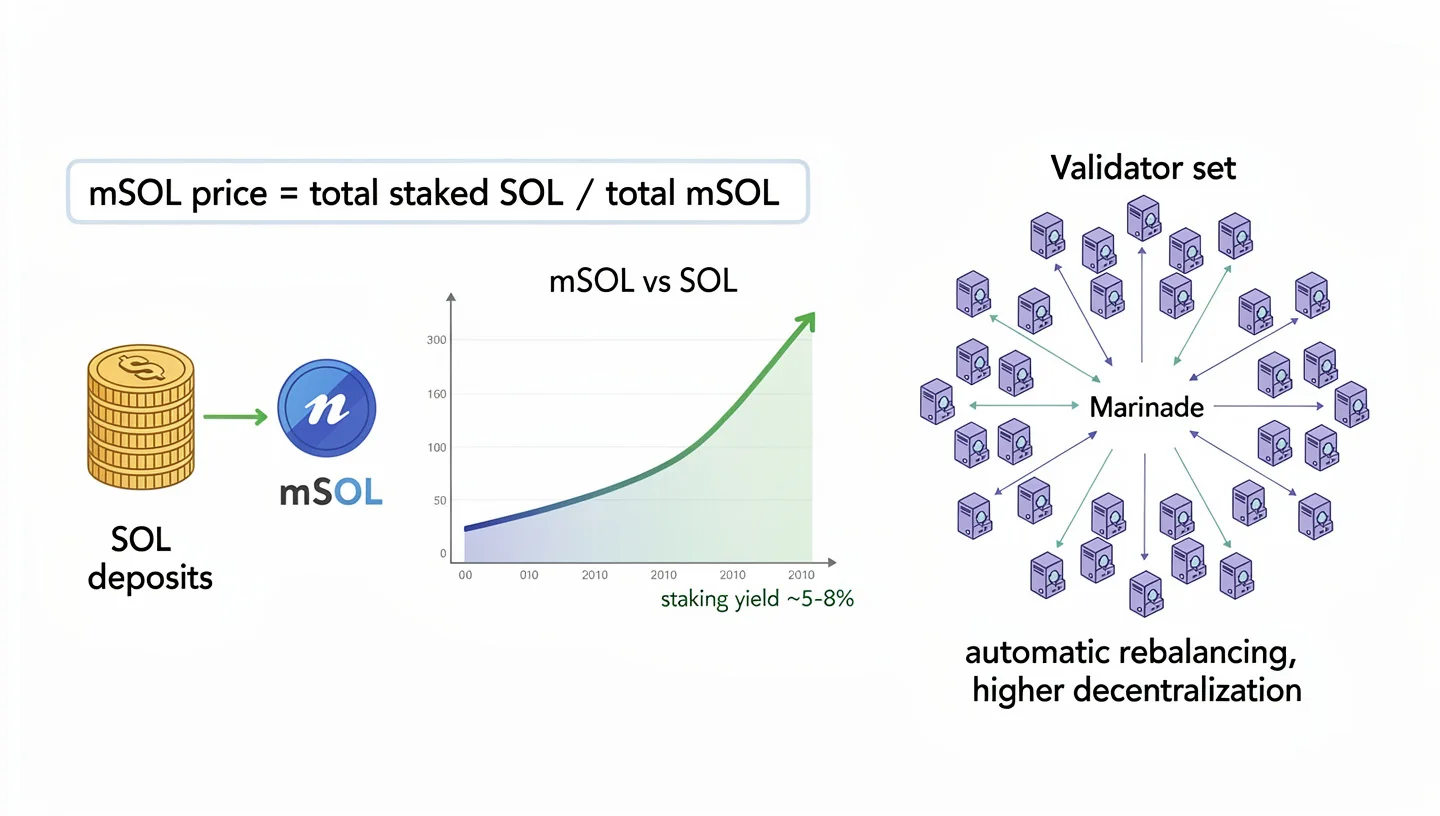
This is the part that trips people up the most, since mSOL doesn’t work like a typical reward system where new tokens get airdropped into your wallet. Instead, mSOL’s price against SOL grows over time. Marinade calculates it with a simple formula, laid out clearly in their official documentation: price of mSOL equals total staked SOL divided by total mSOL tokens minted.
Because new mSOL can only be minted when someone deposits SOL at the current rate, the total staked amount grows every epoch from rewards, while the token supply only grows when new deposits come in. That imbalance is what pushes the price up. If you held onto mSOL for a full year, its value against SOL would have climbed by roughly however much Marinade’s annual yield was over that stretch, commonly somewhere in the 5 to 8 percent range depending on network conditions.
How Your Stake Gets Delegated
You don’t pick a validator yourself when you use mSOL. Marinade runs an algorithmic rebalancer that spreads deposits across more than a hundred different validators, scoring each one on commission, performance, and how much it contributes to decentralization. MNDE, Marinade’s governance token, controls how those scoring weights get set. Every epoch, your underlying stake can shift toward better performing validators automatically, which is part of why mSOL tends to be considered one of the more decentralized options among Solana’s liquid staking tokens rather than concentrating stake in a handful of large operators.
This matters more than it might seem at first. When too much stake concentrates behind a small number of validators, the network becomes more vulnerable to outages or coordinated failures affecting a large share of total stake at once. By spreading deposits across a wide validator set and adjusting that spread automatically, mSOL’s design leans toward strengthening Solana’s decentralization rather than just chasing the single highest yield available in any given epoch.
How to Get mSOL
Getting mSOL is straightforward if you already hold SOL. You can either deposit liquid SOL directly, which gets staked and converted into mSOL right away, or deposit an existing stake account that’s already delegated to a validator, as long as it holds at least 1 SOL. In that second case, Marinade takes over the account and mints mSOL based on the current exchange rate. Both routes end up in the same place. You walk away holding a liquid token that keeps earning while the original SOL stays productive on the network.
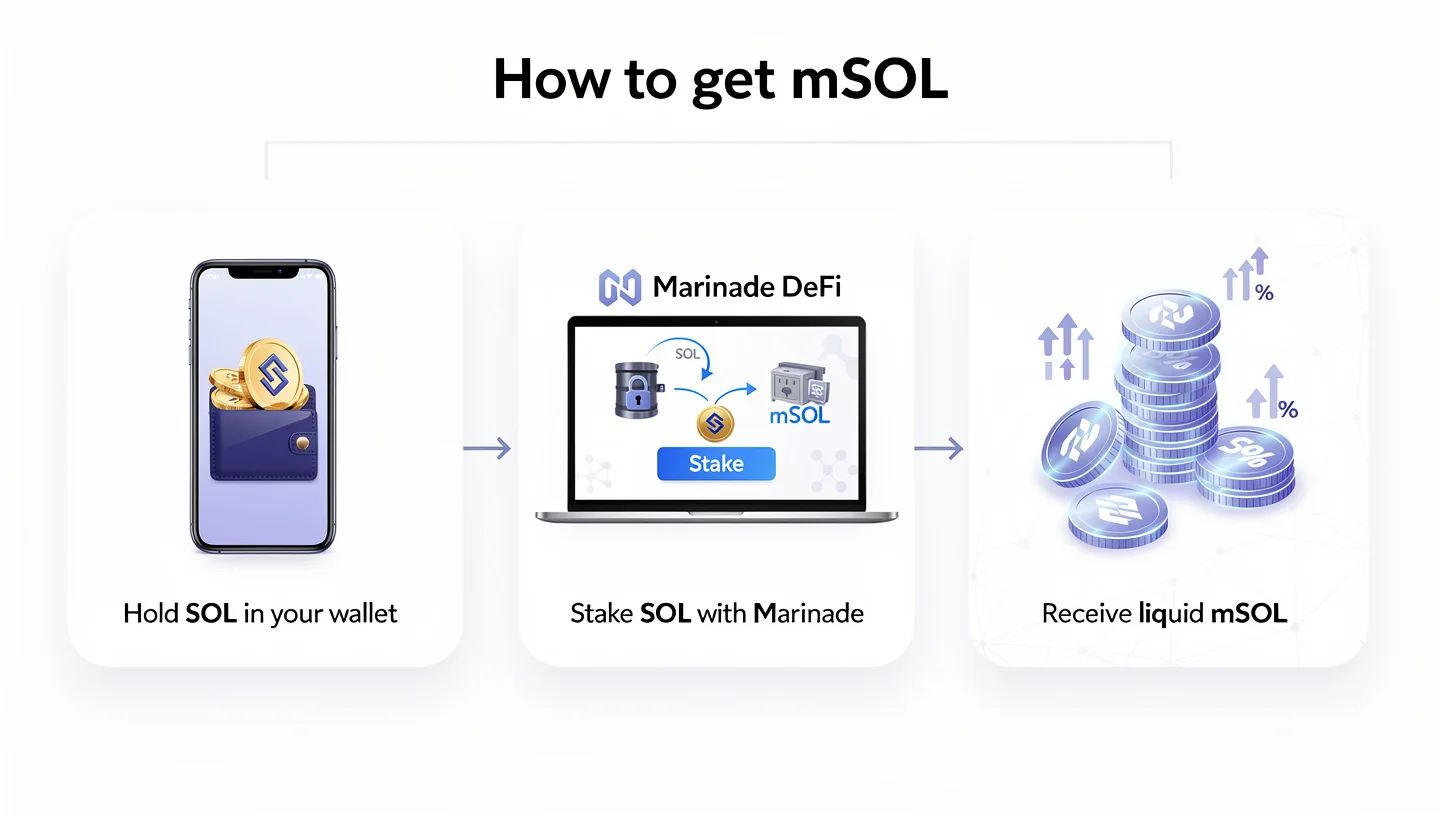
If you don’t have SOL in your wallet yet, you’ll need to acquire some first. Our guide on how to buy Solana walks through that if it’s your first time. Once you’ve got SOL sitting in a wallet like Phantom or Solflare, connecting to Marinade and staking takes just a couple of clicks.
How to Unstake mSOL
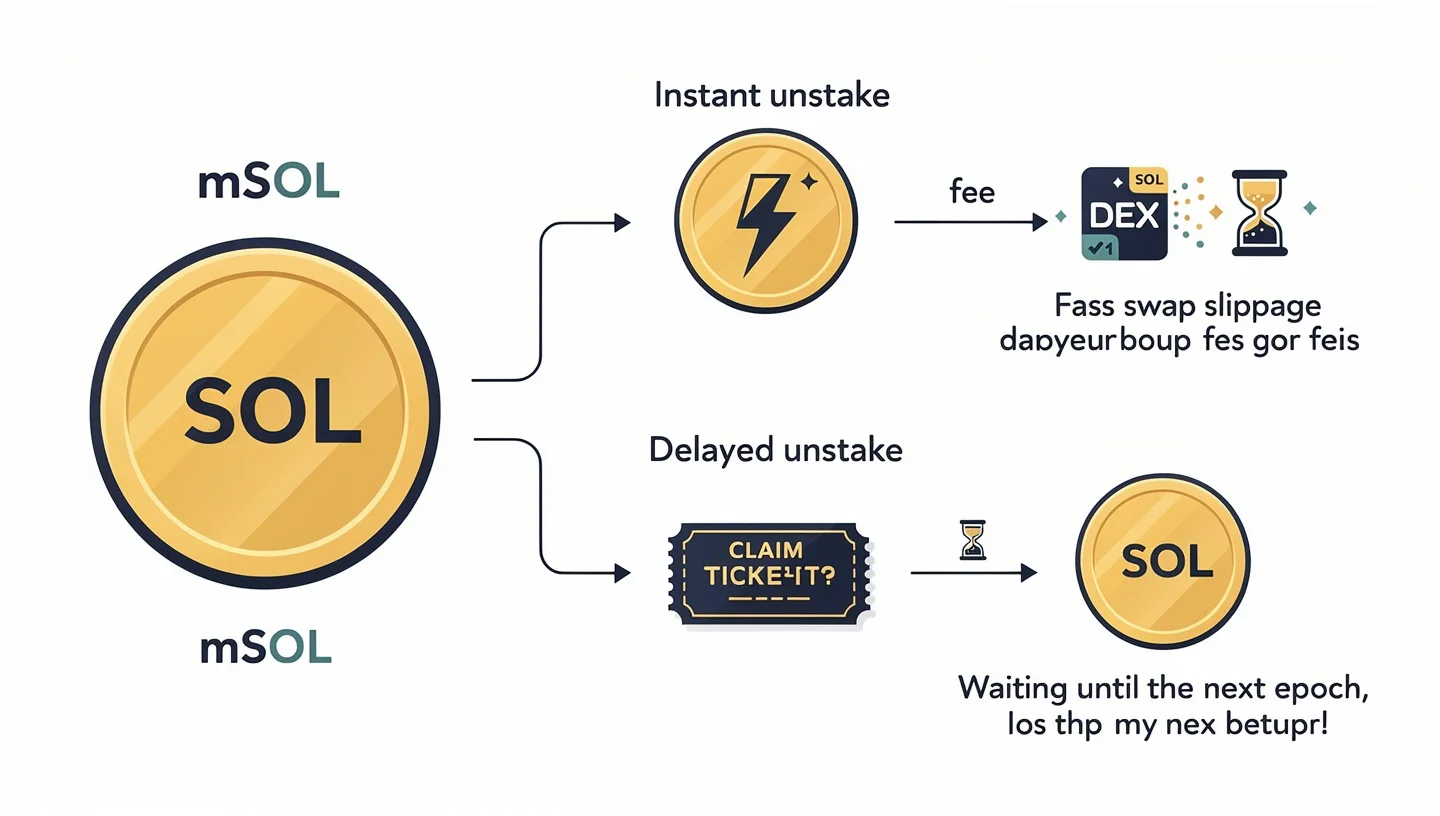
Marinade gives you two ways to convert mSOL back into SOL, and which one makes sense depends on how quickly you need your funds.
Instant Unstake
Instant unstake is really just a swap. Marinade routes your mSOL through Jupiter and trades it for SOL at whatever the current market rate is. You get your SOL immediately, but since it’s a swap rather than a redemption, you’re exposed to slippage and DEX fees. For typical trade sizes, that slippage usually stays under 25 basis points, though very large trades can move the price more noticeably.
Delayed Unstake
Delayed unstake skips the swap entirely. Your mSOL gets burned instead of traded, and you receive a claim ticket showing how much SOL you’re owed and when you can collect it. There’s no fee, but you have to wait until the following epoch, and depending on exactly when during the current epoch you start the process, it might even roll over into the epoch after that. This route works better for larger amounts or anyone who doesn’t mind the wait in exchange for avoiding fees entirely.
What Can You Do With mSOL
mSOL isn’t just something you hold and forget about. It’s built to be used across Solana’s DeFi apps while it keeps earning in the background.
- Lending and borrowing: Supply mSOL as collateral on lending markets, or borrow against it without giving up your staking position
- Liquidity provision: Pair mSOL with SOL or other tokens in liquidity pools to earn trading fees on top of staking rewards
- Single asset staking: Stake mSOL itself to earn MNDE, Marinade’s governance token, an option unique to the Marinade ecosystem
- Trading: mSOL trades on most Solana DEXs and is also listed on several centralized exchanges, including Coinbase and Kraken
Every one of these keeps your underlying SOL staked and earning the whole time. You’re not choosing between staking rewards and DeFi activity. You’re doing both at once, which is really the entire point of liquid staking in the first place. This is also why liquid staking Solana adoption grew so quickly compared to native staking alone. Holders got a way to stay productive with their SOL without ever having to choose between security participation and everyday flexibility.
mSOL vs JitoSOL vs bSOL
These three are the most commonly compared Solana liquid staking tokens, and it’s worth saying upfront that APY figures for each one shift constantly and vary quite a bit depending on which source you check.
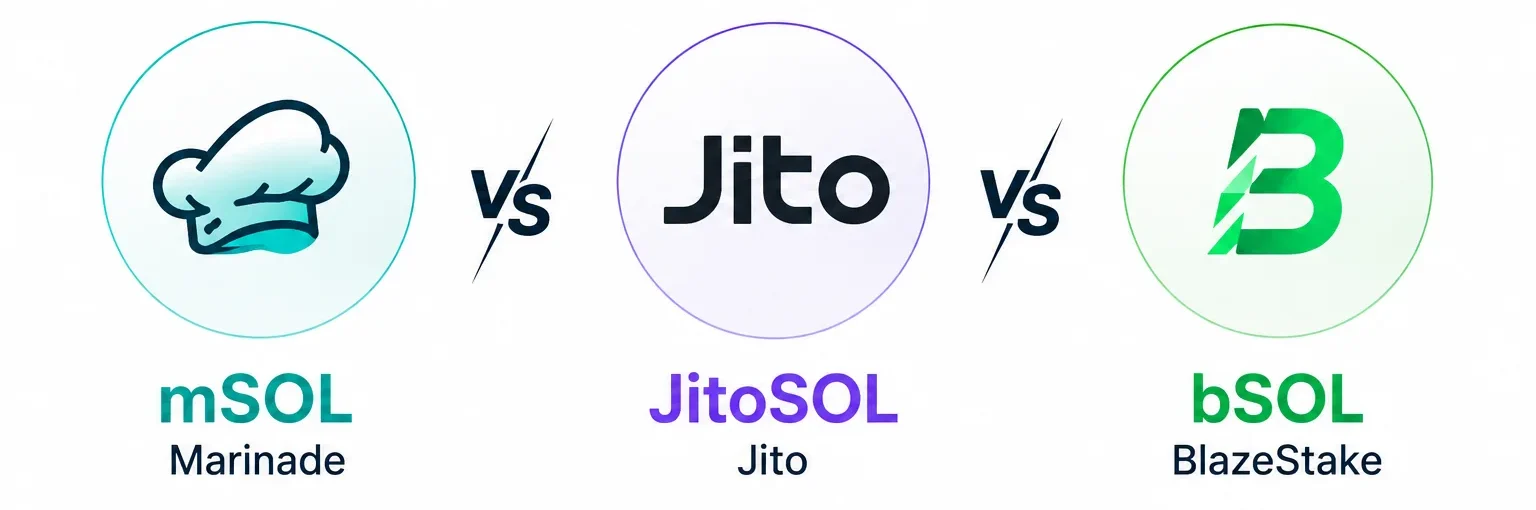
Different trackers have reported mSOL anywhere from roughly 5 percent to 8 percent, and JitoSOL anywhere from under 6 percent to nearly 8.5 percent, so treat any single number as a snapshot rather than a fixed fact.
| Token | Protocol | Key Strength | Validator Set |
|---|---|---|---|
| mSOL | Marinade | Decentralization, longest track record | 100+ validators, algorithmically scored |
| JitoSOL | Jito | MEV capture, deep DeFi liquidity | Concentrated on Jito-Solana client validators |
| bSOL | BlazeStake | Largest validator set, governance incentives | 200+ validators |
The general pattern most trackers agree on is that JitoSOL tends to edge out mSOL on raw yield because it captures MEV tips directly, while mSOL leans harder into validator diversification and has the longer operating history. bSOL spreads across the widest validator set of the three but generally has thinner DeFi integration and shallower liquidity than the other two. None of these differences make one token objectively better. They just suit different priorities.
If yield is the only thing you care about, JitoSOL is usually the starting point for comparison shopping. If you’d rather your stake support a wider, more evenly distributed validator set, mSOL is the more established pick. And if governance participation through a smaller, newer token appeals to you, bSOL’s BLZE incentives are worth a look, though you should weigh that against its comparatively thinner liquidity when it’s time to exit.
If you want a deeper breakdown of how Marinade and Jito specifically differ, our full Marinade vs Jito comparison covers the details.
Marinade Native and Marinade Select
Not everyone wants the LST wrapper, and Marinade offers two alternatives for people who’d rather skip it. Marinade Native delegates your SOL the same way, using the same validator scoring system, but without minting mSOL at all. You get the diversification benefits without any smart contract risk, though you lose the ability to use your position in DeFi.
Marinade Select is aimed at institutions rather than individual stakers. It’s a KYC-gated product built around vetted community validators, designed for funds and custodians who need a more controlled, compliance-friendly setup. It has already crossed 3 million SOL in total value locked, and Marinade has said they expect its yield to eventually match standard staking returns while offering that added layer of vetting.
Between the three products, most everyday holders end up sticking with plain mSOL simply because it gives the widest range of use cases for the smallest amount of extra setup. Marinade Native and Marinade Select solve more specific problems, avoiding smart contract exposure entirely or meeting institutional compliance requirements, and they’re worth knowing about even if they aren’t the right fit for most individual stakers.
Is mSOL Safe
Smart Contract Risk and Audits
Like any liquid staking token, mSOL depends on smart contracts to mint, track, and redeem your position, which adds a layer of risk that plain native staking doesn’t have. Marinade has undergone multiple security audits, and much of its code is open source. Control over the mSOL contract sits with a thirteen-party community multisig that requires six signatures to approve any change, which limits how much power any single party has over the protocol. Neither Marinade nor Jito has recorded a holder loss in their multi-year operating history, which is a meaningful track record in a space where plenty of newer protocols haven’t been tested yet.
It’s worth keeping in mind that no audit removes risk entirely, it just reduces the odds of a specific class of bug slipping through unnoticed. Anyone staking a large amount through mSOL or any other liquid staking token should treat audits as a filter for which protocols are worth considering, not as a guarantee that nothing can ever go wrong.
Depeg Risk
mSOL’s price is designed to only move upward against SOL, but the token you actually trade on the open market can temporarily dip below that underlying value during periods of network congestion or heavy selling pressure. This is called depegging, and it applies to basically every liquid staking token on Solana, not just mSOL. Small, brief gaps are normal and usually correct themselves quickly. A sustained depeg beyond a couple of percentage points, especially alongside falling total value locked or paused withdrawals, is the kind of signal that’s worth paying attention to before adding more exposure.
It’s also worth knowing that depeg risk isn’t unique to mSOL or even to Solana. Any liquid staking token on any chain carries this same structural quirk, since the token’s market price and its underlying redemption value are two separate things that usually track each other closely but aren’t mechanically forced to match at every single moment. Before staking any meaningful amount, it’s worth understanding common Solana scams so you can tell the difference between normal market noise and an actual red flag, and sticking to good habits for keeping your SOL secure regardless of which staking method you choose.
How to Start Liquid Staking Solana

Step 1: Set Up a Wallet
You’ll need a Solana wallet that supports SPL tokens, which covers pretty much every major option. If you’re starting from scratch, our guide on setting up a Phantom wallet covers the basics. Most wallets that already work with SOL will display mSOL correctly without any extra setup once you’ve staked.
Step 2: Fund Your Wallet With SOL
Transfer or buy enough SOL to cover both your staking amount and a small buffer for transaction fees.
Step 3: Connect to Marinade
Head to Marinade’s app and connect your wallet. The interface will show your current SOL balance and the live mSOL exchange rate.
Step 4: Stake Your SOL
Enter the amount you want to stake and confirm the transaction. mSOL will show up in your wallet within moments as a standard SPL token.
Step 5: Put mSOL to Work or Just Hold It
From here it’s up to you. Leave it in your wallet and let the price keep climbing, or move it into lending, liquidity pools, or wherever else fits your strategy. If you’d rather keep things simpler with straightforward native staking instead, our guide on how to stake Solana covers that path, and our breakdown of how Solana validator nodes work is useful background if you’d rather understand what’s happening under the hood before delegating anywhere. Either route gets you exposure to Solana staking rewards, the difference is really just how much flexibility you want along the way.
Liquid Staking Solana FAQ
What exactly is mSOL?
mSOL is the liquid staking token issued by Marinade Finance when you stake SOL through their protocol. It represents your staked position and grows in value against SOL as staking rewards accumulate, and you can trade, lend, or use it in DeFi at any time.
Does mSOL earn rewards automatically?
Yes, but not in the way you might expect. You won’t see separate reward payments land in your wallet. Instead, the exchange rate between mSOL and SOL rises each epoch, so the same amount of mSOL becomes worth more SOL over time.
Is mSOL the same as staking SOL directly?
Not quite. Native staking locks your SOL to a validator and leaves it untouched until you unstake. mSOL represents that same underlying staked SOL, but the token itself is liquid, meaning you can trade or use it while your original SOL stays staked in the background. This distinction is really the whole reason liquid staking Solana exists as a category separate from plain staking.
Can mSOL lose value compared to SOL?
The underlying exchange rate is designed to only move upward, but the market price of mSOL can temporarily trade below that value during periods of network stress, a situation known as depegging. This is usually short-lived and tends to correct itself once conditions normalize.
How long does it take to unstake mSOL?
Instant unstake through a DEX swap takes under a minute but comes with some slippage. Delayed unstake avoids fees entirely but requires waiting for the current epoch to end, typically two to three days.
Is mSOL better than JitoSOL?
Neither is universally better. JitoSOL generally posts a slightly higher yield thanks to MEV capture, while mSOL spreads stake across a more decentralized validator set and has the longer track record. The right choice depends on whether you prioritize yield or decentralization.
What’s the minimum amount needed to get mSOL?
There’s no minimum for staking liquid SOL directly. If you’re depositing an existing stake account instead, it needs to hold at least 1 SOL for Marinade to take it over.
Where can I check mSOL’s current TVL and price?
Live figures for mSOL’s total value locked and exchange rate are tracked on DeFiLlama’s Marinade page, which updates continuously as deposits and withdrawals happen.
Do I need to actively manage mSOL once I have it?
No. Once you hold mSOL, the exchange rate grows on its own every epoch without any action required from you. The only time you need to do anything is if you want to unstake, move it into a DeFi app, or trade it.
Can I use mSOL on other blockchains besides Solana?
mSOL is native to Solana and built as an SPL token, so it lives on Solana by default. Some bridges allow wrapped versions to move to other chains, but the underlying staking mechanism and reward accrual only work on Solana itself.