The number of active Solana validator nodes dropped from 2,560 in 2023 to roughly 770 by March 2026. That decline did not happen because Solana became less popular. It happened because the cost of running a validator node outpaced the revenue most small operators could generate. The primary culprit is vote transaction fees, a protocol-level requirement that costs roughly 1.1 SOL per day regardless of stake level, which translates to approximately $50,000 per year at $130 per SOL. Add bare metal hosting, a mandatory testnet node, and operational labor, and the total annual cost for a new bare metal operation runs between $80,000 and $128,000.
Against that backdrop, the break-even stake sits at approximately 200,000 to 256,000 SOL. The SFDP, the Solana Foundation Delegation Program, provides partial coverage in the first year for new validators and changes the economics considerably for those who qualify. This guide breaks down every cost category, every revenue stream, the hardware the network actually requires in 2026, and an honest answer to whether running a Solana validator node is worth it given the Agave, Firedancer, and Frankendancer client landscape. If you want inflation rewards on your SOL without running your own node, there are simpler alternatives covered at the end.
What Is a Solana Validator Node?
A Solana validator node is a server that participates in the network’s consensus mechanism, voting on the validity of blocks and optionally producing blocks when selected as block leader. Consensus validators do the heavy work of replaying the ledger, submitting votes to a per-node vote account, and helping the rest of the cluster agree on which forks to follow. The rest of the network uses stake-weighted votes to decide block validity.
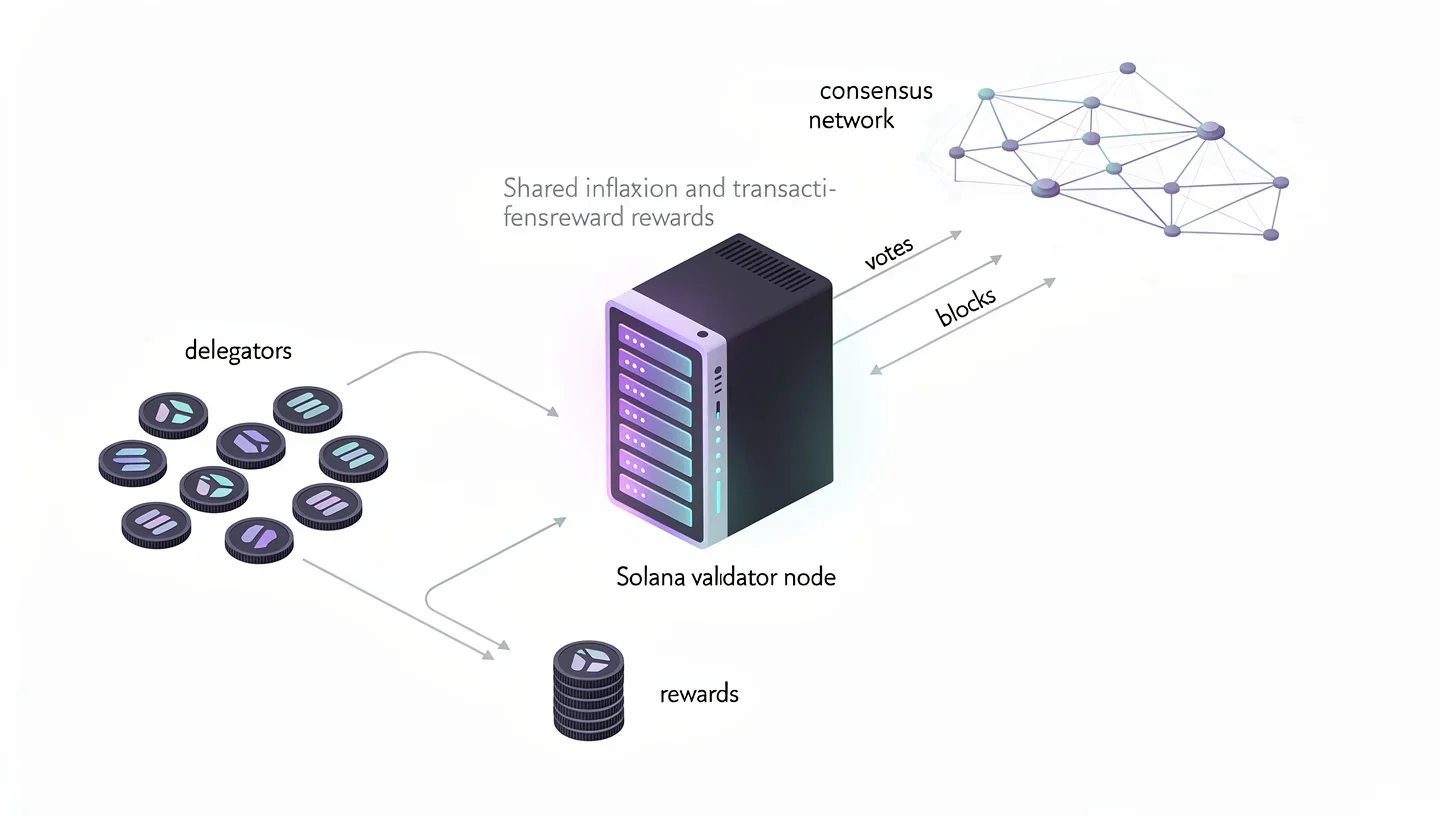
Validators earn inflation rewards proportional to their vote credits and total delegated stake. The commission rate you set determines what percentage of those rewards you keep versus passing on to delegators. Validators also earn a portion of transaction fees when producing blocks as block leader. Running a Solana validator node is distinct from simply delegating SOL to someone else’s validator, which is what most SOL holders do through platforms like Phantom or Solflare.
Solana’s architecture makes it the most hardware-intensive Proof of Stake network to validate. Proof of History, the cryptographic timestamping mechanism at its core, requires sequential hashing that demands strong single-thread CPU performance on top of the high core count that concurrent transaction verification needs. This combination of requirements is what separates Solana’s node hardware from the lighter setups that suffice on Ethereum or Cosmos.
Validator Node vs RPC Node: Key Differences
Two fundamentally different types of nodes run on Solana, and confusing them leads to poor infrastructure decisions. A validator node votes on consensus, earns staking rewards, and requires a funded vote account that pays vote fees on every block. An RPC node does not vote at all. It serves API requests, JSON-RPC queries, and transaction submissions from wallets and applications.
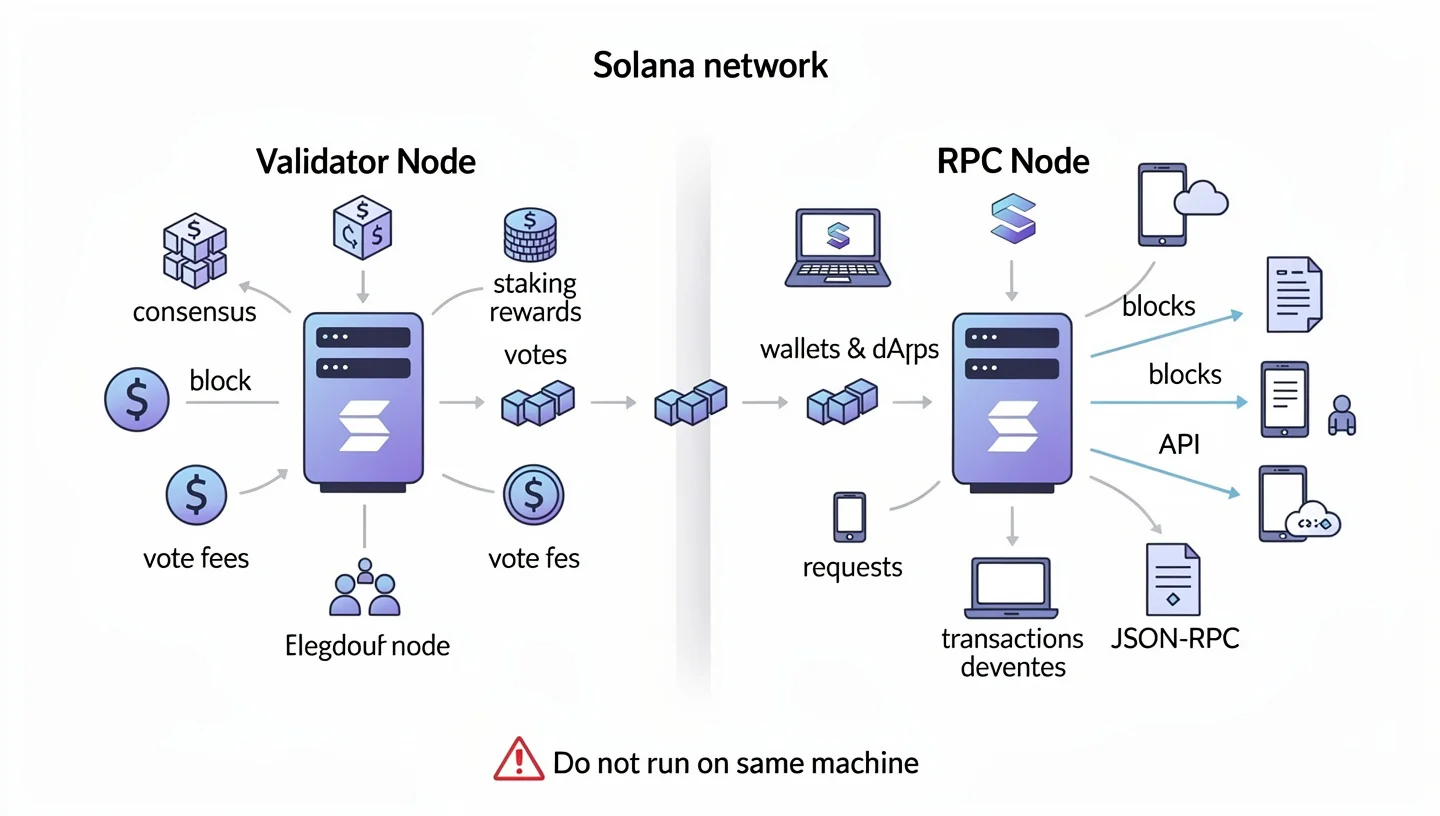
It does not earn staking rewards, but it also pays no vote fees, which makes its economics entirely different.
| Feature | Validator Node | RPC Node |
|---|---|---|
| Consensus role | Yes, votes on every block | No |
| Vote fees | ~$50,000/year at $130 SOL | None |
| Staking rewards | Yes (commission on delegated stake) | No |
| Revenue model | Inflation rewards + MEV tips + block leader fees | API access fees from customers |
| Storage requirement | 2-4 TB NVMe for active ledger | 10+ TB for full archive |
| Who typically runs it | Validators, staking providers | dApp developers, infrastructure providers |
Never run RPC and validator workloads on the same machine. RPC query loads interfere with the time-sensitive consensus operations a validator needs to complete. The latency introduced by handling API calls on the same hardware that processes votes directly increases your skip rate and costs you vote credits. For teams that need RPC access, managed providers like QuickNode and Alchemy serve that function separately at a predictable monthly fee.
To understand what Proof of History actually does and why it puts such specific demands on validator hardware, our guide on Solana Proof of History covers the mechanism in full.
Solana Validator Hardware Requirements 2026
Three developments raised the hardware bar entering 2026. Firedancer’s tile-based architecture went live on mainnet and requires AVX-512 instruction support. SIMD-0256 raised compute-unit limits to 60 million or more per block, with SIMD-0286 potentially pushing that to 100 million. And NVMe Gen5 drives became price-competitive with Gen4, shifting the benchmark for storage performance upward. Running 2024-era hardware in 2026 is not a stable configuration for mainnet validators trying to meet SFDP performance thresholds.
| Component | Minimum | Recommended (Agave) | Firedancer Requirement |
|---|---|---|---|
| CPU | 12-core/24-thread, 2.8GHz, AVX2 | AMD EPYC 9354, 24-core, 3.5GHz+ | AMD EPYC 9354+, AVX-512 |
| RAM | 256GB ECC | 256-512GB ECC | 384-512GB ECC |
| Storage | 2TB NVMe Gen4 | Split NVMe (ledger/accounts/OS) | NVMe Gen4+ (Gen5 preferred) |
| Network | 1Gbps symmetric | 10Gbps symmetric | 10Gbps symmetric |
| Power draw | 200-250W | 350-450W under load | 350-450W under load |
The community maintains a hardware compatibility list at solanahcl.org, updated automatically from operator-submitted benchmark data. Before purchasing hardware, check that list for the current most-deployed configurations rather than relying on spec sheets alone. Hardware that passes synthetic benchmarks may still underperform in practice under Solana’s combined vote, ledger, and gossip workloads.
CPU: Why Single-Thread Speed Matters
The AMD EPYC 9354 family dominates the Solana hardware compatibility list because it balances strong single-thread performance at 3.5GHz base with the 24-core count that concurrent transaction verification requires. Both dimensions matter. High per-core clock speed reduces vote latency, which is the primary performance metric for consensus validators. More cores handle the parallel workloads that Firedancer’s tile-based architecture specifically rewards.
Dual-socket configurations are actively counterproductive for Solana. The NUMA latency introduced by dual-socket memory access patterns slows memory lookups in ways that single-thread-heavy workloads like Proof of History hashing cannot tolerate. Solana operators run single-socket configurations by convention, not preference. AMD Threadripper PRO is a competitive alternative for operators not needing data center form factors.
The minimum viable CPU is a 12-core/24-thread processor at 2.8GHz with AVX2 support. Anything below this will struggle to meet vote deadlines at full network load. For Firedancer, AVX-512 is mandatory, not optional. Attempting to run Firedancer on a processor without AVX-512 will not work.
RAM and Storage: Where Validators Fail
256GB ECC RAM is the practical minimum for an Agave mainnet validator. The ECC requirement is real: uncorrected memory errors on a validator cause ledger corruption that takes the node offline. As Solana’s state grows, the in-memory account cache pressure increases. Operators who started with 256GB in 2024 are adding capacity in 2026 to maintain headroom. Provisioning a motherboard with capacity for 512GB RAM even if you start with 256GB avoids a full server replacement later.
Storage must be split across dedicated drives. The ledger disk holds block data and should be a high-endurance NVMe of at least 2TB. The accounts disk holds the on-chain account state and gets the highest IOPS workload. The OS disk runs the operating system and Agave software and can be a modest SSD. Never put the ledger and accounts on the same drive. The concurrent read/write patterns for these two workloads compete directly if collocated and will consistently degrade validator performance below SFDP thresholds.
Agave, Firedancer, and Frankendancer: Which Client to Use
Agave, developed by Anza Labs, is the stable default. It is written in Rust, widely deployed, and has the most operator experience and community documentation behind it. Most new validators start with Agave.
Firedancer, developed by Jump Crypto, is a complete C-language rewrite of the validator software with a tile-based parallel architecture that extracts significantly more performance from modern multi-core hardware. Firedancer validators show 15 to 28 basis point skip rate improvements versus comparable Agave deployments. As of mid-2026, Firedancer is live on mainnet and increasingly deployed by operators who need that skip rate margin to stay above SFDP thresholds. The hardware requirement is higher: AVX-512 and 384 to 512GB RAM minimum.
Frankendancer is a hybrid, combining the Firedancer frontend network stack with the Agave execution backend. It offers part of Firedancer’s networking performance improvement while retaining Agave compatibility for the execution layer. Frankendancer is the transition path for operators who want Firedancer-grade network performance but are not ready to migrate the full execution stack. If you run Jito-Solana on mainnet, you must also run Jito on testnet as of May 2026.
The Agave documentation recommends Ubuntu 24.04 as the official build target and explicitly states that Docker is not recommended for live clusters and that cloud deployments require significantly greater operational expertise.
Bare Metal vs Cloud vs Colocation: Real Cost Comparison
Bare metal is the standard for competitive mainnet validators. Direct-attached NVMe eliminates virtualization overhead, there are no noisy-neighbor IOPS limits, and monthly costs run $800 to $1,400 for well-specified production hardware. The major providers that explicitly permit cryptocurrency validator workloads in their terms of service include Latitude, Hivelocity, Teraswitch, and Cherry Servers.
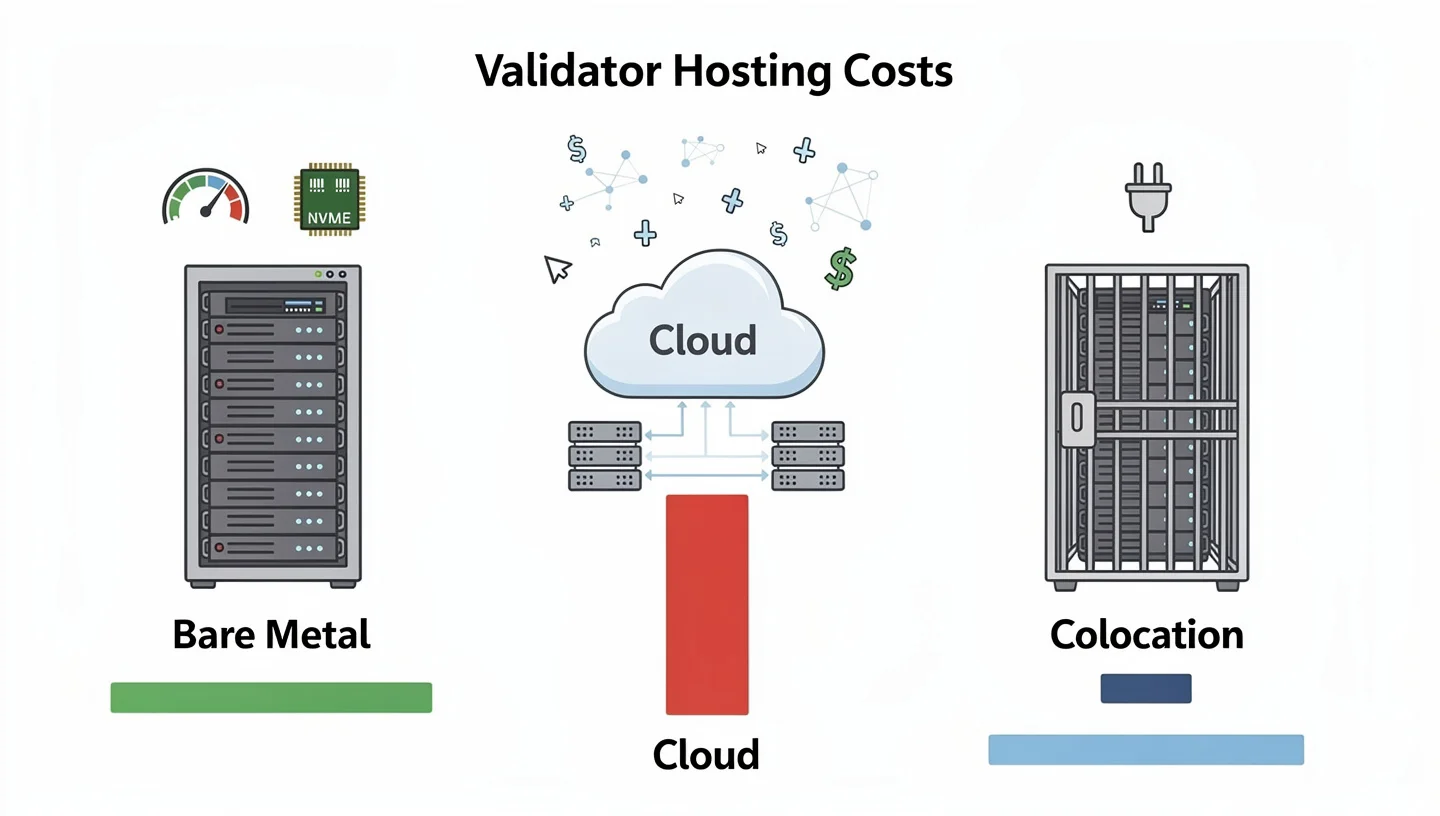
Cloud hosting is not competitive for mainnet validators. The problem is not just instance cost. Egress fees on AWS for Solana’s gossip protocol and turbine shred distribution generate 2 to 5TB of outbound bandwidth per month. At AWS egress rates, that adds $180 to $450 per month on top of instance costs, which are already higher than bare metal for equivalent specs. Cloud ends up 2.5 to 3x more expensive than bare metal for the same configuration, with worse performance due to virtualized storage and noisy-neighbor IOPS variability.
| Configuration | Bare Metal (Annual) | Cloud AWS (Annual) | Colocation (Annual, amortized) |
|---|---|---|---|
| Entry-level (24-core EPYC) | $9,600-$12,000 | $24,000-$36,000 | $5,000-$8,000 |
| Production (32-core EPYC, 512GB RAM) | $12,000-$16,800 | $36,000-$54,000 | $8,000-$11,000 |
Colocation provides the best performance-to-cost ratio for operators running multiple validators over a multi-year horizon. You own the physical hardware, the data center provides power, cooling, and uplinks, and the monthly fee covers space and connectivity rather than compute time. Server hardware amortized over three years at $8,000 to $15,000 plus $200 to $500 per month in colocation fees puts total annual cost at $5,000 to $11,000, substantially below bare metal rental. The upfront capital requirement and the logistical overhead of managing physical hardware are the main barriers.
ASN and Data Center Concentration Limits After May 2026
The May 2026 SFDP update introduced two concentration limits that directly affect provider selection. First, SFDP participants must operate on an Autonomous System Number holding less than 25% of network stake. Second, the data center itself must represent less than 15% of network stake. Both limits enforce geographic and infrastructure decentralization at the delegation program level.
The practical implication: Hetzner and OVH have historically breached the ASN concentration threshold at various points. Validators on those providers risk losing Foundation delegation when the threshold is exceeded, without necessarily receiving advance warning. The SFDP applies a seniority score, and when a data center becomes over-concentrated, Foundation delegation is removed from the newest participants first. New validators are the most exposed to this risk.
Always check current ASN concentration at validators.app before committing to a provider. The 25% limit applies to the ASN level, not the individual provider’s total hosting capacity. A provider can be under the limit now and breach it later as more validators migrate there. Monthly rechecks during early operation are a reasonable precaution.
To understand how Solana transaction fees work at the protocol level, which matters when calculating your expected block leader revenue, our guide on Solana transaction fees covers the base fee, priority fee, and burn model in full.
Solana Validator Node Costs: The Full Breakdown
The complete annual cost for a new bare metal Solana validator node operation in 2026 runs between $80,000 and $128,000. That range is wide because operational labor varies significantly based on automation level and team structure. The fixed floor does not vary: vote transaction fees alone account for approximately $50,000 of that total at current SOL prices, regardless of stake level or operational efficiency.
| Cost Category | Annual Cost | Notes |
|---|---|---|
| Vote transaction fees | ~$50,000-$52,000 | Fixed floor, protocol-level, cannot be reduced |
| Mainnet bare metal hosting | $9,600-$16,800 | Latitude, Hivelocity, Teraswitch |
| Testnet node (mandatory for SFDP) | $2,400-$4,800 | Must mirror mainnet client choice |
| Operational labor | $18,000-$54,000 | 15-30 hours/month at market DevOps rates |
| Total (new bare metal operator) | $80,000-$127,600 | Break-even: ~200,000-256,000 SOL delegated |
The validator count dropping from 2,560 in 2023 to around 770 in early 2026 is directly traceable to this cost structure. Most of the validators who shut down were operating with under 100,000 SOL in total stake, less than half of what is needed to cover costs. They were paying vote fees every day with insufficient rewards coming in to offset them.
Vote Transaction Fees: The Unavoidable $50K Floor
Solana’s consensus mechanism requires every active validator to submit a vote transaction for every block it agrees with. At 432,000 slots per epoch and 0.000005 SOL per vote, the math works out to 2.16 SOL per epoch. With approximately 180 epochs per year, annual vote costs run 389 to 400 SOL per year. At $130 per SOL, that is $50,000 to $52,000 per year in vote fees alone, paid continuously regardless of your stake level, regardless of market conditions, regardless of whether your validator is earning enough to cover them.
This is the structural reality that makes the Solana validator node cost structure unique among major proof-of-stake chains. Ethereum validators pay no per-block vote fees. Cosmos Hub validators pay no mandatory per-block fees. Solana validators pay a large, fixed, SOL-denominated operating expense that runs every single day. At $1 SOL this cost would be negligible. At $130 SOL it becomes the dominant line item in the budget.
The vote fee is a protocol-level requirement, not a configurable cost. It cannot be reduced through operational efficiency. The only ways to offset it are earning enough commission revenue, benefiting from SFDP vote cost coverage during the first year, or not running a validator at all.
Vote Account Management and Silent Failure Risk
The vote account must maintain a sufficient SOL balance to fund ongoing vote transactions. Best practice is to maintain a 0.5 to 1 SOL buffer in the vote account at all times and automate top-ups from the identity account. This is not optional maintenance. It is a critical operational requirement.
If the vote account balance depletes to zero, the validator stops voting immediately. This is a silent failure in the sense that the node continues running and appears healthy from a process perspective, but it earns zero vote credits and generates no rewards. If this persists across an epoch, vote credits for that epoch drop to zero. If the shortfall pushes cumulative credits below the SFDP’s 97% threshold, Foundation delegation removal can follow. A validator that misses this because it lacks automated monitoring can lose weeks of rewards and SFDP standing before anyone notices.
Monitor vote account balance as a first-class metric. Set an alert at 0.5 SOL and trigger automated top-ups from the validator’s identity account well before the balance hits zero.
Testnet Node, Labor, and Hidden Costs
SFDP requires a testnet node meeting baseline performance criteria in at least 5 of the last 10 testnet epochs. This doubles the minimum infrastructure footprint. The testnet node runs at lower spec than mainnet, typically a 12 to 16-core CPU, 128GB RAM, and 1TB NVMe, but it requires the same operational attention: software updates, monitoring, skip rate tracking, and on-call response for cluster incidents.
The mandatory testnet node adds $2,400 to $4,800 per year in hosting costs. Beyond hosting, operational labor is the most variable and most frequently underestimated cost category. Solana releases software updates frequently, and SFDP requires validators to be on the minimum supported version within 48 hours of each release. Cluster incidents requiring operator response happen two to three times per month on average. Vote account balance monitoring, disk management, performance tracking, and governance participation add further time. Realistic estimates for a self-operated single validator run 15 to 30 hours per month, which at market DevOps engineer rates translates to $18,000 to $54,000 per year in labor costs alone.
How Solana Validators Earn Money
Costs only tell half of the picture. Validators have three revenue streams, and understanding the realistic yield from each at different stake levels is what determines whether a specific operation is viable.
Inflation Rewards: The Math Behind Commission
Solana currently runs a 4.7% to 5% annual inflation rate, decreasing 15% per year from an original 8%. Inflation rewards are distributed proportionally to stake-weighted vote credits at the end of each epoch. At 5% commission rate and 4.8% inflation, the annual commission revenue formula is:
Annual commission = Total stake (SOL) × 4.8% × 5% = Total stake × 0.24%
At $130 per SOL, the revenue at different stake levels works out approximately as follows. A validator with 50,000 SOL in total stake earns roughly 120 SOL per year, or about $15,600. At 100,000 SOL, the figure is 240 SOL, or about $31,200. At 500,000 SOL, it climbs to 1,200 SOL, or roughly $156,000. The math explains immediately why validators below 200,000 SOL are operating at a loss relative to the $50,000 vote fee floor alone, before adding hosting and labor.
Block leader rewards add to this when a validator is selected as the block producer for a given slot. Validators receive 50% of all transaction fees from blocks they produce. The other 50% is burned. Block leader revenue scales with stake weight, since more delegated stake means more leader slots, and with network activity, since more transactions per block means more fees per slot. This stream is variable and harder to project, but adds meaningful income for validators with large stake during high-activity periods.
Our guide on Solana staking rewards covers the epoch reward calculation, inflation schedule, and what delegators actually receive after commission in more detail.
Jito MEV Tips: The Variable Revenue Layer
Over 90% of active Solana validators run the Jito-Solana client, which allows MEV searchers to submit transaction bundles with tip payments to validators. Jito MEV has grown from negligible to a meaningful revenue component, typically adding the equivalent of 1% to 1.5% APY on top of base staking yield. During high-activity periods, such as major memecoin launches or large liquidation cascades across DeFi, MEV can represent 15% to 25% of total validator rewards for that epoch.
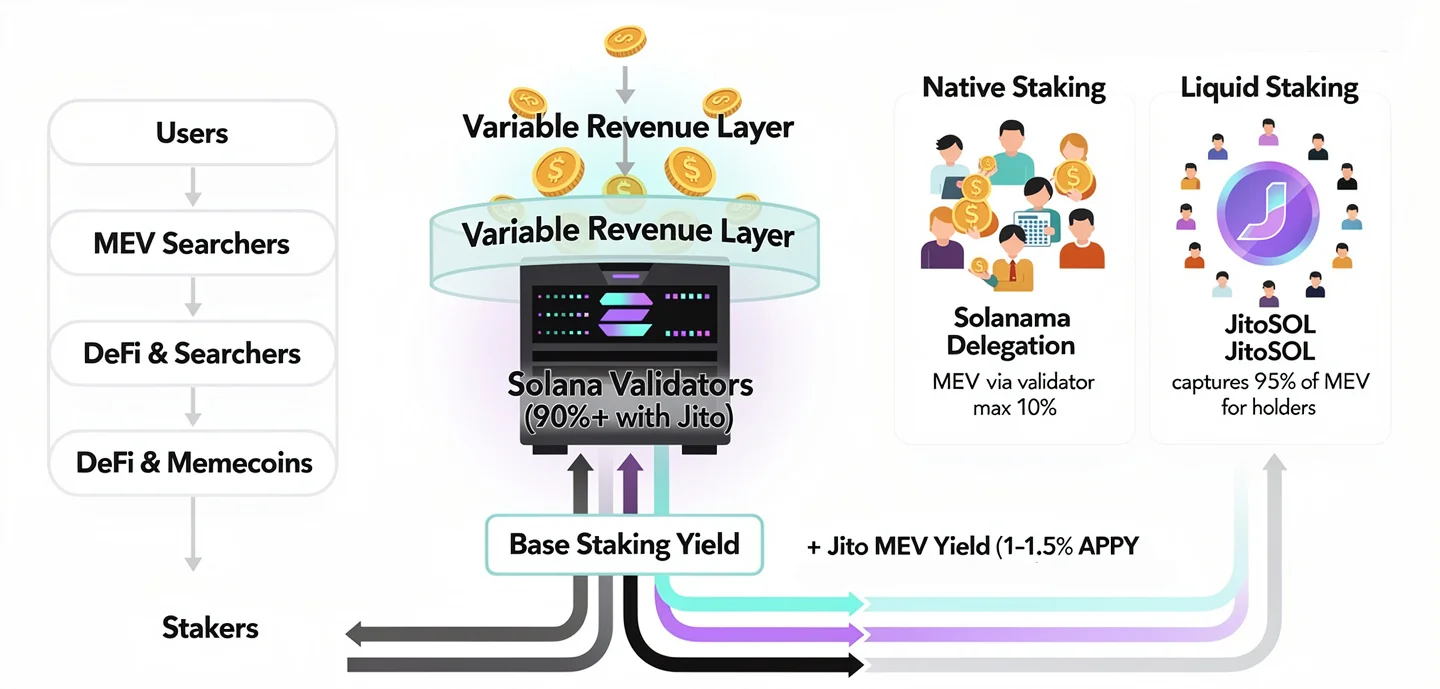
The Jito network dashboard tracks aggregate MEV tips and per-validator share data in real time, updated per epoch. Under current SFDP rules, validators running Jito on mainnet must also run Jito on testnet, and the maximum Jito MEV commission allowed under the program is 10%. Bundle tips are distributed proportionally to the validator’s Jito commission setting rather than flowing through the standard inflation reward calculation.
For holders who want MEV-boosted yield on their SOL without running their own node, liquid staking tokens like JitoSOL capture 95% of this MEV revenue and pass it to token holders. Our comparison at Marinade vs Jito covers the difference between liquid staking and native validator delegation in detail.
SFDP: How the Solana Foundation Delegation Program Works
The Solana Foundation Delegation Program is what makes the economics viable for new validators who do not yet have sufficient community delegation to cover costs independently. It operates through two main mechanisms: vote cost coverage and stake matching.
On vote cost coverage, new SFDP participants receive support on a tapering schedule. The program covers 100% of vote transaction fees in months 1 to 3, 75% in months 4 to 6, 50% in months 7 to 9, and 25% in months 10 to 12. After 12 months, coverage drops to zero. At current SOL prices, the total first-year SFDP subsidy is approximately $31,250 in vote fee coverage. The 12-month window is designed as a runway: new validators use it to attract community delegation before self-funding vote costs becomes mandatory.
On stake matching, SFDP provides Foundation delegation at a ratio relative to external community stake. Currently trending toward 0.5:1 with a cap of around 50,000 SOL of Foundation stake. A validator with 20,000 SOL in community delegation receives approximately 10,000 SOL of Foundation stake, increasing total stake to 30,000 SOL and proportionally increasing commission revenue. The tapering schedule creates a clear financial cliff at month 13. Validators that use the first year to build to 150,000 to 200,000 SOL in total stake can approach break-even. Validators that reach month 13 with 20,000 SOL in community stake face an immediate and steep revenue drop.
SFDP eligibility requires maintaining at least 97% of the cluster’s average vote credits per epoch on mainnet, running a testnet node meeting the 85% threshold for at least 5 of the last 10 epochs, keeping commission at or below 5%, and operating on providers that meet the ASN concentration and data center concentration limits. The May 2026 update added the requirement that validators running Jito on mainnet must also run it on testnet.
To understand the full delegation process including how to attract community stake to your validator, our guide on how to stake Solana covers the delegator perspective and what delegators look for when choosing validators.
Break-Even Stake and ROI by Stake Level
The break-even stake calculation is the most important number for evaluating whether a Solana validator operation makes financial sense. It is the total delegated SOL required for commission revenue to exceed annual operating costs.
Using $80,000 in annual costs, 5% commission, and 4.8% inflation, and running Agave without MEV, the break-even stake works out to approximately 256,000 SOL. At $130 per SOL, that represents roughly $33 million in delegated stake. Running Jito-Solana with MEV adding approximately 1% APY equivalent improves this to around 212,000 SOL, or about $27.6 million. These numbers explain the validator count decline. The majority of operators who shut down were running with under 100,000 SOL of total stake, less than half of break-even.
| Stake Level | Annual Revenue (est.) | Annual Cost | Net Position | Verdict |
|---|---|---|---|---|
| Under 100,000 SOL | ~$31,000 | $80,000+ | -$49,000+ | Loss without SFDP |
| 100,000-200,000 SOL | ~$31,000-$62,000 | $80,000 | Near break-even (with Jito) | Marginal with MEV |
| 200,000-500,000 SOL | ~$62,000-$156,000 | $80,000-$90,000 | Positive | Profitable territory |
| 500,000+ SOL | $156,000+ | $90,000-$100,000 | Strongly positive | Highly profitable |
Under 100,000 SOL: Operating at a Loss
Running a validator with under 100,000 SOL in total delegated stake means operating at a loss in the absence of SFDP vote cost coverage. Commission revenue at this stake level cannot cover the $50,000 vote fee floor, let alone hosting and labor. This is not a temporary shortcoming that better operations can fix. It is a mathematical reality of the fee structure.
The only viable path at this stake level is the SFDP 12-month runway. Use SFDP support in year one to build toward 150,000 to 200,000 SOL in total stake by month 12. Operators who launch without a clear plan for attracting community delegation during that window typically exit within 18 months after the vote cost subsidy stops and the revenue shortfall becomes unmanageable.
200,000 to 500,000 SOL: The Profitable Zone
At 200,000 to 500,000 SOL in total delegated stake, commission revenue from inflation plus MEV tips exceeds fixed costs and the operation generates net positive SOL each epoch. This is where the business case for running a validator becomes clear. The fixed costs spread across a larger stake base while revenue scales roughly linearly with additional delegation.
Above 500,000 SOL, the operation becomes highly profitable in the way that major institutional validators like Coinbase, Figment, and Everstake operate. Their fixed cost base is similar to any other operator but their stake is orders of magnitude larger. The marginal cost of additional stake is close to zero while revenue increases proportionally. This explains why the validator landscape is bifurcating into a small number of large profitable validators and a smaller number of smaller operators on SFDP support.
How to Set Up a Solana Validator Node: Step by Step
The setup process below covers the core steps from hardware provisioning to testnet participation. Running on testnet first before migrating to mainnet is not optional for SFDP participants. It is also operationally sensible: testnet gives you a low-stakes environment to identify hardware issues, skip rate problems, and configuration errors before they cost real vote fees on mainnet.
Step 1: Provision Your Hardware and Network
Select a bare metal provider from the options that permit cryptocurrency validator workloads: Latitude, Hivelocity, Teraswitch, or Cherry Servers are the commonly used options. Confirm the provider’s ASN concentration is below 25% at validators.app before ordering. Select a server matching at minimum the Agave recommended specification: single-socket AMD EPYC with 24 or more cores at 3.5GHz or above, 256GB ECC RAM, split NVMe storage, and a 10Gbps uplink. Install Ubuntu 24.04, the official build target for Agave. Configure the split NVMe mount points for ledger, accounts, and OS separately before installing any validator software.
Step 2: Generate Keypairs and Create Your Vote Account
A validator requires two primary keypairs. The identity keypair identifies your validator on the network and signs votes. The vote account keypair is the account that receives vote credits and commission. Generate both using the Solana CLI:
solana-keygen new -o ~/validator-keypair.json
solana-keygen new -o ~/vote-account-keypair.json
Set a separate withdraw authority keypair that controls fund withdrawal from the vote account. Keep the withdraw authority on an air-gapped device separate from the server. Fund the vote account with at least 1 SOL to start, keeping the recommended 0.5 to 1 SOL buffer for ongoing vote fees.
Step 3: Start on Testnet and Validate Performance
Install Agave using agave-install update and configure the validator to connect to testnet first. Run the node for at least 5 to 10 epochs before considering mainnet migration. During this period, monitor your skip rate against the cluster average and verify that vote credits per epoch consistently meet the SFDP baseline of 85% of cluster average. Use solana validators --output json to pull per-validator performance data. Fix any hardware or configuration issues that show up in skip rate or vote credit data before moving to mainnet, where every missed vote has a real cost.
Step 4: Migrate to Mainnet and Apply for SFDP
Once testnet performance is stable, migrate to mainnet-beta. Fund the mainnet vote account, configure the same client (Agave, Firedancer, or Frankendancer) that you ran on testnet, and set commission to 5% or below for SFDP eligibility. Apply for SFDP at the Solana Foundation’s current application process, which requires a minimum period of testnet operation meeting the baseline criteria. If you plan to run Jito-Solana on mainnet, configure Jito on testnet before applying, as the May 2026 update made this a SFDP requirement. Monitor your vote account balance daily and set up automated top-up scripts before your mainnet node goes live.
Monitoring Your Solana Validator Node
Monitoring is not a secondary concern for a Solana validator node. It is a core operational requirement. Three metrics drive the most critical operational decisions: skip rate, vote credits, and vote account balance.
Skip rate measures the proportion of slots your validator was assigned as leader but did not produce a block. A skip rate at the cluster average is baseline acceptable. SFDP will remove Foundation delegation if your skip rate exceeds the cluster average by more than 3%. Set an alert at cluster average plus 3% and investigate hardware, network, or software causes immediately when it fires.
Vote credits per epoch determine your SFDP standing. The mainnet requirement is 97% of the cluster average. Missing that threshold for a single epoch is a yellow flag. Missing it for multiple consecutive epochs puts you at risk of Foundation delegation removal. Track vote credits at Solana Compass, which provides per-validator epoch breakdowns.
Vote account balance monitoring needs an automated alert at 0.5 SOL and an automated top-up trigger before it hits zero. A zero-balance vote account is a silent failure that stops earning vote credits while the node appears to be running normally. This is one of the most common and most avoidable causes of unexpected revenue loss for new validators.
Disk management deserves its own monitoring track. Solana’s ledger grows continuously. Without regular pruning of old ledger data to the configured retention window, disks fill and the validator crashes. Set a disk space alert at 80% utilization and automate ledger cleanup as part of the routine maintenance cycle.
Our guide on how to store SOL long term covers the hardware wallet and cold storage setup for the withdraw authority keypair, which should be kept offline and separate from the validator server itself.
Is Running a Solana Validator Worth It? Who It Makes Sense For
The honest answer is that running a Solana validator node makes sense for a narrower group of operators in 2026 than it did in 2022. The cost structure rewards scale and punishes undercapitalization severely.
- Makes sense if you have a clear path to 200,000 SOL or more in total delegated stake within 24 months, you have existing DevOps team capacity to absorb operational labor without paying full market rates, you are an institutional entity where running your own node provides compliance, custody, or governance advantages beyond the pure financial return, or you are committed to the 12-month SFDP runway with a specific stake growth plan behind it.
- Does not make sense if you have under 100,000 SOL in expected total stake, no path to growing beyond that, and no SFDP support lined up. You will pay $50,000+ per year in vote fees while earning a fraction of that in commission. The same SOL delegated to a liquid staking protocol like Marinade or Jito earns 7% to 9% APY with zero operational overhead.
Managed Node vs Self-Hosted: The Alternative Path
For institutions that want native staking rewards without the full operational burden, managed node providers like Everstake and Figment offer validator-as-a-service. You provide the stake and they operate the hardware, manage software updates, handle monitoring, and maintain SFDP compliance on your behalf. This is a higher-cost model than self-hosted operation but eliminates the labor component and the operational risk of a team that has not run validators before.
For most retail SOL holders, the practical alternative to running your own node is liquid staking through Marinade or Jito. You deposit SOL, receive mSOL or JitoSOL in return, earn 7% to 9% APY including MEV, and keep your position fully liquid without any operational requirements. The yield is slightly lower than what a well-run validator earns at scale, but the difference is not large enough to justify the operational complexity and capital requirements for most holders.
If you want to get SOL to delegate or stake through any of these routes, our guide on how to buy Solana covers every purchase method available before you decide which staking model to use.
Solana Validator Node vs Ethereum and Cosmos: Cost Comparison
Putting Solana’s validator cost in context against other major proof-of-stake chains makes the structural difference clear.
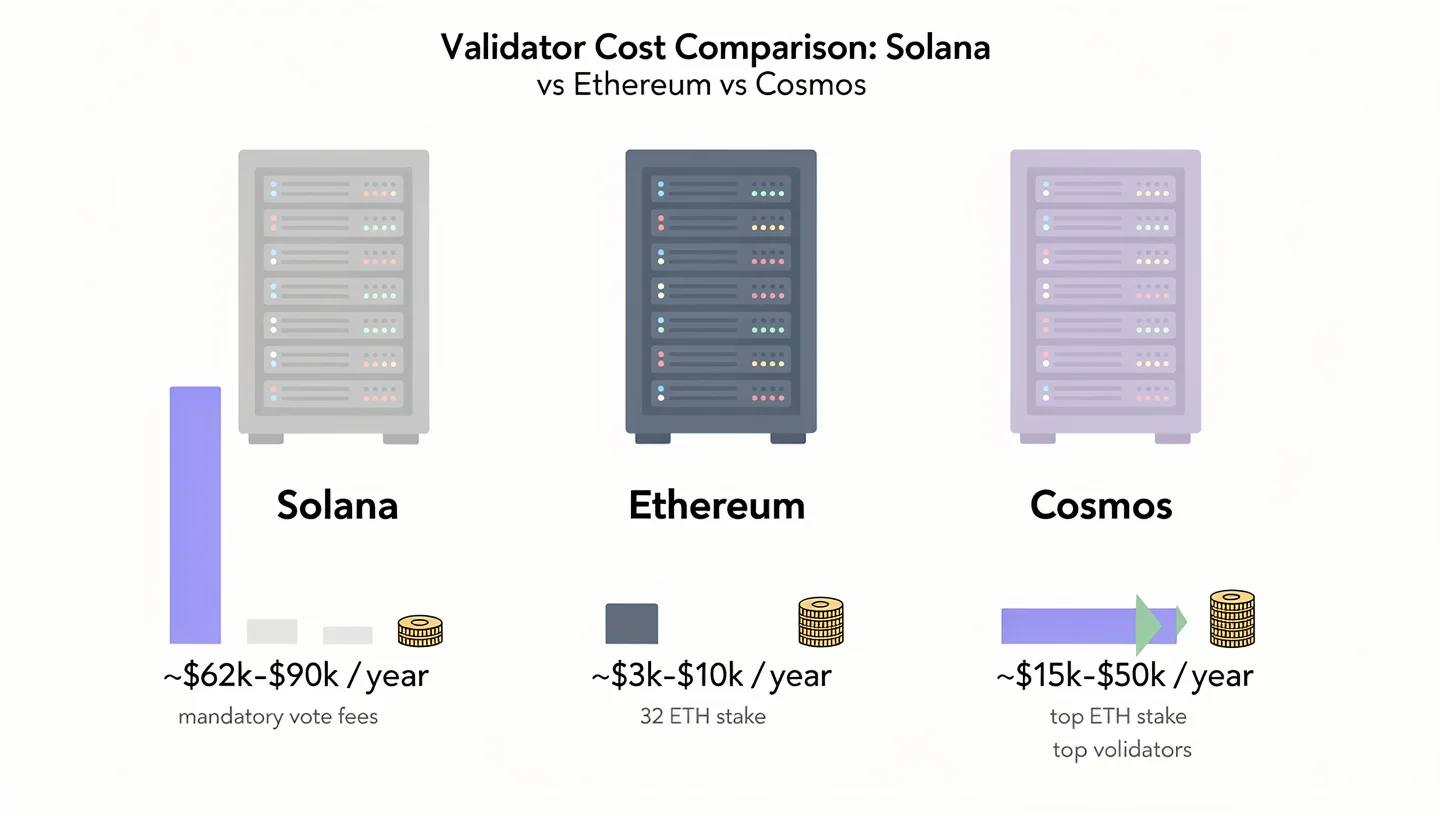
| Chain | Annual Cost | Mandatory Vote Fees | Minimum Stake |
|---|---|---|---|
| Solana | $62,000-$90,000+ | Yes (~$50,000/year at $130 SOL) | No fixed minimum, break-even ~200,000 SOL |
| Ethereum | $3,000-$10,000 | No | 32 ETH per validator key |
| Cosmos Hub | $15,000-$50,000 | No | No fixed minimum, competitive top 175 |
An Ethereum validator running on consumer hardware at home costs $3,000 to $10,000 per year with no mandatory per-block fees. A Cosmos validator runs $15,000 to $50,000 per year. Solana’s $62,000 to $90,000 minimum is 8 to 15 times higher than Ethereum and 3 to 6 times higher than Cosmos, almost entirely because of the vote transaction fee floor. This comparison is why Solana’s validator count is structurally lower than Ethereum’s despite comparable or higher network usage, and why SFDP exists in the first place.
Solana Validator Node: FAQs
How Much Does It Cost to Run a Solana Validator in 2026?
Running a production Solana validator on bare metal costs approximately $80,000 to $128,000 per year in 2026. The breakdown is roughly $50,000 in mandatory vote fees, $9,600 to $16,800 in mainnet bare metal hosting, $2,400 to $4,800 for the testnet node required by SFDP, and $18,000 to $54,000 in operational labor. The vote fee floor cannot be reduced regardless of how efficiently you run the rest of the operation.
How Much SOL Do I Need to Run a Validator?
There is no protocol-enforced minimum SOL requirement to run a validator. In practice, the relevant number is the amount you need to break even. With $80,000 in annual costs, 5% commission, and no MEV, the break-even stake sits at approximately 256,000 SOL. Running Jito-Solana improves this to around 212,000 SOL. Validators operating below 100,000 SOL in total stake are structurally unprofitable without SFDP vote cost coverage.
What Is the Break-Even Stake for a Solana Validator?
The break-even stake at current parameters is approximately 200,000 to 256,000 SOL in total delegated stake, depending on whether you run Jito-Solana for MEV revenue. At $130 per SOL, the lower figure represents roughly $27.6 million in delegated stake. Adding Jito MEV tips to the revenue side improves the break-even threshold meaningfully because MEV adds approximately 1% APY equivalent on top of base inflation rewards.
What Is SFDP and How Does It Work?
SFDP, the Solana Foundation Delegation Program, provides two forms of support to new validators. First, it covers vote transaction fees on a tapering schedule: 100% in months 1 to 3, declining to zero by month 12. The total first-year subsidy is approximately $31,250 at current SOL prices. Second, it matches community delegation with Foundation stake at approximately 0.5:1 with a 50,000 SOL cap. Eligibility requires meeting the 97% vote credit threshold, running a compliant testnet node, and operating on providers that meet the ASN and data center concentration limits.
What Is the Difference Between a Validator and an RPC Node?
A validator node participates in consensus by voting on every block, paying vote fees, and earning staking rewards proportional to delegated stake and commission. An RPC node does not participate in consensus at all. It serves API requests from wallets and applications, earns revenue through API access fees, and pays no vote fees. Never run both on the same machine, as RPC query loads interfere with the latency-sensitive operations a validator needs to complete on time.
Is Running a Solana Validator Profitable?
Profitability depends almost entirely on total stake. Below 100,000 SOL, validators operate at a structural loss without SFDP coverage. At 100,000 to 200,000 SOL, operations approach break-even with Jito MEV and tight cost control. Above 200,000 SOL with Jito MEV enabled and efficient infrastructure, a validator generates positive net SOL each epoch. Above 500,000 SOL, the operation is highly profitable because fixed costs are spread across a large delegation base while revenue scales with stake.
Why Did the Number of Solana Validators Drop?
The validator count fell from 2,560 in 2023 to approximately 770 by early 2026. The cause is the cost structure, specifically the vote fee floor. Operators who launched without understanding that vote fees alone cost $50,000 per year at current SOL prices found themselves paying hundreds of SOL in fees per month while earning insufficient rewards to cover them. When SFDP support ended at month 12 for operators who had not built sufficient stake, the economics became untenable and they shut down.
Can I Run a Solana Validator at Home?
Running a production mainnet validator from a home connection is not viable for most users. The core problem is bandwidth symmetry. Solana validators need a sustained 10Gbps symmetric connection for gossip protocol and turbine shred distribution. Consumer broadband with asymmetric bandwidth, where download speed significantly exceeds upload, cannot maintain the upstream capacity a validator needs during peak network activity. The result is increased skip rate and missed vote credits. Home setups are appropriate for devnet and testnet learning, not for mainnet operations with real stake and real vote fees on the line.