Choosing between Marinade, Jito, and Coinbase for staking SOL comes down to a simple trade-off. Jito pays more through MEV rewards but concentrates stake on a narrower set of validators. Marinade pays slightly less but spreads stake across hundreds of validators and carries the longest track record on Solana. Coinbase pays the least but asks the least of you, with no wallet setup and no liquid staking token to manage. None of these is wrong. Each fits a different type of holder. This guide breaks down mSOL versus JitoSOL versus custodial Coinbase staking on fees, yield, validator risk, and DeFi access, with a separate look at Sanctum as a fourth option worth knowing about.
What Is Liquid Staking and Why It Matters
Liquid staking solves a problem that has existed since Solana’s earliest staking days. Native staking locks your SOL with a validator. To get it back, you wait through a 2-3 day cooldown period tied to epoch boundaries. During that window, the SOL sits idle and cannot be used anywhere else.
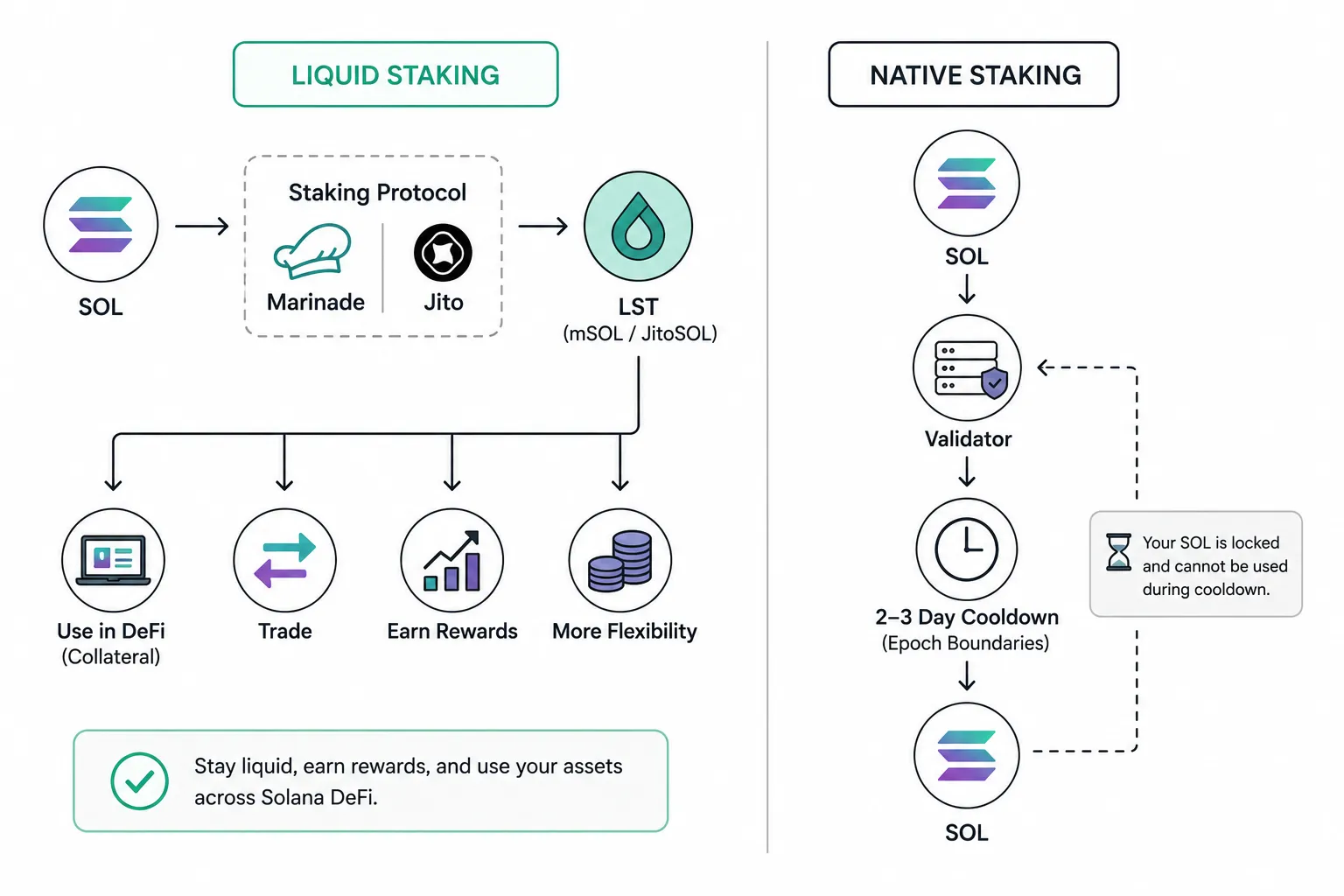
A liquid staking token, or LST, fixes this. Instead of locking SOL directly, you deposit it into a staking protocol and receive a tradeable token in return, mSOL from Marinade or JitoSOL from Jito. That token represents your staked position plus accrued rewards and its value rises against SOL over time as staking rewards compound. You can hold it, trade it, or deploy it across DeFi protocols as collateral while the underlying SOL keeps earning. The instant you want SOL back, you swap the LST on a DEX rather than waiting out the cooldown.
Solana’s own validators have no 32 SOL minimum the way Ethereum does. Any amount can delegate to any validator. Validators compete on commission, typically 5% to 10%, taken from rewards before the rest passes to delegators. Liquid staking protocols aggregate stake across many validators at once, which spreads the commission burden and gives you one pooled token instead of managing dozens of individual delegations yourself.
Marinade Finance: The Liquid Staking Pioneer
Marinade launched in 2021 and remains the largest liquid staking protocol on Solana by total value locked, with TVL above $1.5 billion. When you stake through Marinade, you receive mSOL, an interest-bearing token whose redemption value rises as rewards accrue. There is no new token landing in your wallet each epoch the way native staking sometimes works. Instead, the same mSOL balance simply becomes worth more SOL over time.
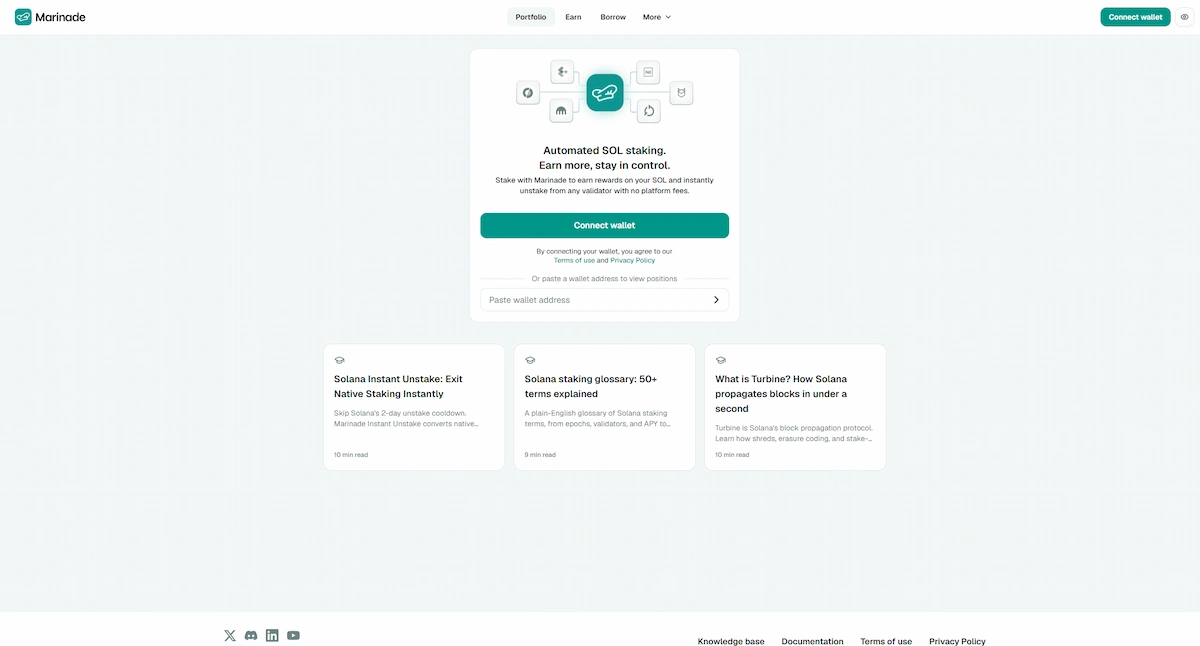
Current APY on Marinade runs in the 7% to 8% range, with some sources citing a more stable 6.4% baseline compared to the wider swings seen on MEV-driven alternatives. The protocol distributes stake across more than 100 validators, with figures from some sources putting the number above 400, selected through an open-source scoring formula that weighs performance, commission, and decentralization. An explicit cap on per-validator concentration prevents any single operator from absorbing too much of Marinade’s pooled stake, which keeps the delegation spread wide rather than concentrated.
The mSOL token carries the deepest DeFi integration of any Solana LST, a direct result of being first to market. You can deposit it into lending protocols like Solend or Kamino to earn additional yield, post it as collateral for a stablecoin loan, or provide liquidity with it on a DEX. Marinade also holds SOC 2 Type 2 certification, a notable distinction for a DAO-governed protocol and one most competitors do not have. The standard fee on Marinade is 6% of staking rewards, not 6% of your principal.
Marinade’s SAM and PSR: The V2 Upgrade
Marinade’s v2 upgrade introduced two mechanisms that directly respond to the kind of optimization Jito built for MEV. The Stake Auction Marketplace, or SAM, lets validators bid competitively for delegated stake, which pushes commission rates down and rewards validators who offer the best terms rather than simply the largest existing operators. Protected Staking Rewards, or PSR, insures stakers against a specific category of loss: validator downtime. Under PSR, validators post a SOL bond. If that validator goes offline and misses block rewards, the bond pays out proportionally to stakers to cover what they would have otherwise lost. This backstop reduces downside exposure in a way that standard liquid staking does not typically offer.
Marinade Native vs Marinade Liquid Staking
Beyond mSOL, Marinade Native offers direct validator delegation through Marinade’s automated strategy without wrapping your SOL into a token at all. This appeals specifically to institutional stakers and anyone who wants to eliminate smart contract risk entirely while still benefiting from Marinade’s validator selection and yield optimization. You give up the liquidity and DeFi composability of mSOL, but you also remove the protocol’s smart contract from your risk equation. Marinade is currently the only Solana liquid staking provider offering this kind of automated native option as a parallel product line.
To understand the smart contract architecture underpinning protocols like Marinade and Jito, our guide on Solana smart contracts explains how on-chain programs are deployed and audited.
Jito: Maximum Yield Through MEV Extraction
Jito built its entire model around capturing MEV, or Maximal Extractable Value, the profit available from optimally ordering transactions within a block. When traders execute large swaps or arbitrage opportunities open up on-chain, the sequence in which those transactions land matters. The Jito-Solana validator client sequences transactions to capture that value and redistributes it to stakers holding JitoSOL.
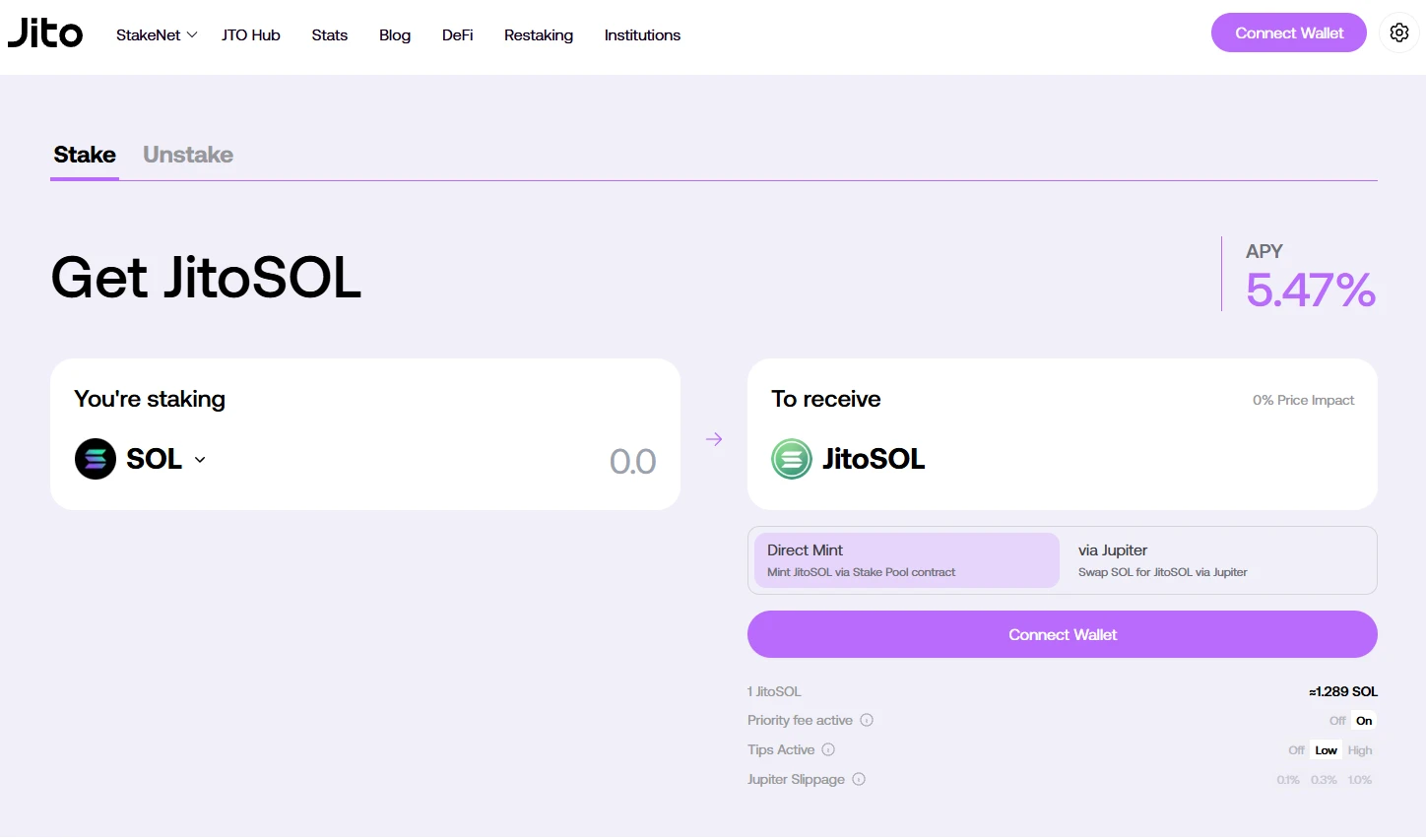
JitoSOL captures roughly 95% of the MEV revenue the protocol generates, with the remaining 5% routed to the Jito DAO treasury. This MEV layer typically adds 0.5% to 1% on top of base staking yield, though the figure swings with network activity. During heavy memecoin launches or large liquidation events, MEV revenue spikes. During quiet markets, it can compress toward zero. The result is an effective APY that has ranged from roughly 7% in low-MEV periods to over 9% during high-MEV stretches, against Marinade’s comparatively steady 6.4%. Jito charges a 4% fee on rewards, lower than Marinade’s 6%.
As of March 2026, Jito surpassed Marinade in liquid staking TVL, a shift driven largely by Jito’s December 2023 airdrop and the market traction that followed. JitoSOL now has some of the deepest DeFi integration on Solana, accepted as collateral across Marginfi, Kamino, and Drift, with one of the deepest liquidity pools in the ecosystem for low-slippage exits.
Jito’s Stakenet: Validator History and Steward Program
Jito’s validator selection runs through an infrastructure layer called Stakenet, built from two components. The Validator History Program collects up to three years of performance data on every validator on Solana: vote credits, commission history, MEV commission, client version, and more. The Steward Program then computes a score from that history and continuously updates delegation decisions so that stake routes to the best-performing validators at any given time, rather than sitting static with operators whose performance has since declined. This data-driven approach is what Jito points to as its answer to the validator selection problem Marinade’s open-source formula also tries to solve, just with a heavier weighting toward MEV-optimized operators.
The Validator Concentration Debate
The trade-off behind Jito’s MEV advantage is validator concentration. As of April 2026, roughly 60% of Solana’s total stake runs through validators operating the Jito MEV client, a significant share by any measure. That concentration is what makes the MEV yield possible in the first place, but critics argue it pushes the network toward reliance on a single validator software implementation, which has implications for client diversity and, by extension, network resilience and censorship resistance. Marinade, by contrast, spreads its delegated stake across a far wider validator set with an explicit cap preventing concentration, prioritizing decentralization over MEV optimization. Neither approach is objectively correct. It is a genuine trade-off between yield concentration and structural dispersion that every staker is implicitly taking a side on.
Coinbase: Centralized Staking Convenience
For users who want the simplest possible path with no wallet setup, no LST to manage, and no validator selection to think about, Coinbase staking is the alternative. Your SOL sits inside your existing Coinbase account, rewards accrue automatically, and tax documentation arrives without any manual tracking.
The trade-off shows up immediately in the numbers. Coinbase pays around 5% APY on staked SOL, well below both Marinade and Jito. The fee is not stated as a separate line item; it is simply built into that lower advertised rate, reflecting Coinbase’s operational costs and margin. On a $10,000 stake, choosing Coinbase over a decentralized alternative can cost more than $200 a year in foregone yield, and that gap compounds. Over five years, the difference between staking through Jito and staking through Coinbase on the same $10,000 position can exceed $1,000.
The other cost is custody. Coinbase holds your private keys. The old crypto rule applies directly here: not your keys, not your crypto. If Coinbase suffers an exchange failure, a security breach, or a regulatory freeze, your staked SOL is exposed to that institutional risk regardless of how secure your personal account password is. In exchange, you get FDIC-adjacent institutional custody practices, insurance coverage on certain balances, and a regulatory compliance posture that some investors specifically want. For holders who already keep their SOL on Coinbase and have no interest in self-custody, the convenience may be worth the yield gap. For anyone optimizing returns or who already values holding their own keys, it is the weakest option on this list financially.
Marinade vs Jito vs Coinbase: Side by Side
| Feature | Marinade | Jito | Coinbase |
|---|---|---|---|
| Token | mSOL | JitoSOL | None (custodial) |
| APY | 7-8% (6.4% stable baseline) | 7-9%+ (MEV-driven, variable) | ~5% |
| Fee | 6% of rewards | 4% of rewards | Built into lower APY |
| TVL | $1.5B+ | Surpassed Marinade (March 2026) | Not publicly disclosed |
| Custody | Non-custodial | Non-custodial | Custodial |
| Validators | 100+ (some sources cite 400+), capped concentration | Concentrated on Jito MEV client (~60% of network stake) | Not applicable |
| DeFi access | Deepest integration (Solend, Kamino) | Deep integration (Marginfi, Kamino, Drift) | None |
| Best for | Decentralization-focused, DeFi-native users | Yield-maximizing users comfortable with smart contracts | Beginners, simplicity-first holders |
Fee Comparison: What $10,000 Actually Costs You
Advertised APY numbers do not tell the whole story until you account for fees. The table below shows the approximate annual cost of each provider’s fee structure on a $10,000 stake.
| Provider | Fee Structure | Effective Cost on $10,000 Stake |
|---|---|---|
| Marinade | 6% of rewards | ~$42/year |
| Jito | 4% of rewards | ~$28/year |
| Coinbase | Built into ~5% APY | ~$200+/year vs decentralized alternatives |
The fee difference alone is modest in dollar terms between Marinade and Jito. The real gap opens against Coinbase. Choosing Jito over Coinbase on a $10,000 position compounds to a difference of more than $1,000 across five years, simply from the yield spread and fee structure, without counting any growth in the underlying SOL price itself.
Sanctum: The Third Option for Instant Liquidity
Sanctum does not issue its own headline LST the way Marinade and Jito do, though it offers one called INF. Instead, it solves a different problem entirely: fragmented liquidity across the LST landscape. Jito has a dedicated pool for JitoSOL. Marinade has one for mSOL. If you hold either and want to exit instantly, you are limited to that specific pool’s depth.
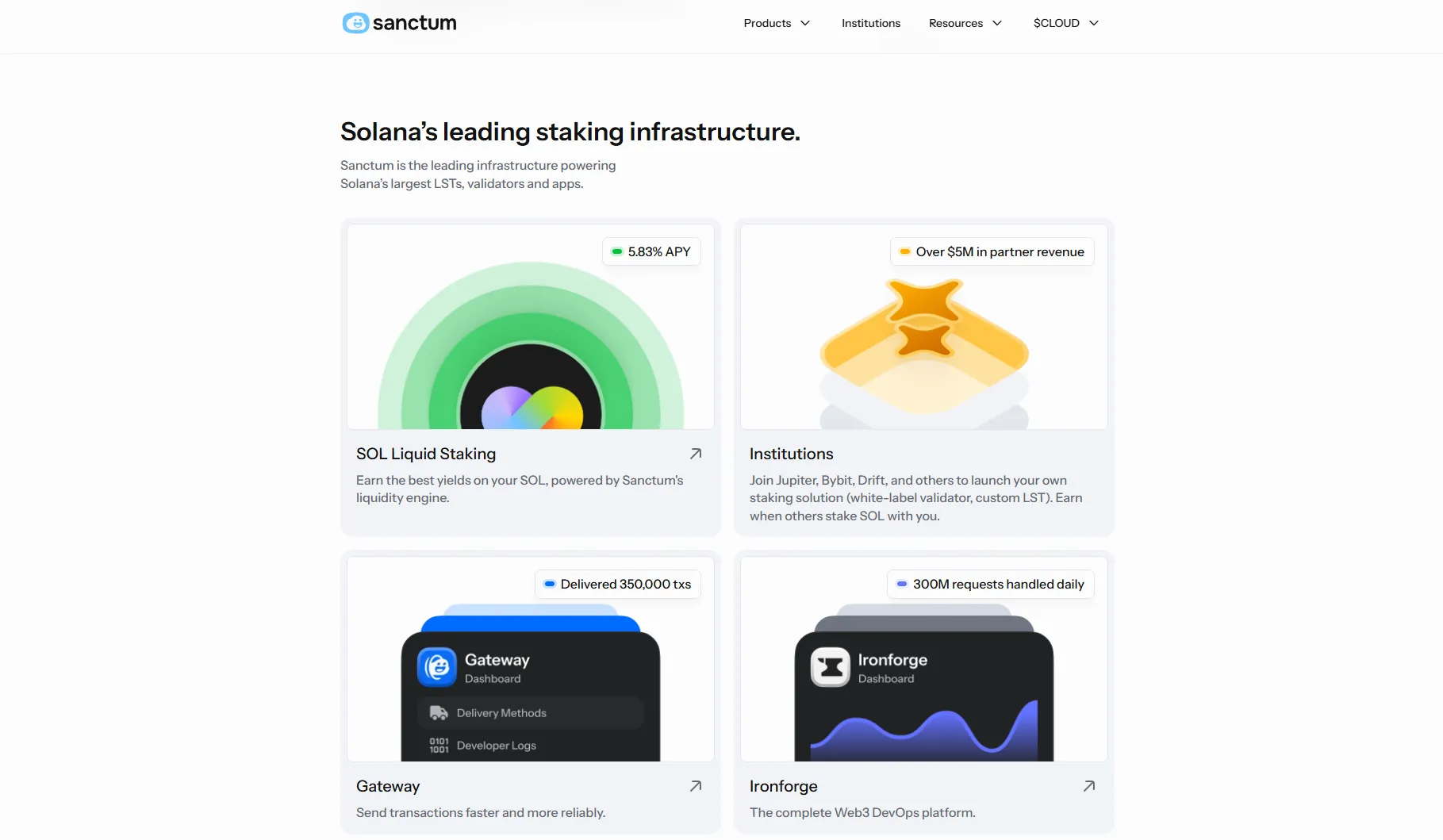
Sanctum’s Infinity pool aggregates liquidity across more than 200 supported LSTs, including mSOL, JitoSOL, bSOL, and JupSOL. When you want instant unstaking for any of them, Sanctum routes through whichever liquidity source, including its own pool or Jupiter directly, offers the best price at that moment. The fee for this aggregated routing is small, typically 0.1% to 0.3%, and it is fully non-custodial throughout. For users who do not want to be locked into a single protocol’s liquidity depth, or who want exposure to the broader LST ecosystem beyond just mSOL or JitoSOL, Sanctum functions as the liquidity layer sitting on top of everything else covered in this guide rather than a direct competitor to any of them.
Governance Tokens: MNDE vs JTO
Both protocols distribute governance authority through native tokens, but the two models work differently. JTO, Jito’s governance token, focuses narrowly on protocol parameters: staking fees, validator delegation strategy, and how MEV tip revenue gets distributed. JTO itself carries no direct yield. Revenue the protocol generates flows into a community-managed treasury rather than back to JTO holders automatically.
MNDE, Marinade’s token, works differently by combining governance with value accrual. Holders lock MNDE to receive veMNDE voting rights, and the protocol returns value through a 50% token buyback program rather than distributing staking yield directly to MNDE holders. Neither token is something most stakers need to think about when choosing between mSOL and JitoSOL for the staking decision itself, but the governance design reflects each protocol’s broader philosophy: Jito’s treasury-first model versus Marinade’s buyback-and-lock incentive structure.
Security Considerations: Smart Contract Risk and Validator Risk
Both Marinade and Jito rely on smart contracts to manage deposits, mint LSTs, and distribute rewards. Both have undergone multiple independent audits, but smart contract risk never reaches zero for any protocol, regardless of audit history. The practical mitigation is diversification: spreading a large position across more than one LST rather than concentrating everything in a single protocol, and staying alert to security advisories from the teams behind each.
Even with liquid staking, your SOL ultimately sits delegated to real validators. If a validator misbehaves, suffers extended downtime, or gets penalized through slashing, that risk passes through to LST holders to some degree. Choosing platforms with decentralized validator sets, as Marinade emphasizes, and monitoring skip rate trends reduces this exposure. Depeg risk is the related concern specific to LSTs: in periods of severe market stress, the LST’s trading price can briefly diverge from its underlying redemption value. This has happened to competing LSTs like Lido’s stSOL during volatile periods, though Marinade and Jito have generally held their pegs more reliably given their liquidity depth.
- Smart contract risk: diversify across multiple LSTs, monitor protocol security updates, avoid putting an outsized share of holdings into any single liquid staking token
- Validator risk: favor decentralized validator sets, watch for rising commission or skip rates, redelegate if a validator’s performance declines
- Custodial risk: centralized options like Coinbase offer insurance and compliance but hold your private keys, meaning exchange-level failures are outside your control
For users who prefer to hold their staking position with a hardware wallet layered on top of either protocol, our guide on how to store SOL long term covers pairing a Ledger device with Phantom or Solflare for cold storage while still earning staking rewards.
How to Choose Your Staking Strategy
The right choice depends less on which protocol is objectively best and more on what you actually plan to do with your SOL.
- Beginners: Start with a small stake through Phantom or Solflare’s native staking interface, or move directly into Marinade for liquid staking with the longest track record. Stake a modest amount first, monitor rewards for a few weeks, and get comfortable with the unstaking process before committing larger sums.
- Active DeFi users: Liquid staking tokens unlock additional yield layers that native staking cannot. Deposit mSOL or JitoSOL into a lending protocol, provide liquidity on a DEX, or use either as collateral for a leveraged position, all while the underlying stake keeps earning its base reward.
- Large holders: Fee optimization and diversification matter more at scale. Consider splitting a significant position across both Marinade and Jito rather than concentrating in one, or look at direct validator delegation to avoid protocol fees entirely if you are comfortable managing validator relationships yourself.
- Simplicity-first holders: If you already keep SOL on Coinbase and do not want to manage a self-custody wallet, the lower yield from custodial staking may still be worth the convenience and built-in tax reporting.
For a full walkthrough of setting up a self-custody wallet before staking through Marinade or Jito, our guide on how to set up Phantom Wallet covers the process from installation to your first transaction.
Tax Implications of Staking Rewards
Staking rewards are generally treated as income at their fair market value the moment you receive them, regardless of whether you are staking through Marinade, Jito, or Coinbase. Selling staked tokens or the LST they were converted into later triggers a separate capital gains event based on any price change since you received them. With native staking, new SOL often lands directly in your wallet each epoch. With an LST, you do not receive new tokens; instead, the value of your existing mSOL or JitoSOL balance rises, which changes how that income needs to be tracked for reporting purposes.
Tax treatment varies by jurisdiction, and accurate record keeping matters regardless of which provider you use. Tools that track on-chain staking activity can help, but nothing in this guide constitutes tax advice. Consult a professional familiar with cryptocurrency taxation in your specific jurisdiction before filing.
Marinade vs Jito vs Coinbase: FAQs
Is Jito or Marinade Better?
Neither is universally better. Jito delivers higher APY through MEV capture but concentrates stake on a narrower validator set, which raises decentralization concerns. Marinade offers a more stable yield and spreads stake across a much wider validator base, prioritizing network health over maximum return. Yield-focused stakers typically prefer Jito. Stakers prioritizing decentralization and stability typically prefer Marinade.
What Is the Difference Between mSOL and JitoSOL?
mSOL is Marinade’s liquid staking token, distributing stake across 100 or more validators with no MEV component, paying a steadier 7% to 8% yield. JitoSOL is Jito’s liquid staking token, concentrated on validators running the Jito MEV client and earning both base staking rewards plus a share of MEV revenue, which pushes its yield higher but with more variability, typically 7% to 9% or more depending on market conditions.
Is Coinbase Staking Worth It?
Coinbase staking suits users who value simplicity over yield. At roughly 5% APY, it trails both decentralized options significantly, and the fee is built into that lower rate rather than itemized. For holders who already keep SOL on Coinbase and have no interest in managing a self-custody wallet, the convenience and built-in tax documentation may justify the lower return. For anyone optimizing for yield, a decentralized alternative pays more.
What Is MEV in Solana Staking?
MEV, or Maximal Extractable Value, is the profit available from optimally sequencing transactions within a block, particularly around large swaps and arbitrage opportunities. Jito built specialized validator software using Bundles to capture this value and shares roughly 95% of it with JitoSOL holders, adding 0.5% to 1% or more to the effective annual yield depending on network activity.
How Much Do Staking Fees Cost?
On a $10,000 stake, Marinade’s 6% fee on rewards costs roughly $42 a year. Jito’s 4% fee costs roughly $28 a year. Coinbase does not itemize a fee but its lower advertised APY effectively costs more than $200 a year compared to either decentralized option, a gap that compounds to over $1,000 across five years on the same position.
Is Liquid Staking Safe?
Liquid staking on established protocols like Marinade and Jito is reasonably safe but carries non-zero risk. Smart contract risk exists despite multiple independent audits. Depeg risk can briefly affect an LST’s trading price during extreme market stress. Diversifying across more than one LST and staying alert to protocol security updates reduces, but does not eliminate, this exposure.
How Long Does Unstaking Take?
Native unstaking through either protocol takes the standard 2 to 3 day epoch cooldown to return native SOL. For instant unstaking, swapping your LST on a DEX takes a single transaction under a minute, at the cost of pool spread slippage, typically under 25 basis points for moderate trade sizes. Sanctum’s aggregated Infinity pool is specifically built to make this instant exit reliable across a wide range of LSTs.
What Is the Minimum to Stake SOL?
There is no meaningful minimum stake requirement on either Marinade or Jito. Solana validators themselves have no 32 SOL threshold the way Ethereum requires, and liquid staking protocols pool contributions from many users, so even a fraction of a SOL can be staked. In practice, keep at least 0.05 SOL outside your staked position to cover transaction fees on future actions.
If you have not yet acquired SOL to stake, our guide on how to buy Solana covers every purchase method available before you move funds into any staking protocol.