Finding the best DEX on Solana depends entirely on what you are trying to do. If you want the best price on a swap, Jupiter is the clear default. If you want the deepest liquidity for new token launches, Raydium wins. If you want a clean interface and capital-efficient liquidity provision, Orca takes that spot. None of these platforms wins outright across every category, and most experienced Solana traders end up using all three depending on the task in front of them. This guide breaks down each one by fee structure, liquidity depth, security track record, and the specific use case it handles best, with Meteora and a handful of smaller platforms covered for traders who need something more specialized.
The Solana DEX Landscape in 2026
Solana’s decentralized exchange ecosystem now processes over $2 billion in daily trading volume across dozens of platforms. Total value locked across Solana DeFi sits above $8 billion, having roughly doubled year over year as more traders and liquidity providers moved capital onto the network. Unlike Ethereum, where a single platform tends to dominate, the Solana DEX landscape is spread across several major venues that each specialize in something different.
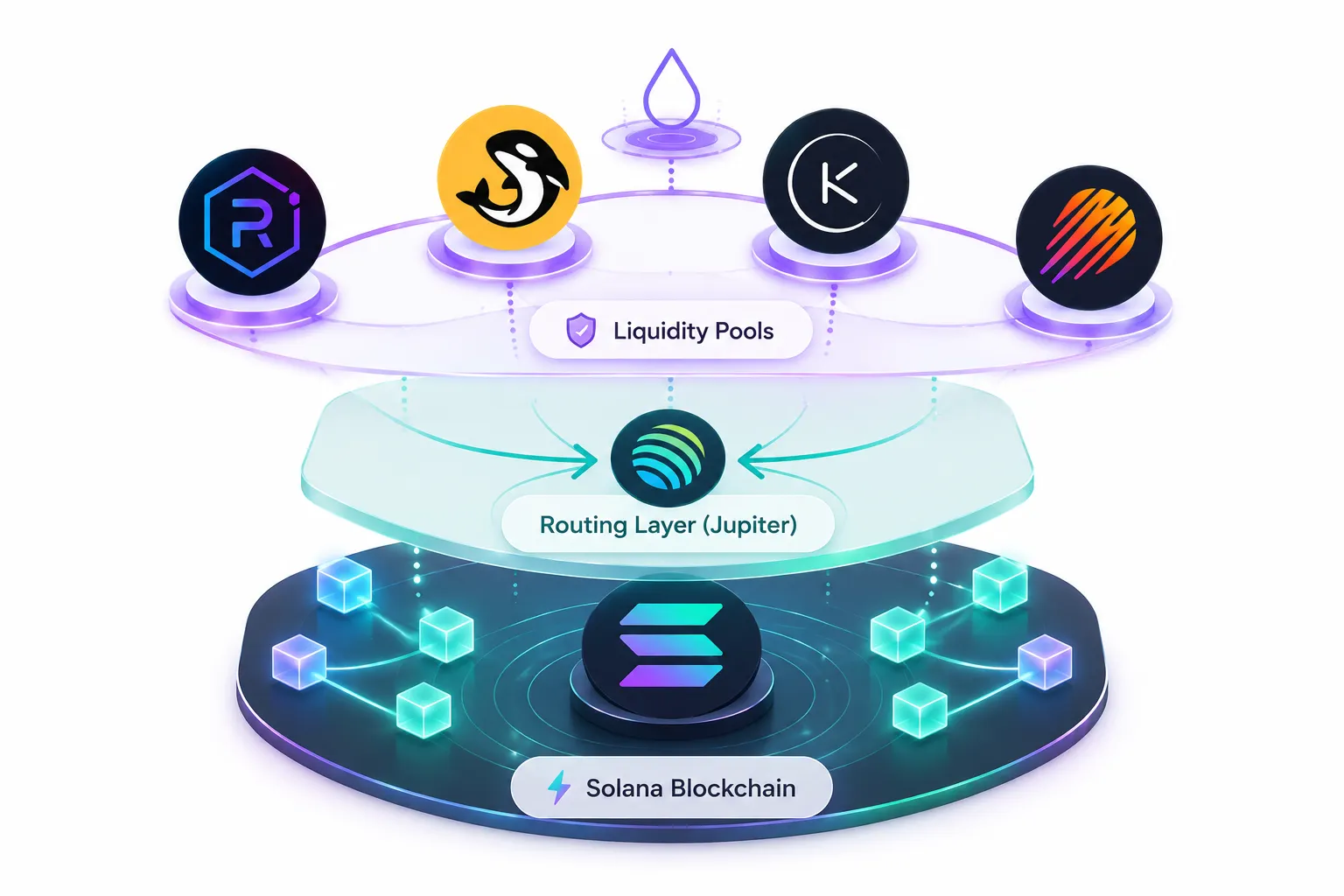
The architecture works in layers. At the base, automated market makers like Raydium, Orca, and Meteora hold liquidity in pools governed by smart contracts. On top of that sits a routing layer, where Jupiter scans every pool simultaneously and finds the best execution path for any given trade. Most retail traders interact with Jupiter rather than visiting individual platforms directly, but understanding what each underlying venue does helps when you want to do more than a simple swap.
Solana’s cost structure makes this distributed model practical in a way that is not possible on Ethereum. Gas runs under a cent per transaction, blocks confirm in under a second, and the upcoming Firedancer validator client has demonstrated throughput exceeding one million transactions per second in testing. For a full picture of how the network processes these transactions at the protocol level, our guide on how Solana works covers the validator architecture and block production model behind every trade you execute.
Jupiter: The Aggregator King
Jupiter is a DEX aggregator, meaning it does not run its own liquidity pools. Instead, it scans every major liquidity source on Solana, including Raydium, Orca, Meteora, Lifinity, and dozens of smaller pools, and routes your trade through whichever combination delivers the best price. On a large trade, Jupiter sometimes splits the order across two or three pools at once rather than sending the whole thing through a single venue, which reduces price impact compared to going direct.
Jupiter routes more than 80% of all Solana swap volume, making it the default interface for most active traders on the network. The platform charges zero platform fee on standard swaps. You pay only what the underlying pool charges, typically 0.25% to 0.3%, plus the minimal Solana network fee. This 0% platform fee model is one of the main reasons most traders default to Jupiter rather than visiting individual DEXs for routine swaps.
Beyond basic swaps, Jupiter has expanded into a full trading platform. Limit orders let you set a target price and walk away. DCA, or dollar-cost averaging, automates recurring purchases over a set schedule. Jupiter Perps adds leveraged perpetual futures on SOL, BTC, ETH, and other assets with leverage up to 100x. The JUP token handles governance through Jupiter DAO, giving holders a vote on fee parameters and platform direction.
For nearly any swap, Jupiter is where to start. The only exception is sniping a token so new it has only just listed on Raydium and Jupiter has not indexed the pool yet, in which case going direct to Raydium saves a step.
How to Swap Tokens on Jupiter
Go to jup.ag and click Connect Wallet. Select the token you want to sell in the top field and the token you want to receive in the bottom field. Jupiter calculates the route automatically and displays the expected output along with the price impact. Check the slippage setting before confirming. The default of 0.5% works for major pairs like SOL and USDC. For thinner pools, you may need to raise it, but a higher slippage setting accepts a worse rate if the price shifts before your transaction lands. Confirm in your wallet and the swap settles in under a second.
Raydium: Deepest Liquidity and Token Launches
Raydium is Solana’s largest AMM by total liquidity depth and the default venue where new tokens go live. When a token launches through Pump.fun and completes its bonding curve, Raydium is where it migrates for ongoing trading. This first-mover position on fresh listings means Raydium often captures the earliest and most active trading volume for any new token, well before other venues catch up.
Standard Raydium pools use a constant product model charging a 0.25% swap fee, split between liquidity providers and the protocol. Its CLMM pools let providers focus capital within a chosen price band rather than spreading it across the entire curve, which improves capital efficiency for pairs with predictable trading ranges. Raydium processed roughly $35.6 billion in 30-day volume as of early 2026, making it one of the highest-volume DEXs on any blockchain by that measure.
On the security side, Raydium has been audited by Cyberscope and runs an active Immunefi bug bounty with a payout pool above $505,000 for critical findings. The RAY token handles governance. For a deeper understanding of why Solana transaction fees stay low even when trading volume is this high, our guide on Solana transaction fees explains the fee model and how priority fees work during congestion.
How to Provide Liquidity on Raydium
Providing liquidity means depositing two tokens into a pool in equal value and receiving LP tokens that represent your share. Every trade through that pool pays you a portion of the fee. On standard pools the 0.25% fee splits with 0.22% going to liquidity providers and 0.03% to RAY buybacks. On CLMM pools, you select a price range and your capital only earns fees while the price trades inside that range.
Before depositing into any volatile pool, understand impermanent loss. If the price ratio between your two tokens shifts significantly, your position can end up worth less than simply holding both tokens outright. This risk is most severe on new token pools and far lower on established stable pairs. Earning enough in fees to offset impermanent loss is the core calculation every liquidity provider needs to make before committing capital.
Orca: Concentrated Liquidity Pioneer
Orca built its reputation on Whirlpools, its version of concentrated liquidity that lets providers focus capital within a specific price range. A provider depositing $10,000 in a tightly concentrated range can deliver roughly the same trading depth as $100,000 spread across a traditional full-range pool. This capital efficiency is the core reason serious liquidity providers on Solana spend time on Orca specifically for major pairs.

The platform’s clean interface is its most cited advantage for regular traders. Many users prefer swapping directly on Orca rather than going through Jupiter for routine trades on pairs with deep liquidity. Fee tiers run from 0.01% up to 1%, with stable pairs like USDC/USDT sitting at the bottom and volatile pairs higher to compensate providers for added risk.
Orca was reviewed by Neodyme in a detailed audit that identified and resolved vulnerabilities before they reached production. The platform runs an Immunefi bounty paying up to $500,000 for critical findings. The ORCA token handles governance the same way RAY does for Raydium. Orca processed around $22.8 billion in 30-day volume as of early 2026, with the SOL/USDC pool holding some of the deepest concentrated liquidity on the network.
How to Swap and Provide Liquidity on Orca
Swapping on Orca works the same as any DEX: connect your wallet at orca.so, select the pair, check the price, and confirm. For liquidity provision, go to the Pools tab and pick a pair. You will choose a price range for your Whirlpool position. A narrow range earns more in fees per dollar deposited while price stays inside it but goes out of range and stops earning the moment price moves past either edge. A wider range earns less per dollar but stays active longer. Check the current fee tier for the pool before depositing so you understand what return is realistic for the pair you choose.
Meteora: The Fastest-Growing Solana DEX
Meteora is built around its Dynamic Liquidity Market Maker, or DLMM, which divides the price range into discrete bins and adjusts swap fees automatically based on current market volatility. During a volatile launch, fees rise to protect liquidity providers from being picked off by informed traders. During calm periods, fees drop to attract volume. This dynamic fee structure has made Meteora a preferred venue for new memecoin launches specifically because volatility is highest in the first hours after a token goes live.
Several of the largest Solana memecoin launches in the past year, including pools that held hundreds of millions in TVL at peak activity, used Meteora’s DLMM pools as primary liquidity. Meteora processed roughly $14 billion in 30-day volume as of early 2026, a significant figure for a platform considerably younger than Raydium or Orca. A proposed MET token would extend community governance to the platform, following the same pattern RAY and ORCA established earlier in Solana’s DEX development.
PumpSwap and Other Notable Solana DEXs
Beyond the main platforms above, several venues serve specific niches worth knowing about even if they are not everyday trading destinations.
PumpSwap: Built for Memecoin Trading
PumpSwap, built by the Pump.fun team, keeps token creation and trading inside the same product. When a token completes its bonding curve on Pump.fun, it migrates directly into a PumpSwap pool rather than requiring a separate step on an external DEX. The platform charges 0.25% per trade, with 0.20% going to liquidity providers and 0.05% retained by the protocol. PumpSwap racked up over $10 billion in volume in its first ten days of operation, an unusually fast start for any new DEX. Nine independent audits from firms including OtterSec and Pashov Audit Group have reviewed the code, an unusually high number for a recently launched platform.
Lifinity, Phoenix, and Drift
Lifinity uses oracle-based pricing rather than relying purely on pool ratios, which reduces impermanent loss exposure for liquidity providers and can offer tighter spreads on major pairs. Phoenix runs a fully on-chain order book, or central limit order book, matching buy and sell orders directly rather than pricing trades against a pool. Drift combines perpetual futures with spot trading, and its spot market contributes liquidity that Jupiter routes through when the pricing is competitive. None of these three handle the volume of the top platforms individually, but together they add meaningful depth to what Jupiter can aggregate across the network.
To understand the smart contract layer that every pool and routing decision depends on, our guide on Solana smart contracts explains how on-chain programs are built, deployed, and audited.
Jupiter vs Raydium vs Orca vs Meteora: Comparison Table
| DEX | Model | Swap Fee | Best For | Audit |
|---|---|---|---|---|
| Jupiter | Aggregator | 0% platform fee (underlying pool fees apply) | Best price on any swap, limit orders, DCA, perps | Multiple firms |
| Raydium | AMM + CLMM | 0.25% standard, variable on CLMM | New token launches, deepest liquidity, LP farming | Cyberscope + Immunefi |
| Orca | Concentrated liquidity (Whirlpools) | 0.01% to 1% by tier | Major pairs, capital-efficient LP, clean interface | Neodyme + Immunefi |
| Meteora | DLMM (dynamic fee) | Variable, adjusts with volatility | Memecoin launches, volatile pairs | Multiple external audits |
| PumpSwap | AMM | 0.25% | Pump.fun token migrations | 9 audits (OtterSec, Pashov) |
Audits and Security Track Record by Platform
Every platform covered here has gone through independent security review, but the depth varies. Raydium’s primary audit comes from Cyberscope, backed by an Immunefi bounty exceeding $505,000 for critical vulnerabilities. Orca went through a detailed review by Neodyme that identified and fixed real issues before launch, with a similar bounty running alongside. PumpSwap stands out for the number of reviews it has undergone, nine separate audits from firms including OtterSec and Pashov, a high count for any recently launched platform.
None of this eliminates smart contract risk entirely. Audits reduce the chance of known bug classes reaching production, but new exploits appear on audited code regularly across all of DeFi. Treat audit history as one signal among several rather than a guarantee, and size positions accordingly on any pool that does not yet have years of live trading volume behind it.
For a broader guide on how to stay safe when using these platforms, our guide on how to keep Solana safe covers approval management, phishing risks, and the specific attack patterns targeting active DeFi users.
Which DEX Should You Use? Decision Guide
Most experienced Solana traders do not pick one platform and commit to it. They use whichever tool fits the specific task at hand.
- Use Jupiter if you want the best price on any swap, you need DCA or limit orders, you are trading a larger amount and want your order split across pools to reduce price impact, or you want access to leveraged perpetual futures without a separate account.
- Use Raydium if you want to provide liquidity on high-volume memecoin pools, earn farming rewards, or need to trade a token within the first minutes of its launch before it appears elsewhere.
- Use Orca if you want to provide concentrated liquidity on a major pair like SOL/USDC, prefer a cleaner standalone swap interface, or are comfortable actively managing a price range for better capital efficiency.
- Use Meteora if you are trading a token in its first hours and want a fee structure designed for that volatility, or you are providing liquidity on a freshly launched memecoin pair.
When you swap through Jupiter, it often routes through Raydium and Orca pools anyway. Choosing Jupiter as your default does not mean avoiding the others. It means letting the routing engine decide which underlying venue gives the best execution on each specific trade.
How to Get Started Trading on Solana DEXs
Before using any of the platforms above, you need a Solana wallet funded with enough SOL to cover trades and network fees. The full setup takes under fifteen minutes.
| Feature | Phantom | Backpack | Solflare |
|---|---|---|---|
| Hardware wallet support | Ledger | Ledger, Keystone, Trezor | Ledger, Trezor |
| Integrated swap | Yes (Jupiter routing) | Yes (0% platform fee) | Yes |
| xNFT / app support | No | Yes | No |
| Best for | Beginners and daily use | NFTs and power users | Staking and validator analytics |
Step 1: Set Up a Solana Wallet
Download Phantom or Solflare directly from the official site, not from a search ad or third-party link. Create a new wallet, write down your seed phrase on paper, and store it somewhere offline. Both are fully non-custodial, meaning your private keys never leave your device. Our full guide on how to set up Phantom Wallet covers the complete process from installation through your first transaction.
Step 2: Fund Your Wallet With SOL
You need SOL for two things: the assets you plan to trade, and the small network fee every transaction requires. Keep at least 0.05 SOL set aside specifically for fees so you do not run out mid-session. Buy SOL through an exchange and withdraw to your wallet address, or use a fiat on-ramp like MoonPay built directly into Phantom. Our guide on how to buy Solana covers every purchase method available and the exact withdrawal steps from major exchanges.
Step 3: Execute Your First Swap
Go to jup.ag and connect your wallet. For a first trade, SOL to USDC is a low-risk pair with deep liquidity. Enter a small amount, review the expected output and slippage setting, and confirm. Once comfortable with the basic flow, explore Raydium or Orca directly when you want to provide liquidity or trade a specific pool not yet covered by Jupiter’s index.
Pre-Trade Safety Checklist on Solana DEXs
A few consistent habits catch most of the problems that cost traders money on Solana.
- Check the token address against the project’s official source before trading any unfamiliar token. Copycat tokens with identical names are common and Jupiter does not filter them automatically.
- Look at the liquidity pool depth before placing a large order. A thin pool means significant price impact even on moderate trade sizes.
- Set slippage carefully. Too tight and your trade fails during normal volatility; too loose and you accept a meaningfully worse price.
- Review wallet permissions after connecting to any new platform. Revoke token approvals you no longer need rather than leaving them active indefinitely.
- Understand smart contract risk on any pool you are about to deposit into, especially newer or unaudited ones.
- Know your exit before entering. Solana’s speed means prices can move significantly in seconds, so having a clear plan for when you will take profit or cut a loss matters more than on slower chains.
For a full guide on keeping your wallet safe while trading across these platforms, our article on Solana scams covers the specific token fraud patterns, phishing attacks, and wallet drainer methods most commonly used against active DEX traders.
Best DEX on Solana: FAQs
Is Jupiter Better Than Raydium?
They serve different purposes. Jupiter is a DEX aggregator that finds the best available price across every Solana liquidity venue, including Raydium itself. For swapping tokens, Jupiter is almost always the better choice because it checks every available pool rather than just one. Raydium is the stronger choice when you specifically want to provide liquidity, earn farming rewards on the RAY side, or access a newly launched token before Jupiter has indexed its pool.
Does Jupiter Route Through Raydium and Orca?
Yes. Jupiter’s routing engine pulls liquidity from Raydium, Orca, Meteora, Lifinity, and dozens of other sources on every swap it calculates. When you trade through Jupiter, you are often using Raydium or Orca pools indirectly without realizing it, just via whichever path returns the best execution at that moment. Jupiter does not add a platform fee on top of whatever the underlying pool charges.
What Is the Lowest-Fee Solana DEX?
For raw platform fees, Jupiter charges nothing on top of the underlying pool cost, making it the most consistent choice. Raydium standard pools charge 0.25%. Orca ranges from 0.01% to 1% by tier, with stable pairs at the low end. Meteora’s dynamic fee sits between those ranges during normal conditions and rises during volatile launches. Running the same swap through Jupiter typically shows you the cheapest available path across all of them simultaneously.
Which Solana DEX Is Best for Beginners?
For straightforward swapping, Jupiter handles the comparison work automatically so you do not need to check multiple platforms manually. For users interested in providing liquidity for the first time, Orca’s clean interface and clear pool structure make it the easier of the two main AMMs to start with. Both platforms let you swap tokens with no prior trading experience required, and both connect directly with Phantom or Solflare in a single click.
Can I Provide Liquidity on Jupiter?
No. Jupiter does not run its own liquidity pools and has no LP deposit feature. It is purely a swap aggregator and trading interface. To become a liquidity provider and earn trading fees, you need to deposit directly into Raydium or Orca. Jupiter routes trades through those pools but does not replicate their liquidity provision functionality at any tier.
What Is Impermanent Loss?
Impermanent loss is the gap between holding two tokens outright and depositing them into a liquidity pool as an LP. When the price ratio between the pair shifts, the pool rebalances automatically, leaving you with more of the token that lost value and less of the one that gained. The loss reverses if price returns to the original ratio, which is why it is called impermanent, but in practice volatile pairs rarely return precisely to the entry point. Trading fee income partially offsets this, but on high-volatility pairs it often does not fully cover the gap. Always run an impermanent loss estimate before depositing into any non-stable pair.
Is It Safe to Trade on Solana DEXs?
The established platforms covered here, Jupiter, Raydium, Orca, and Meteora, are all audited and have processed billions in cumulative volume. Smart contract risk never reaches zero, but the bigger practical risk for most traders is interacting with a fraudulent or unaudited token contract, not the trading platform itself. Checking wallet permissions regularly, verifying token addresses before trading, and keeping your seed phrase offline covers most realistic exposure for everyday DEX use.
What Is the Best DEX for Memecoins?
PumpSwap and Raydium handle the bulk of fresh memecoin trading because that is where tokens land first after completing their bonding curve on Pump.fun. Meteora’s dynamic fee model is particularly well suited to the extreme volatility of the first hours after a token goes live, which is why several of the largest recent launches have used its DLMM pools as primary liquidity. Once a memecoin has settled into more stable trading, Jupiter becomes the most efficient venue for routine swaps because its aggregator finds the best price across all of those pools simultaneously.