Solana DeFi is the collection of apps and protocols built on Solana that let people trade, lend, borrow, and earn yield without going through a bank or broker. Instead of an institution approving your transaction, a smart contract handles it automatically, and instead of trusting a company with your money, you keep control of it the entire time.
Solana has become one of the busiest homes for this kind of activity because the network processes transactions fast and cheaply enough that even small, frequent actions make financial sense. Below we break down what decentralized finance actually means, the main categories of apps you will run into, the terms worth knowing before you start, and the risks that come with all of it.
What Is DeFi, in Plain English
DeFi, short for decentralized finance, replaces the usual financial middlemen, banks, brokers, lenders, with code running directly on a blockchain. A smart contract is simply a program that executes automatically once certain conditions are met, no employee needs to approve anything and no office needs to be open.
| Traditional Finance | DeFi |
|---|---|
| A bank holds and controls your money | You hold your own assets in a wallet |
| Institutions set interest rates | Rates are set by supply and demand in the market |
| Limited hours, limited access | Available 24 hours a day, worldwide |
| Approval and paperwork required | Open to anyone with a wallet, no approval needed |
Why Solana Became a Hub for DeFi
Speed and cost are the two biggest reasons Solana DeFi has grown so quickly. The network can theoretically handle tens of thousands of transactions per second, and in practice it regularly processes several thousand, which keeps things moving even when a lot of people are using an app at once. Fees sit at a small fraction of a cent per transaction, which matters a great deal once you consider that an active DeFi user might swap, deposit, or adjust a position dozens of times in a single week. On a network where fees run higher, that kind of activity gets expensive fast. On Solana it barely registers.
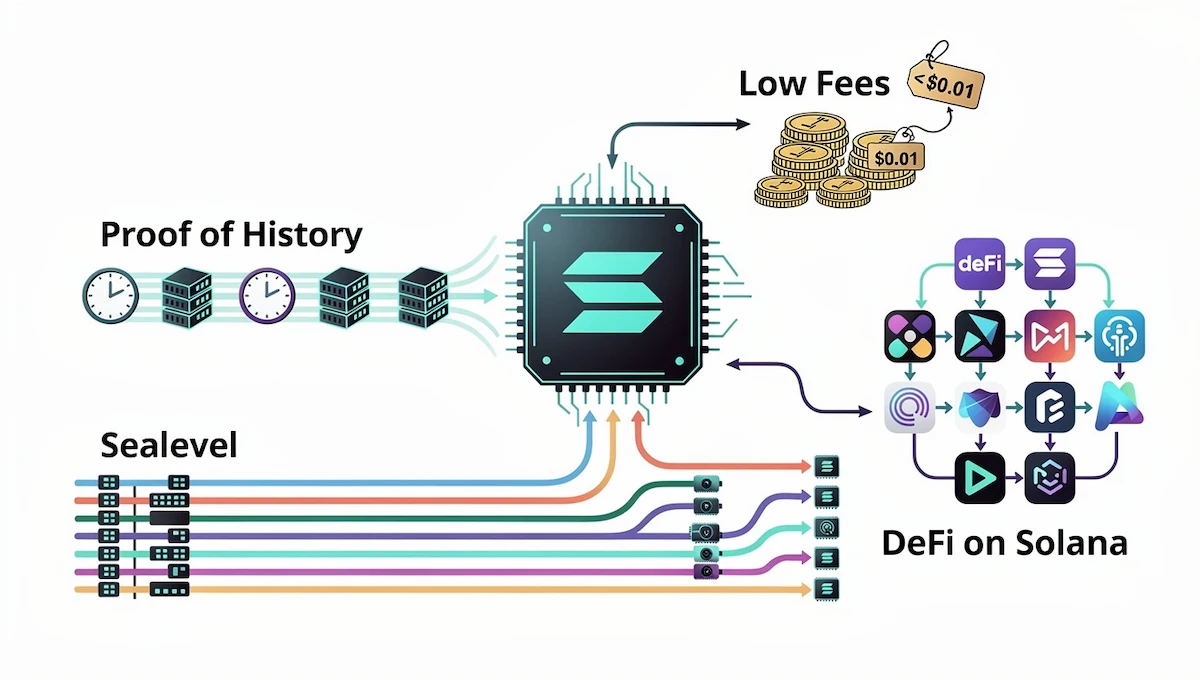
Two specific pieces of engineering sit behind that speed. Proof of History gives the network a built-in sense of time, letting validators agree on the order of transactions without constantly talking back and forth to check. Sealevel, Solana’s parallel processing system, lets the network execute many transactions at once instead of one at a time, as long as those transactions do not touch the same piece of data. Together they are a big part of why a busy DeFi app on Solana does not slow everything else on the network down the way it might elsewhere.
Part of what makes this possible is how Solana orders and processes transactions under the hood. If you want the fuller technical picture of how the network actually works before getting into the DeFi side of things, our guide on how Solana works covers the consensus mechanism and architecture behind the speed.
Fees deserve a closer look too, since they are such a central part of why DeFi on Solana feels different from DeFi anywhere else. A typical swap or deposit costs a tiny fraction of a cent, and that cost barely moves even when the network is busy, which stands in sharp contrast to blockchains where fees can spike to several dollars during periods of high demand. This predictability is a big part of why strategies that involve frequent, small transactions, such as active liquidity management or rebalancing a position daily, are realistic on Solana in a way they simply are not elsewhere. If fees specifically are what you are curious about, our breakdown of Solana transaction fees explains exactly what you pay and why it stays so low.
The Main Types of DeFi Applications on Solana
Solana DeFi is not one single thing, it is a collection of different categories of apps, each solving a different financial need. The major ones are decentralized exchanges for trading, lending and borrowing platforms, yield farming and liquidity provision, staking and liquid staking, derivatives trading, and a growing stablecoin and real-world asset sector. Each works differently, and most serious DeFi users end up combining several of them rather than sticking to just one.
Decentralized Exchanges on Solana
A decentralized exchange, usually shortened to DEX, lets you swap one token for another directly from your own wallet, without ever depositing funds onto a centralized platform. Instead of a company matching buyers and sellers behind the scenes, a DEX relies on liquidity pools, pots of tokens that traders swap against, with prices adjusting automatically based on how much of each token sits in the pool.
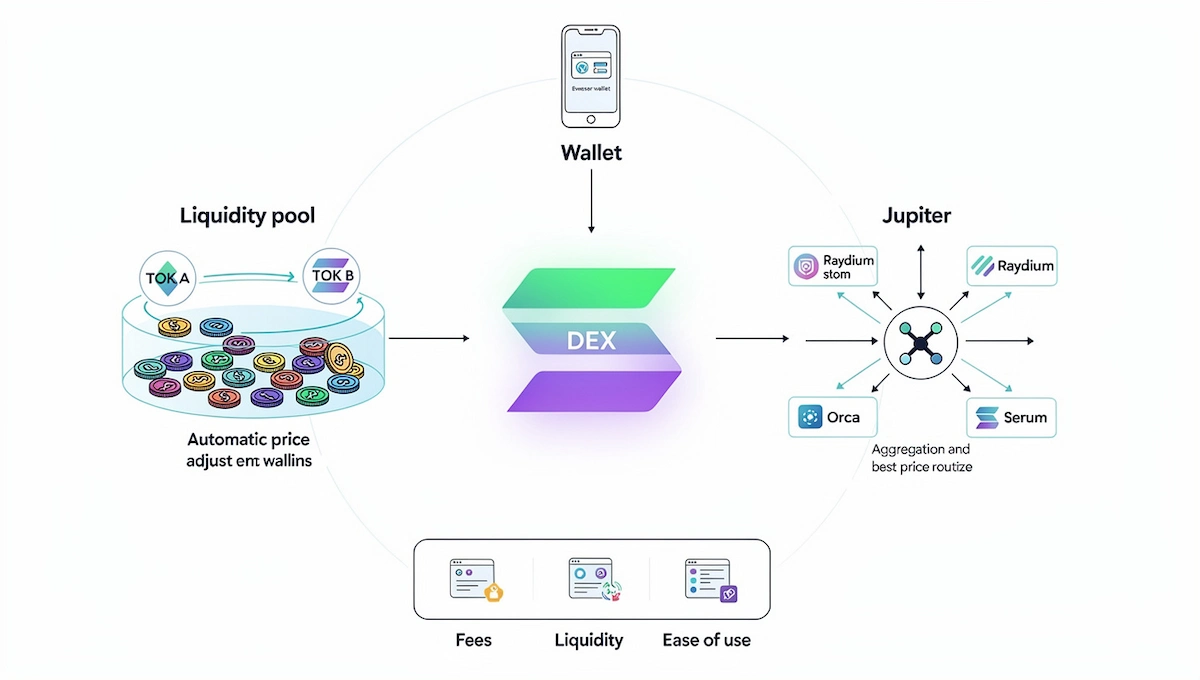
Jupiter is the most widely used option on Solana, acting as an aggregator that scans multiple exchanges at once to find the best price for a given swap. Raydium combines liquidity pools with order book functionality, and Orca is known for a simpler interface and concentrated liquidity features that let traders get better pricing on popular pairs. Serum was an earlier on-chain order book exchange that several other Solana protocols built on top of in the network’s early DeFi days, and while it carries less weight now, it played a real role in shaping how trading infrastructure on Solana developed. If you want a full comparison of how these platforms stack up against each other, our guide to the best DEX platforms on Solana walks through fees, liquidity, and ease of use across the main options.
Lending and Borrowing on Solana
Lending and borrowing protocols let you earn interest on assets you deposit or borrow against collateral you already hold. Deposit SOL, USDC, or another supported token into a lending pool and you start earning interest paid by borrowers on the other side of that same pool. Interest rates are not fixed by a bank, they shift automatically based on how much of the pool is currently being borrowed against how much sits idle.
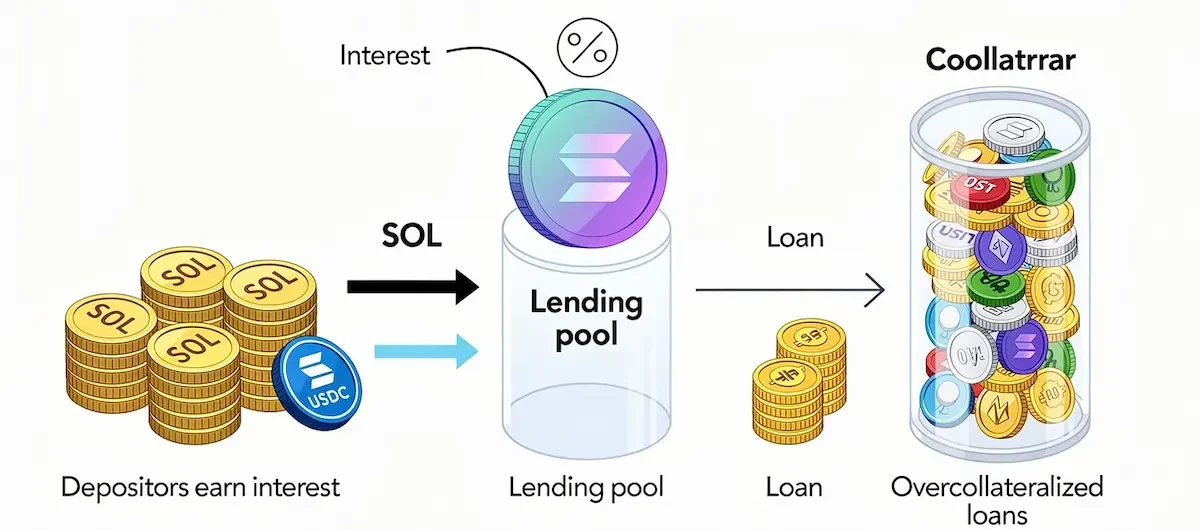
Borrowing works in reverse. Put up collateral worth more than the amount you want to borrow, and the protocol lets you draw out a loan without anyone running a credit check. This overcollateralization requirement exists to protect lenders, since the protocol has no way to chase someone down for repayment the way a traditional bank can. Kamino and Save are among the larger lending platforms on Solana, each supporting a range of assets and offering tools for managing positions in one place.
Yield Farming and Liquidity Provision
Yield farming describes the practice of putting your crypto to work across DeFi protocols to earn a return, usually by supplying liquidity to a pool or staking a token somewhere that pays rewards. The most common version involves depositing two tokens into a liquidity pool on a DEX, which earns you a share of the trading fees every time someone swaps using that pool.
There is a real risk worth understanding before jumping in, usually called impermanent loss. When the prices of the two tokens in a pool move apart from each other, the value of your deposited position can end up lower than if you had simply held both tokens separately in your wallet. It is called impermanent because the loss only becomes permanent once you actually withdraw while the prices are still out of balance. Some farming strategies layer several protocols together, depositing LP tokens from one platform into another to earn a second round of rewards, which can boost returns but also stacks risk on top of risk.
Staking and Liquid Staking on Solana
Staking lets you earn rewards by delegating SOL to a validator that helps secure the network, and it is usually considered one of the lower-risk entry points into Solana DeFi since it does not involve smart contract exposure the way lending or liquidity pools do. The tradeoff with native staking is that your SOL gets locked and takes a few days to unstake if you need it back.
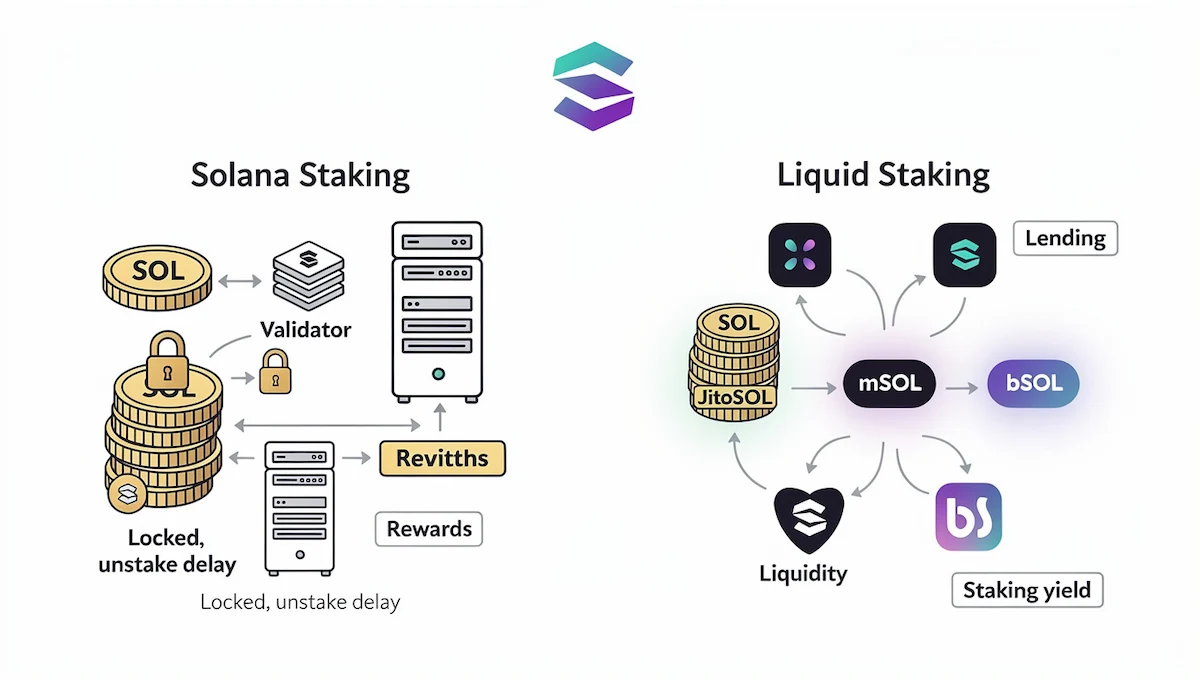
Liquid staking solves that problem. Deposit SOL into a liquid staking protocol, such as Jito or Marinade Finance, and you receive a token back, JitoSOL or mSOL depending on which you chose, that keeps earning staking rewards while remaining fully usable across other DeFi apps. This lets a single position earn staking yield and participate in lending or liquidity provision at the same time, rather than forcing a choice between locking SOL away or keeping it fully flexible. Our guide on liquid staking on Solana covers the mechanics in more depth, including how the yield is actually generated and what happens behind the scenes when you deposit.
Different liquid staking tokens take slightly different approaches to validator selection and yield generation, and the differences are worth understanding before picking one. Some focus on spreading delegation across a broad, diversified validator set, while others concentrate specifically on validators that capture additional revenue from transaction ordering, which can add a modest yield boost on top of standard staking rewards. If you want to see how the major liquid staking tokens actually compare on this front, our breakdown of mSOL versus JitoSOL versus bSOL is a good next read.
Derivatives and Perpetuals on Solana
Derivatives platforms let traders take leveraged positions on an asset’s price without actually owning it. Perpetual futures, often just called perps, are the most common form on Solana, letting someone trade with several times their deposited collateral and hold a position indefinitely as long as they maintain the required margin. Drift Protocol is one of the larger names here, offering leveraged trading alongside spot markets, and this corner of Solana DeFi tends to attract more experienced traders given the higher risk that comes with leverage.
Stablecoins and Real-World Assets on Solana
Stablecoins are tokens designed to hold a steady value, usually pegged to the US dollar, and they function as the working capital of DeFi. USDC and USDT both run on Solana and show up constantly as the other half of trading pairs, lending pools, and liquidity positions, since they let users move value around without taking on price volatility in the process. Beyond those two major names, Solana also hosts its own smaller stablecoins built specifically for this network, such as Solayer USD and USDH, which were created to give the ecosystem options that are not simply bridged in from elsewhere.
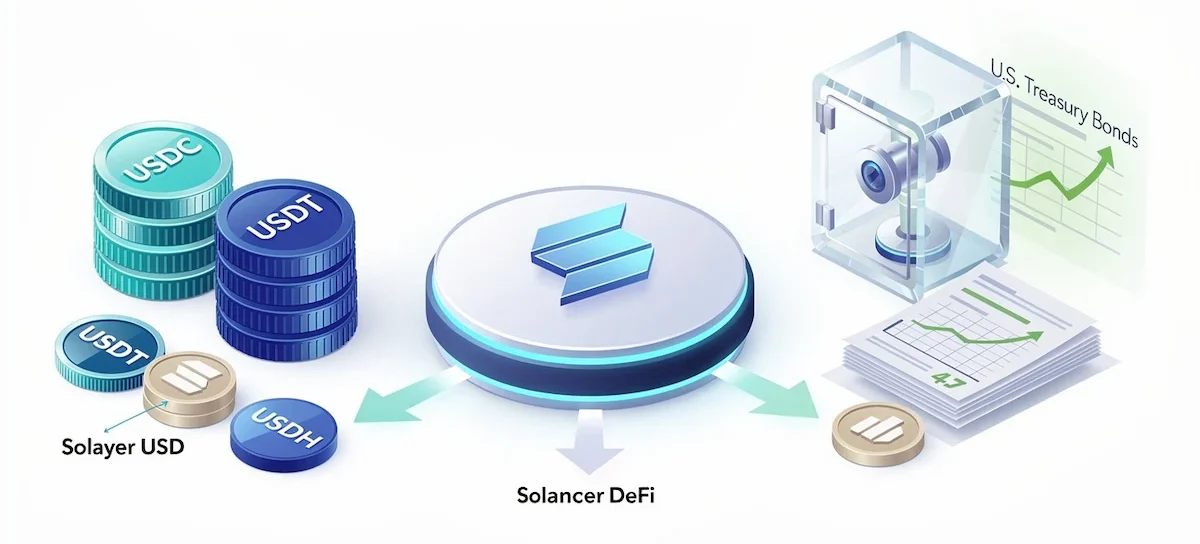
A newer category layered on top of this is real-world asset tokenization, where things like short-term government bonds get represented as an on-chain token that pays yield. Ondo Finance is one of the better known names bringing this kind of product to Solana, offering a token that tracks a yield backed by US Treasury holdings rather than anything tied to crypto market movement. This brings a more traditional, lower-volatility return into the same wallets and protocols people already use for everything else in Solana DeFi, and it has been one of the faster-growing corners of the ecosystem over the past year or two.
NFTs and Meme Coins Within the DeFi Ecosystem
DeFi on Solana does not exist in a bubble separate from the rest of what happens on the chain, and two categories worth a quick mention here are NFTs and meme coins, both of which lean on the same underlying DeFi infrastructure even though they get talked about as their own thing. NFT marketplaces use the same wallets and often the same swap infrastructure as any other DeFi app, and NFT lending, where a collection can be used as collateral for a loan, blurs the line between the two categories directly.
Meme coins have become an enormous part of daily activity on Solana, with millions of tokens launched through platforms built specifically for this purpose. Nearly all of that trading happens through the same decentralized exchanges covered above, which means the DEX and liquidity infrastructure built for serious DeFi use is also what powers the meme coin trading that Solana has become known for. Whether that counts as DeFi in the strict sense is a matter of definition, but the plumbing underneath is identical either way.
Key DeFi Terms Every Solana User Should Know
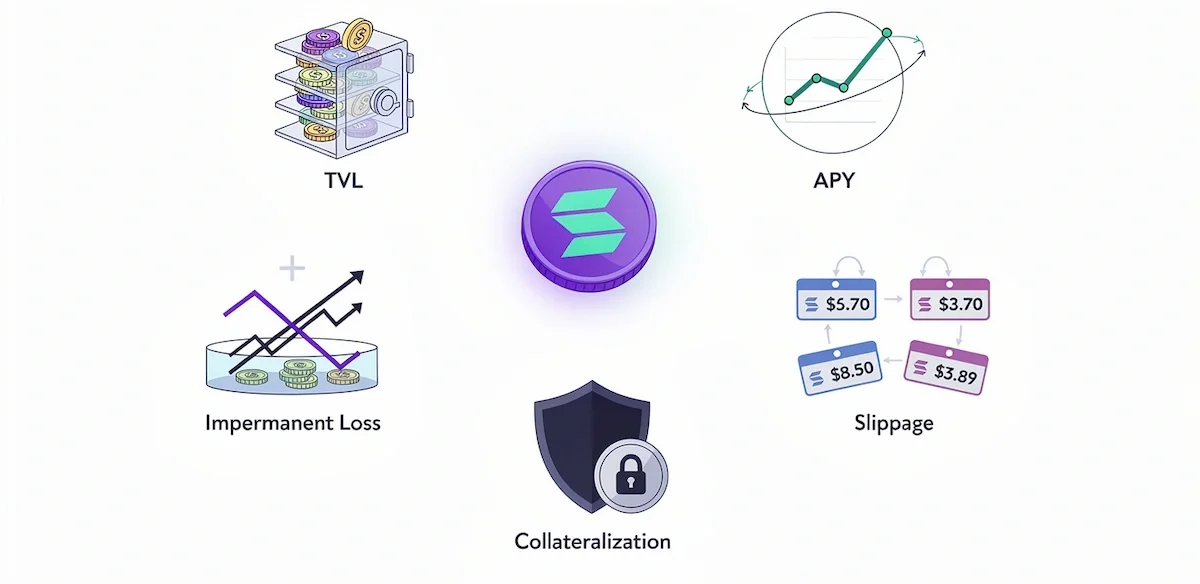
Total Value Locked (TVL)
TVL measures the total amount of money deposited across a protocol or an entire blockchain’s DeFi apps. A higher TVL often signals more trust and usage, though it is not a guarantee that a protocol is safe, just a sign that more capital has chosen to sit there.
Annual Percentage Yield (APY)
APY is the yearly return a position earns, including the effect of compounding. A 10 percent APY on a $1,000 deposit works out to roughly $100 over a year, assuming the rate stays constant, which in DeFi it rarely does.
Impermanent Loss
As covered above, this is the reduction in value that can happen when the tokens inside a liquidity pool move apart in price compared to simply holding them separately. It is one of the first concepts worth understanding before supplying liquidity anywhere.
Slippage
Slippage is the gap between the price you expect on a trade and the price you actually get once it executes. It tends to be larger on bigger trades or in pools with thin liquidity, and most DEX interfaces let you set a maximum slippage tolerance to protect against a trade executing at a worse price than planned.
Collateralization
This is the practice of backing a loan with an asset worth more than the amount borrowed, and almost every lending protocol in Solana DeFi requires it. Deposit $150 worth of SOL to borrow $100 of USDC, for example, and that extra buffer protects the lender if SOL’s price drops, since the protocol can liquidate the collateral before the loan becomes worth more than what is backing it.
Benefits of Using DeFi on Solana
- Speed: transactions confirm in well under a second, so swaps, deposits, and withdrawals feel close to instant.
- Low cost: fees are small enough that frequent, active use does not eat into returns the way it can elsewhere.
- Open access: anyone with a wallet and an internet connection can use these apps, with no account approval process standing in the way.
- Self custody: your assets sit in your own wallet rather than a company’s balance sheet.
Risks and Limitations of Solana DeFi
None of this comes without tradeoffs, and being honest about the downsides matters as much as understanding the upside. Smart contract bugs are the most direct risk, since a flaw in a protocol’s code can be exploited to drain funds, and no amount of caution on your part can fix a vulnerability in someone else’s program. Market volatility affects every position, and leveraged derivatives in particular can lose value quickly during a sharp move.
Solana itself has had a history of network outages in its earlier years, periods where the chain stopped processing transactions entirely, though the frequency of these events has dropped considerably as the network has matured. There is also an ongoing conversation about decentralization, since Solana is generally considered more centralized around a smaller set of validators compared to a network like Ethereum, even though it remains meaningfully decentralized compared to any centralized exchange or bank. None of these risks are a reason to avoid Solana DeFi entirely, but they are worth weighing honestly before committing serious money to any single protocol.
How to Get Started With Solana DeFi
Getting into Solana DeFi for the first time does not require much beyond a wallet and a small amount of SOL to cover fees. If you have not set one up yet, our walkthrough on setting up a Phantom wallet covers the installation and security basics from the start, including how to back up your seed phrase properly before you ever connect to a DeFi app. A wallet is the one piece of this whole process you genuinely cannot skip, since every DeFi interaction, from swapping tokens to depositing into a lending pool, happens by approving a transaction directly from it.
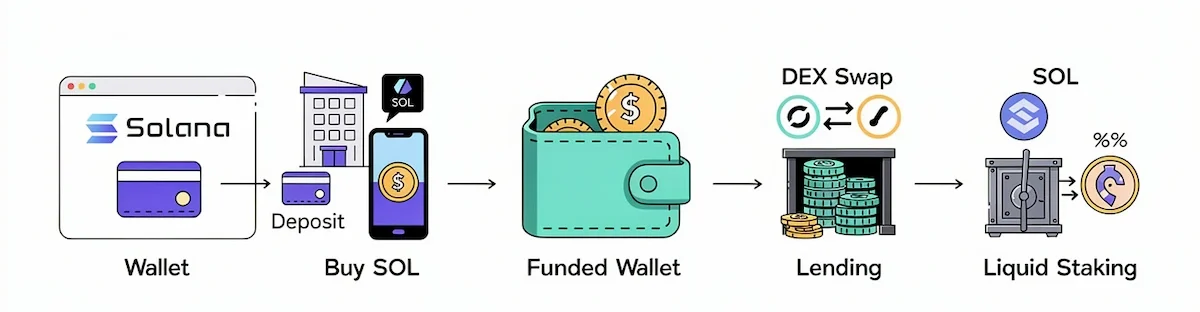
Once your wallet is set up, the next step is funding it. Most people buy SOL on a centralized exchange and send it over, though some wallets now support buying directly inside the app itself. Either way, you only need a small amount to get started experimenting, there is no reason to deposit more than you are comfortable learning with while you get a feel for how everything connects. Our guide on how to buy Solana walks through the simplest ways to get your first tokens.
From there, the usual path is to start with a simple swap on a DEX before touching anything more complex. Connect your wallet, pick the tokens you want to trade, review the rate, and confirm. Once that feels comfortable, exploring a lending platform with stable assets, or trying a liquid staking token, are natural next steps that carry lower complexity than jumping straight into leveraged derivatives or layered yield farming strategies.
Safety Tips Before You Start
- Start small. Use an amount you are comfortable learning with before committing more.
- Stick to established protocols that have operated for a while and gone through a security audit.
- Watch for red flags such as guaranteed returns, pressure to act quickly, or anonymous teams with no track record.
- Keep your seed phrase private and never enter it anywhere outside your own wallet app.
- Double check every transaction before approving it, since DeFi transactions cannot be reversed once confirmed.
Security habits matter just as much as picking the right protocols, and this is honestly the part most newcomers underestimate. Our guide on keeping Solana safe covers practical steps for protecting your wallet, from how you store your seed phrase to how you check a site is legitimate before connecting.
Most losses in Solana DeFi do not actually come from protocol hacks or smart contract bugs, they come from scams and phishing, fake websites that look identical to a real app, malicious browser extensions, or messages pretending to be support staff asking for your seed phrase. No legitimate protocol or wallet provider will ever ask for your seed phrase under any circumstance, and treating that request as an automatic red flag will protect you from the large majority of scams out there. Our overview of common Solana scams is worth a read before you start connecting your wallet to new apps.
Solana DeFi vs Ethereum DeFi
Ethereum was where DeFi first took off, and it still holds a larger total amount of value locked across its protocols today. What Solana offers instead is speed and cost. Transactions that cost a dollar or more on Ethereum during busy periods cost a fraction of a cent on Solana, and confirmation that can take minutes on Ethereum happens in under a second here. Ethereum generally wins on the sheer number of established, battle-tested protocols and overall decentralization, while Solana has carved out a reputation as the place where fast-moving trading activity, frequent small transactions, and newer experimental apps tend to land first.
Bottom Line
Solana DeFi covers a wide and still-growing set of tools, trading, lending, yield farming, staking, and more, all running without a central company in the middle. The speed and low cost of the underlying network is what makes frequent, everyday use of these tools realistic rather than something only reserved for large transactions. Like any corner of DeFi, it comes with genuine risk alongside the opportunity, and the people who do well with it tend to be the ones who start small, stick to established protocols, and take the time to understand what they are actually using before putting serious money behind it.
Frequently Asked Questions
What is DeFi on Solana?
Solana DeFi is the set of decentralized apps and protocols built on the Solana blockchain that let people trade, lend, borrow, and earn yield using smart contracts instead of traditional financial institutions.
Is Solana DeFi safe to use?
It carries real risk, including smart contract bugs, market volatility, and scams, but established protocols that have been audited and operated for a long time are generally considered safer starting points than newer, unproven ones.
What is the difference between staking and yield farming?
Staking involves delegating SOL to a validator to help secure the network and earn rewards, while yield farming usually means supplying liquidity or tokens to a DeFi protocol to earn trading fees or incentive rewards, often carrying more risk in exchange for potentially higher returns.
Do I need a lot of money to start using Solana DeFi?
No. Low transaction fees mean you can start with a small amount, try a simple swap, and work your way up to more complex strategies once you understand how each type of protocol works.
What is TVL and why does it matter?
TVL, or total value locked, measures how much money sits deposited in a protocol or across an entire blockchain’s DeFi ecosystem. It is a useful signal of trust and usage, though a high TVL alone does not guarantee a protocol is safe.
Can I lose money using Solana DeFi?
Yes. Risks include impermanent loss, liquidations on leveraged positions, smart contract failures, and ordinary market downturns. Only use funds you are prepared to lose, especially while you are still learning.
Is Solana DeFi taxed?
In most countries, yes. Swaps, lending rewards, and staking income are generally treated as taxable events. Our broader overview of Solana taxes covers how trading, staking, and DeFi activity are typically taxed.
How is Solana different from Ethereum for DeFi?
Solana offers significantly faster transactions and lower fees, which suits frequent trading and smaller transactions well. Ethereum holds a larger, more established base of DeFi protocols and is generally viewed as more decentralized, with each network appealing to somewhat different use cases.