Jito is the name behind a piece of Solana infrastructure most holders use without realizing it. It runs the validator software that handles a majority of the network’s blocks, it issues a liquid staking token called JitoSOL, and it has a governance token called JTO. Three different things, one project, and a fair amount of confusion about how they fit together.
The short version is that Jito is a Solana protocol built around MEV, short for maximal extractable value, and liquid staking. It captures extra revenue that would otherwise sit invisibly inside the network and routes a share of it back to ordinary stakers. Below we break down what that actually means, how the pieces work together, and what to know before staking through it.
What Is Jito, in Plain English
Jito is a Solana infrastructure project that does two connected jobs. First, it runs a modified version of the Solana validator client that most of the network’s validators have adopted, and that client handles how transactions get ordered inside a block. Second, it operates a liquid staking pool. Deposit SOL and you receive JitoSOL back, a token that keeps growing in value as it earns both regular staking rewards and a share of MEV revenue.
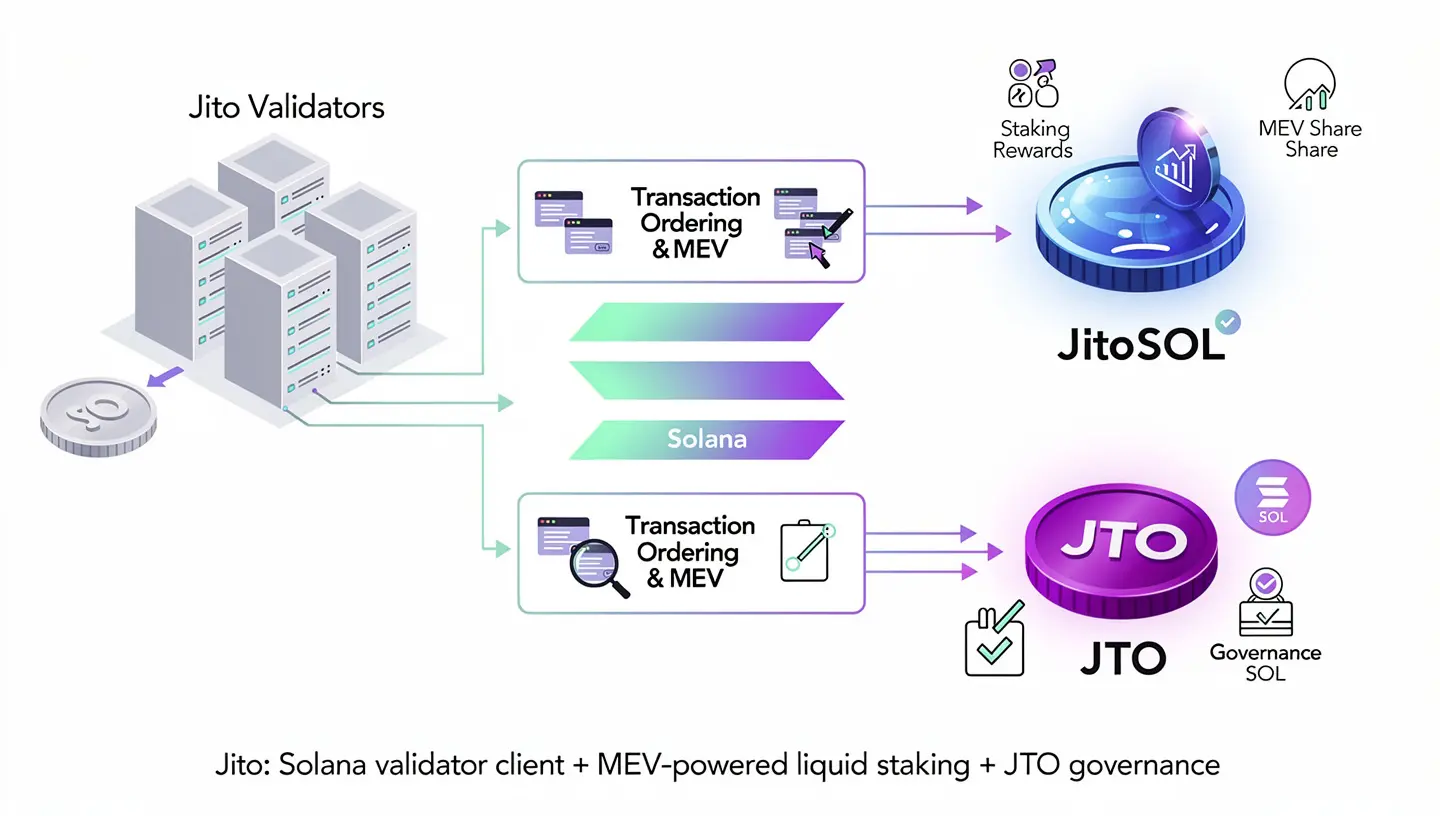
JTO, the third piece, is separate from JitoSOL. It is a governance token, not a yield-bearing asset, and holding it gives you voting power over how the protocol is run rather than a direct claim on staking returns.
What MEV Actually Is
Most people understand plain staking well enough. Lock up SOL, a validator does the work, you get a percentage back. What that simple picture leaves out is that validators can also earn a second, less visible stream of income by controlling which transactions go into a block and in what order. That second stream is MEV, maximal extractable value.
Picture a large swap on one decentralized exchange that pushes a token’s price out of line with where it trades on another exchange. Whoever gets to act on that gap first captures a profit, and the validator producing the block has the power to decide who gets that spot. On a fast, high-volume network like Solana, opportunities like this show up constantly, and the value involved has grown into a genuinely large part of how the network’s economics actually work.
How Jito Works as a Protocol
The Jito-Solana Validator Client
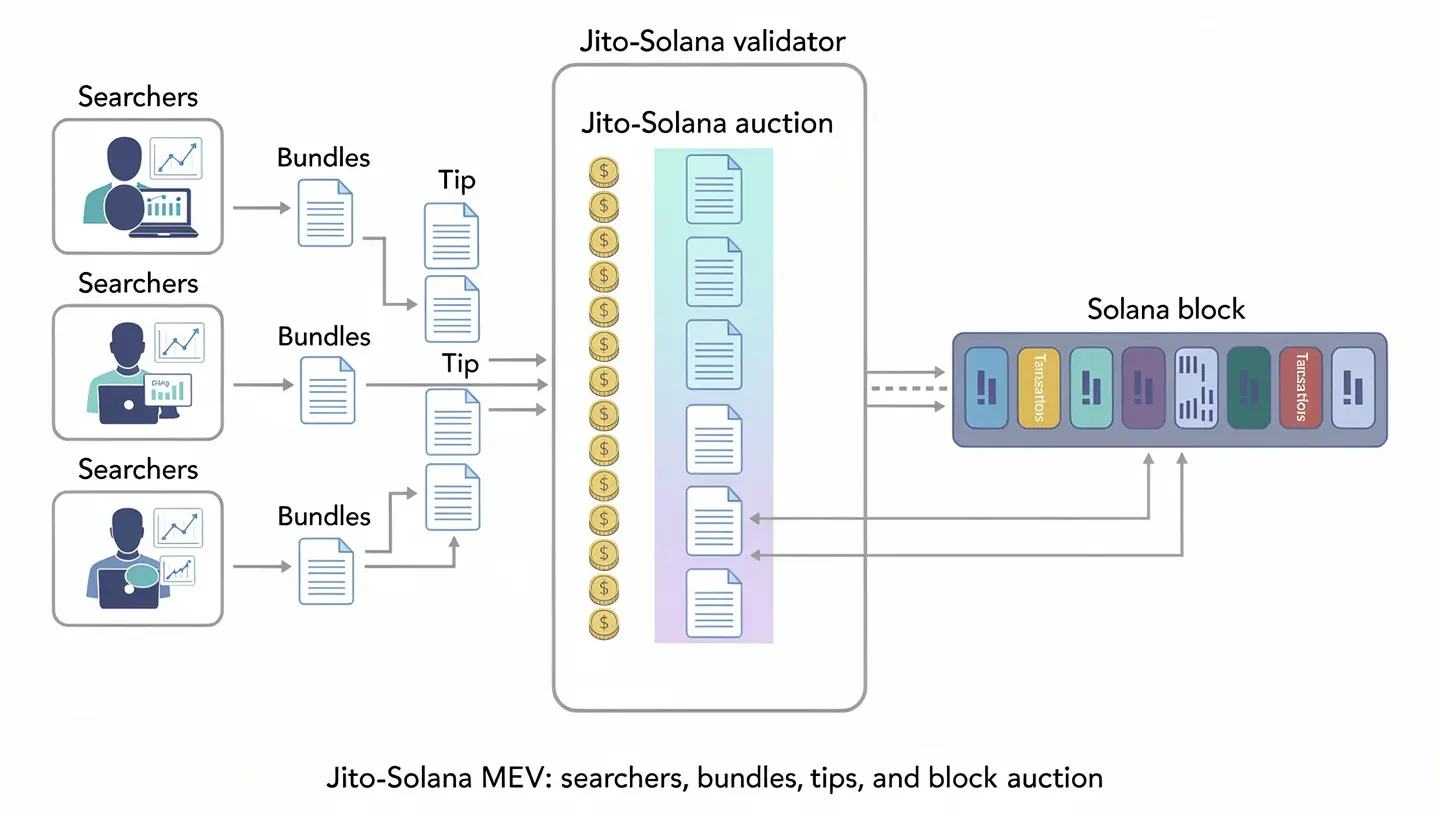
Jito Labs built its own version of the Solana validator software, generally called the Jito-Solana client. Rather than letting MEV opportunities get captured in a chaotic, unpredictable way, this client introduces a structured auction for block space. Specialized traders, usually called searchers, submit groups of transactions along with a tip, and validators running the Jito client accept that tip in exchange for placing the group in the right spot in the block.
Bundles, Tips, and the Block Auction
These grouped transactions are called bundles. A bundle either executes completely, in the exact order submitted, or it fails entirely, which protects the searcher from a half-finished trade landing badly. Validators earn the tip attached to each bundle, and because Jito-client validators now make up the large majority of Solana’s active stake, this auction system has effectively become the standard way blockspace gets priced on the network.
Why Solana’s MEV Looks Different From Other Chains
Solana does not use a public waiting area for pending transactions the way some other blockchains do. Transactions go straight to the validator scheduled to produce the next block, which cuts down on some of the obvious front-running seen elsewhere, but it does not remove MEV, it just moves where the activity happens. Instead of bots watching a public queue, most of the action now happens through the searcher and bundle system Jito built around.
JitoSOL: The Liquid Staking Token
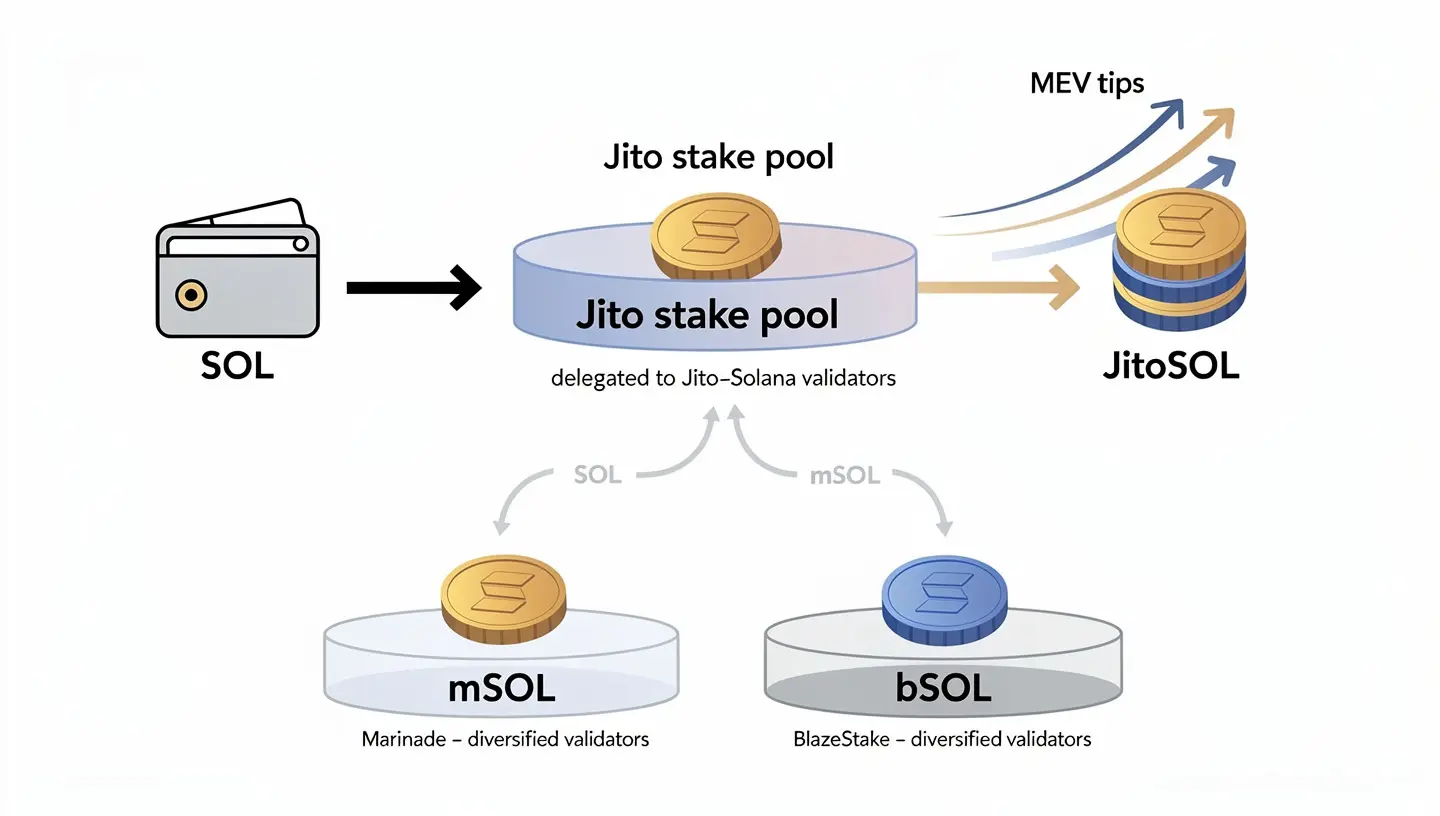
JitoSOL is what most everyday users actually interact with. Deposit SOL into the Jito stake pool and you get JitoSOL in return, a token that represents your share of the pool. Unlike regular staking, where rewards trickle in as more SOL added directly to your balance, JitoSOL’s value simply rises against SOL over time as rewards accumulate inside the pool.
How JitoSOL Combines Staking Rewards and MEV
The yield behind JitoSOL comes from two sources stacked together. The base layer is ordinary Solana staking rewards, the same inflation-driven return any staked SOL earns. On top of that sits a second layer, the tips collected by Jito-client validators, pooled and passed along to JitoSOL holders. In practice this has usually added a modest boost above standard staking yield, though the exact size of that boost moves with how much trading activity is happening on the network at any given time. If you want the fuller picture of how staking rewards accumulate in general before layering MEV on top, our guide on Solana staking rewards covers the basics.
JitoSOL vs mSOL vs bSOL
JitoSOL is not the only liquid staking token on Solana, and it helps to see where it sits among the alternatives. Marinade Finance issues mSOL, one of the oldest liquid staking tokens on the network, and it spreads delegation across a wide, diversified set of validators chosen through an open scoring system rather than focusing on any single client. BlazeStake issues bSOL, which takes a similar broad-delegation approach with its own validator selection method. Both work on the same core principle as JitoSOL: deposit SOL and receive a token that grows in value over time as staking rewards accumulate inside the pool, with no separate reward transactions to track.
The real difference is what sits underneath the yield. JitoSOL specifically delegates only to validators running the Jito-Solana client, which is exactly what lets it layer MEV tips on top of ordinary staking rewards. mSOL and bSOL, by spreading delegation more broadly across validators regardless of which client they run, generally do not capture that same extra layer, though some of their delegated validators may still run Jito’s software independently. In practice this means JitoSOL has historically shown a modest yield edge over the other two during periods of heavy network activity, while mSOL and bSOL can offer a slightly more diversified validator set in exchange. Our side by side comparison of mSOL versus JitoSOL versus bSOL goes much deeper into how the three actually compare on yield, decentralization, and risk profile.
Choosing between them usually comes down to what you value more, the extra yield potential from MEV capture or a validator set spread more widely across the network. Some stakers split their position across more than one liquid staking token for exactly this reason, treating it as a simple form of diversification rather than betting everything on a single protocol’s approach. If you are still weighing where to stake in the first place and want a broader comparison beyond just the token mechanics, our breakdown of Marinade versus Jito versus Coinbase covers fees, decentralization, and ease of use across all three options.
JTO: The Governance Token
JTO is a separate instrument from JitoSOL, and mixing the two up is one of the most common points of confusion. Holding JitoSOL earns you staking and MEV yield. Holding JTO gives you a vote in the Jito DAO, which controls things like stake pool fee settings, treasury spending, and how validators get chosen for delegation through the protocol’s StakeNet program. JTO does not automatically pay you a share of protocol revenue the way a dividend would, though governance proposals about directing more of that revenue toward JTO holders have been an ongoing topic within the DAO.
Where Jito Came From
Jito Labs was founded by Lucas Bruder and Zano Sherwani, and the team began by building searcher tooling before turning that experience into the validator client and block engine the protocol runs today. The Jito-Solana client launched publicly in 2022, and the JitoSOL liquid staking pool followed as an extension of that same infrastructure, letting the tips already flowing through the validator network get shared with ordinary stakers rather than staying entirely with searchers and validators. The JTO governance token arrived later, distributed through an airdrop to early users of the protocol, and it has traded on major exchanges since.
What makes Jito notable within the Solana ecosystem is how these pieces reinforce each other. The validator client generates tip revenue, the liquid staking pool distributes a share of that revenue to depositors, and the governance token gives the community a say in how the whole system is tuned going forward. Few projects on Solana combine infrastructure, a yield product, and governance quite this tightly, which is part of why Jito has grown into one of the more closely watched protocols on the network.
Extractive MEV vs Value-Creating MEV
Not every form of MEV is harmful, even though the term often gets used as shorthand for something predatory. A few common patterns worth knowing:
- Sandwich attacks: a bot places trades immediately before and after a user’s transaction to profit off the price movement it causes, worsening the outcome for the original trader.
- Toxic arbitrage: exploiting a price gap between exchanges in a way that degrades execution quality for regular users caught in between.
- Cross-exchange arbitrage: balancing prices across different decentralized exchanges, which actually narrows spreads and can improve pricing for everyone else.
- Efficient liquidations: closing out underwater lending positions quickly and cleanly, which keeps lending protocols solvent without unnecessary market disruption.
Jito’s bundle system was built partly to shift the balance toward the second, less harmful category, by making coordinated, value-creating strategies easier to execute cleanly while making pure spam and failed attack attempts more costly to spam the network with.
How Solana’s MEV Differs From Ethereum’s
Ethereum’s approach to MEV runs through a system called proposer-builder separation, where specialized builders assemble blocks and validators simply accept the most profitable one offered to them through a relay network. Solana works differently. It processes transactions in parallel across many independent lanes rather than one shared queue, which creates a much higher volume of potential MEV opportunities per second, but also makes the extraction mechanics more technically involved. Jito’s block engine was built specifically to handle that Solana-native version of the problem rather than simply porting over Ethereum’s model.
Risks to Understand Before Using JitoSOL
Smart Contract Risk
JitoSOL is issued by a protocol built on top of Solana, not by the network itself. Any bug or exploit in Jito’s smart contracts could affect the value of JitoSOL relative to plain SOL. This is a standard risk shared by every liquid staking token, not something unique to Jito.
Validator Concentration Risk
Because so much of Solana’s stake now runs the Jito client, a serious bug in that single piece of software could theoretically ripple across a large share of the network at once. This is a broader concern for Solana’s decentralization generally, not just for people holding JitoSOL, and it is a topic that comes up regularly in discussions about the network’s health.
Governance Risk
The Jito DAO controls fee structures and treasury decisions through JTO voting. A poor governance decision, or a coordinated push by a small group of large holders, could shift parameters in ways that reduce yield or change how the protocol operates, though this remains a lower-probability concern compared to the other risks listed here.
MEV Yield Moves With the Market
The extra return JitoSOL offers over plain staking is not fixed. It depends entirely on how much trading activity is happening on Solana at any given time. During quiet stretches the boost can be small, and during busy, volatile periods it can be considerably larger. Treat it as a variable bonus layered on top of base staking yield, not a guaranteed number.
How to Stake SOL Through Jito
Staking through Jito works the same basic way as any other liquid staking protocol, and the whole process usually takes only a couple of minutes once your wallet is set up. Connect a Solana wallet to the Jito staking interface, choose an amount of SOL to deposit, and confirm the transaction. JitoSOL lands in your wallet almost immediately and starts accruing value from that point forward, with no separate claim step needed the way native staking rewards sometimes require. If you have not set up a self-custody wallet yet, our walkthrough on setting up a Phantom wallet covers the basics before you get to the staking step.
It is worth deciding upfront whether liquid staking actually suits what you are trying to do. Native staking through a validator you pick yourself keeps things simple and avoids relying on a third-party protocol’s smart contracts, but it locks your SOL and requires an unstaking wait whenever you want it back. Liquid staking through Jito trades that simplicity for flexibility, letting your position stay usable the whole time at the cost of the additional protocol risk described earlier. If you want to compare both routes properly before deciding which fits your situation, our guide on how to stake Solana walks through native delegation step by step alongside the liquid staking alternative.
Using JitoSOL in DeFi
Because JitoSOL is a standard token rather than a locked position, it can move freely through Solana’s decentralized finance apps while still earning its underlying yield in the background. Holders use it as collateral on lending platforms to borrow against without giving up staking returns, supply it into liquidity pools alongside other assets to earn trading fees on top, or simply hold it as a yield-bearing asset that stays fully liquid the whole time rather than sitting locked in a stake account. This composability is a big part of why liquid staking tokens in general have become popular across Solana, since they let a single position generate staking yield and DeFi yield at the same time instead of forcing a choice between the two.
The tradeoff worth keeping in mind is that stacking strategies on top of JitoSOL layers additional risk on top of the liquid staking risk already covered above. Using it as collateral introduces liquidation risk if the borrowed position moves against you, and depositing it into a liquidity pool introduces impermanent loss risk on top of everything else. None of this makes JitoSOL unsuitable for DeFi, it is simply worth sizing any additional strategy with the underlying protocol risk already in mind. Our rundown of the best DEX platforms on Solana is a good next stop if you want to see where JitoSOL and similar tokens actually get put to work.
Who Should Actually Care About Jito
Not every SOL holder needs to think hard about this. If you already hold SOL on a centralized exchange’s staking product, you are almost certainly not capturing any MEV yield at all, since most exchanges keep that revenue for themselves. If you are staking natively through a wallet, you are earning base rewards but missing the MEV layer unless you specifically chose a Jito-client validator. Active DeFi users get the most out of JitoSOL’s composability, since it lets staking yield sit underneath other strategies rather than being locked away. Anyone more interested in shaping how the protocol itself operates, rather than simply earning yield, is the audience JTO is really built for.
Bottom Line
Jito sits at an unusual intersection of three roles on Solana: validator software, MEV infrastructure, and liquid staking provider. JitoSOL is how ordinary holders access the yield that setup generates, JTO is how the protocol’s direction gets decided, and understanding the difference between the two clears up most of the confusion people run into. MEV itself is not going away, and Jito has become the main way Solana turned what used to be invisible, one-sided profit into something shared more broadly with everyday stakers.
Frequently Asked Questions
What is Jito in simple terms?
Jito is a Solana protocol that runs validator software used by most of the network, operates a liquid staking pool that issues JitoSOL, and has a governance token called JTO. It is built around capturing MEV and sharing it with stakers.
Is JitoSOL the same thing as JTO?
No. JitoSOL is a liquid staking token that earns staking and MEV yield. JTO is a separate governance token that lets holders vote on how the protocol is run.
Is JitoSOL safe to hold?
JitoSOL carries the same general risks as other liquid staking tokens, mainly smart contract risk and the broader concern around how concentrated Solana’s validator set has become around the Jito client. It is not risk-free, but it has been operating and audited for some time.
How is JitoSOL different from staking SOL directly?
Native staking locks SOL to a validator and pays rewards directly into your stake balance. JitoSOL instead gives you a liquid token that rises in value over time, stays usable across DeFi, and adds a share of MEV revenue on top of base staking rewards.
What is MEV and why does it matter on Solana?
MEV is the extra profit a validator can capture by choosing which transactions to include in a block and in what order. On a fast, high-volume network like Solana, this has grown into a meaningful part of overall network economics, which is why a protocol built specifically to manage it matters.
Does Jito control most of Solana’s validators?
The Jito-Solana client is run by a large majority of the network’s active stake, though the validators themselves remain independently operated. Jito provides the software and auction infrastructure rather than directly running every validator.
Can I use JitoSOL in DeFi protocols?
Yes. JitoSOL is a standard SPL token, so it can be used as collateral, supplied to liquidity pools, or traded like any other token while it continues earning its underlying yield in the background.
Is Jito the same as Jito Labs?
Jito Labs is the company that built the Jito-Solana client and the broader protocol. The Jito Foundation and the Jito DAO oversee governance through the JTO token. In everyday conversation, people mostly just say Jito to refer to the whole project.