Solana moves fast, and that speed is exactly what makes tax season painful for anyone who uses it seriously. A single afternoon of swapping on Jupiter, staking a bit of SOL, and farming a new pool can generate dozens of separate events that a tax authority expects you to report. None of the underlying rules are unique to Solana, crypto is still treated the same way everywhere, but the sheer volume and speed of activity on this chain is what trips people up.
This guide walks through how Solana is taxed in plain terms, covering staking, trading, DeFi, NFTs, memecoins, and what to actually put on your return when the year ends. None of this is personal tax advice, just a clear picture of how the rules generally apply so you are not guessing.
Do You Have to Pay Taxes on Solana
Yes. In the United States and most other countries, cryptocurrency including SOL is treated as property, not currency. That single classification is the root of almost every rule that follows. Selling, trading, or spending SOL creates a capital gain or loss, calculated as what you received minus what you originally paid. Earning SOL through staking, airdrops, or other rewards creates ordinary income, taxed at its value the day you received it.
Two things are never taxable on their own: buying SOL with cash, and simply holding it. You only owe something once you dispose of the asset or receive new value from it.
What Counts as a Taxable Event on Solana
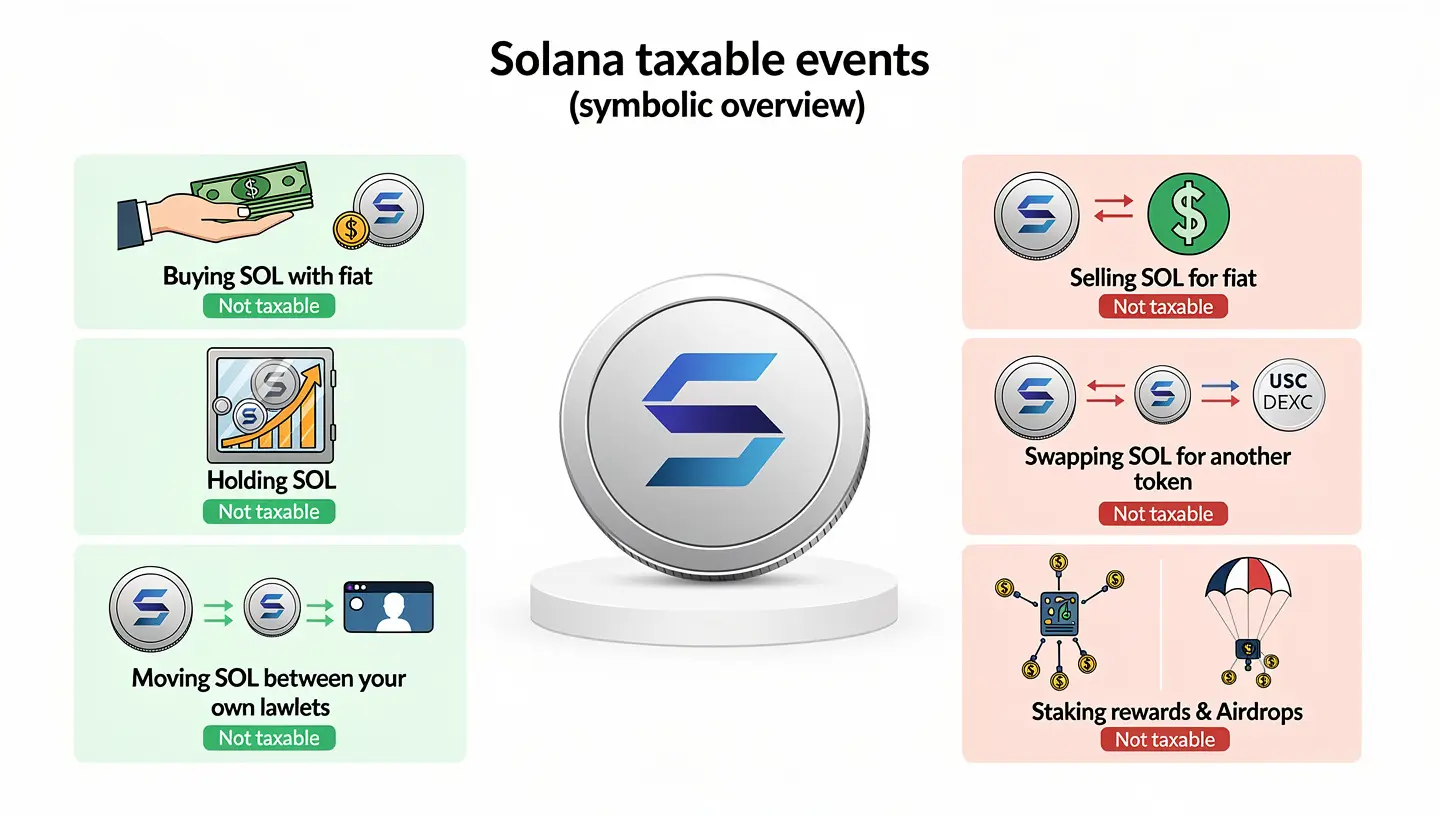
Here is a quick breakdown of the common Solana actions and how they are typically treated.
| Action | Taxable? | How it works |
|---|---|---|
| Buying SOL with fiat | No | Sets your cost basis, no tax owed yet |
| Holding SOL | No | No tax on unrealized gains, no matter how much it rises |
| Selling SOL for fiat | Yes | Capital gain or loss based on proceeds minus basis |
| Swapping SOL for another token | Yes | Treated as a disposal, same as a sale |
| Moving SOL between your own wallets | No | Not a disposal, basis carries over |
| Staking rewards | Yes | Ordinary income at value when received |
| Airdrops | Yes | Ordinary income at value when received |
The swap row surprises the most people. Trading SOL for USDC or any other token on a decentralized exchange feels like moving sideways, but the tax authority sees a completed sale at that moment’s price, whether or not any cash ever touched your bank account.
Solana Tax Rates for 2026
There is no separate rate just for Solana. What matters is how long you held the asset and how much you earn overall.
- Short-term capital gains, for SOL held one year or less, are taxed at your regular income tax bracket, which can run as high as 37 percent in the US.
- Long-term capital gains, for SOL held more than a year, get a lower rate, generally 0, 15, or 20 percent depending on your total income.
- Staking rewards and airdrops are always ordinary income at the time you receive them, no matter how long you later hold the tokens. Each reward starts its own separate holding clock for capital gains purposes.
Active traders flipping tokens inside a year end up paying the higher ordinary rate on those gains, essentially the same bracket that applies to a paycheck, which is one reason short-term Solana trading can carry a heavier tax load than people expect.
How Are Solana Staking Rewards Taxed
The Epoch Problem: Why Staking Creates So Many Tax Events
When you delegate SOL to a validator, rewards post automatically every epoch, roughly every two to three days, and compound straight back into your stake without you pressing anything. The standard position is that each of these credits counts as income the moment it lands, because you have the ability to unstake and move the coins at any point, a concept usually called dominion and control. A full year of staking can generate well over a hundred separate income entries, each with its own dated value, which is exactly why manual spreadsheets fall apart fast for active stakers. If you want the deeper mechanics of how staking rewards accrue in the first place, our guide on Solana staking rewards covers the full picture before we go further into how the income side actually gets taxed.
Native Staking vs Liquid Staking
Liquid staking tokens work differently from a tax standpoint. Instead of collecting individual reward credits, holders of tokens like mSOL, JitoSOL, or bSOL watch the token’s redemption value climb against SOL over time. Whether minting or redeeming these tokens counts as a taxable trade is genuinely unsettled, with tax professionals split between a conservative position, treating the swap into and out of the token as a disposal, and a more aggressive one that treats it as a simple deposit and withdrawal.
Neither position has been confirmed by regulators yet, so whichever you choose, apply it consistently. If you want a full breakdown of the reporting side of native staking rewards specifically, including forms and common mistakes, our dedicated piece on whether Solana staking rewards are taxed goes much deeper than we have room for here.
Running a Validator: Business or Hobby
Delegating is not the only way to earn from staking. Some holders run their own validator instead, and that choice changes the tax picture more than people expect. Operating your own validator, rather than simply delegating, usually shifts the picture into business territory. Commission income and block rewards are still ordinary income, but they typically land on a business schedule rather than a simple income line, which opens the door to deducting real costs like hardware and hosting while also introducing self-employment tax on the profit.
Anyone weighing whether to run infrastructure themselves should read our overview of how a Solana validator node works before deciding, since the tax picture changes quite a bit once real business expenses and self-employment obligations enter the equation.
How Solana Trading and Swaps Are Taxed
Away from staking, plain buying and selling is where most people rack up their actual gains and losses. Every sale or swap of SOL, whether it lands in your bank account as cash or simply becomes a different token, is a disposal. Your gain or loss equals the value you received minus your cost basis, the amount you originally paid including fees, and this is the calculation that ends up on your return far more often than anything staking related. If you have not yet picked a place to buy your first SOL, our walkthrough on how to buy Solana covers the practical steps, and it is worth keeping receipts and screenshots from whichever platform you use, since that is your primary proof of cost basis if anything is ever questioned.
Trading directly on a decentralized exchange follows the exact same rule as trading on a centralized one. The tax authority does not care whether the swap happened through an order book or an automated market maker, a completed trade is a completed trade either way. The same logic applies in reverse once you are ready to cash out. Selling SOL for stablecoins on a DEX and selling it for dollars on a centralized platform produce the same kind of taxable disposal, just with different paperwork trailing behind them, so it helps to plan the exit the same way you planned the entry. Our guide on how to sell Solana walks through the main routes and what to expect at each one.
How Solana DeFi Activity Is Taxed
Swapping on Jupiter, Raydium, and Orca
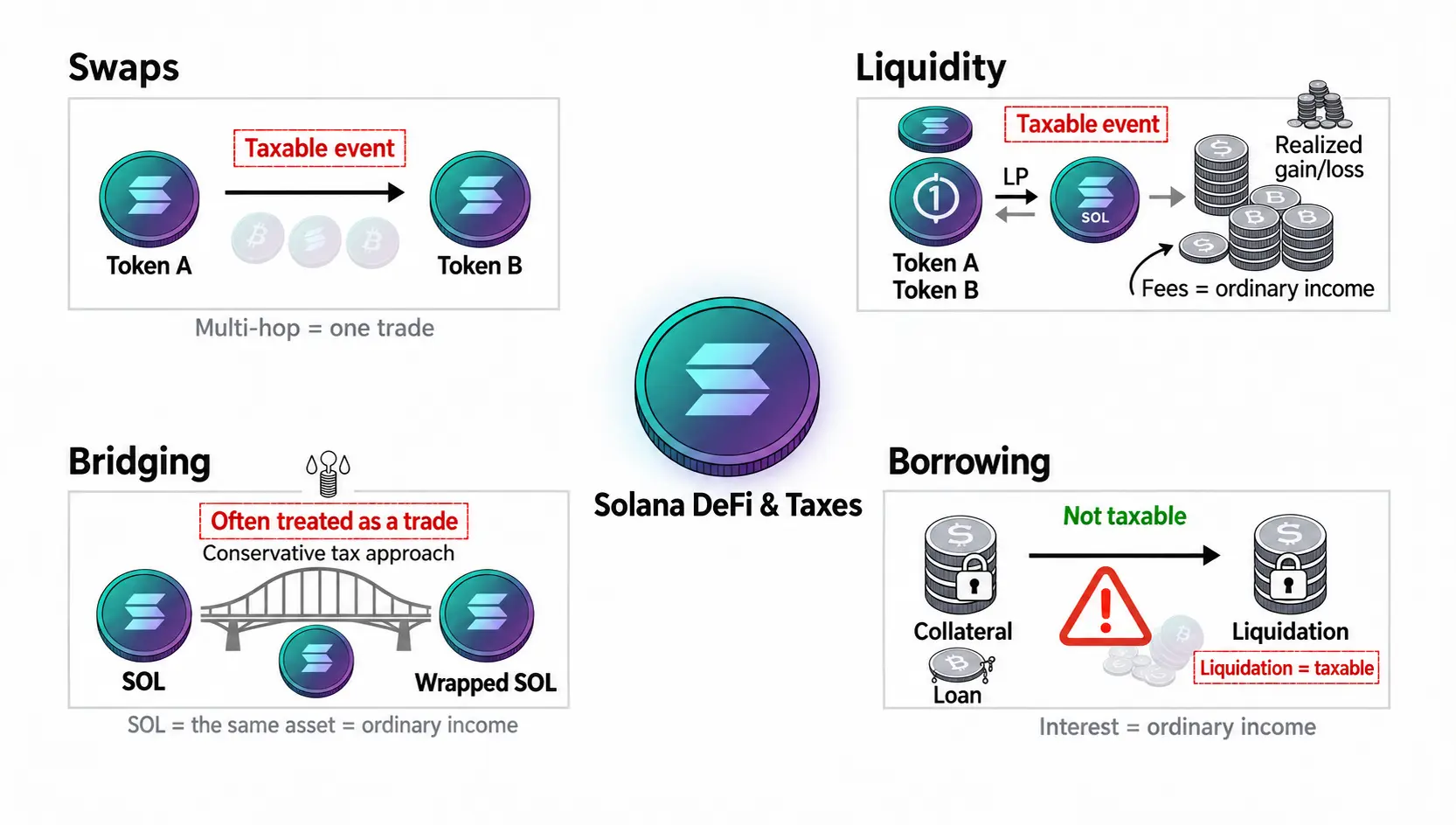
Every swap on a Solana decentralized exchange, whether it routes through Jupiter, Raydium, or Orca, disposes of one token and acquires another, and that is a taxable event each time. Multi-hop swaps that pass through several tokens along the way are generally collapsed into a single trade from the first token to the last, since the intermediate hops are routing mechanics rather than separate positions you actually held.
Providing Liquidity and LP Tokens
Depositing tokens into a liquidity pool on Raydium or Orca and receiving an LP token back is commonly treated as disposing of the tokens you put in, which can trigger a gain or loss right at deposit. Removing liquidity later is its own separate disposal of the LP token, and any impermanent loss or gain gets realized at that point. Fees earned along the way are usually ordinary income at the value when they are credited or claimed. If you are still choosing which exchange to use for this kind of activity, our rundown of the best DEX platforms on Solana compares the main options.
Lending, Borrowing, and Liquidations
Borrowing against your crypto is not itself taxable, since loan proceeds are not income. The exception is liquidation. If your collateral gets seized because your position fell below the required threshold, that forced sale realizes a gain or loss at whatever the market price was that moment, often the worst possible timing. On the lending side, interest earned from protocols is ordinary income at the value when it is received.
Bridging SOL to Other Chains
Moving SOL to another blockchain through a bridge is treated cautiously by most tax platforms as a taxable disposal, since you are technically giving up the original asset and receiving a wrapped or bridged version on a different chain. There is limited formal guidance on this specific action, so many active bridgers choose the conservative route and log it as a trade rather than assuming it is a simple transfer.
How Solana NFTs Are Taxed
Solana NFTs follow the same property rules as everything else on the chain. Buying an NFT with SOL is really two events bundled into one: you are disposing of the SOL at its current value, which can trigger a capital gain or loss, and acquiring the NFT with a cost basis equal to that same value. Selling the NFT later produces its own separate gain or loss. Creator royalties earned from secondary sales count as ordinary income at the time they are received. Compressed NFTs, despite their far lower minting cost, are taxed under the same framework, since the compression is a technical detail rather than a different asset class in the eyes of the rules.
How Memecoins and Pump.fun Tokens Are Taxed
Memecoins bring an extra wrinkle worth knowing about. If you create a token yourself, on a platform like Pump.fun for example, you are generally treated as the original owner of that asset, which means proceeds from any later sale are typically taxed as income with a zero cost basis, since you did not pay anything to acquire it. If instead you simply buy someone else’s token, your cost basis is the fair market value you paid, plus fees, exactly like buying any other crypto asset. Trading memecoins afterward is treated like any other capital gains event.
How Solana Airdrops Are Taxed
Airdropped tokens are ordinary income at their fair market value the day you gain control over them, regardless of whether you ever sell a single token. That value also becomes your cost basis going forward, so a later sale is a separate, second calculation measuring gain or loss from that starting point. This caught a lot of people off guard during past Solana airdrop seasons, when tokens claimed at a high price later dropped in value, leaving holders with a real tax bill on paper gains that had already evaporated by the time they filed.
Cost Basis and Record Keeping for Solana
Your cost basis is simply what you paid for an asset, including fees, or the value you already reported as income for anything you earned rather than bought. Keeping this straight across a busy Solana wallet, with staking rewards, swaps, and NFT trades all mixed together, is the single hardest part of filing accurately. A growing trend across tax authorities is requiring cost basis to be tracked on a wallet by wallet basis rather than pooled together across every account you own, which means transfers between your own wallets need clean records showing the basis moved along with the coins. Because a single active wallet can generate hundreds of dated entries in a year, most people lean on dedicated crypto tax software rather than tracking everything in a spreadsheet by hand.
How to Report Solana Taxes
The general reporting flow in the US looks like this for most individual filers:
- Total your capital gains and losses from every sale, swap, or disposal, and report them on Form 8949 and Schedule D.
- Total your income from staking rewards, airdrops, and similar sources, and report it as other income on Schedule 1, or on Schedule C if the activity rises to the level of a business, such as running a validator.
- Cross-check any 1099-DA forms you received from exchanges against your own records, since these broker forms only cover activity that happened on that specific platform and often miss the correct cost basis for coins that arrived from a self-custody wallet.
- Answer the digital asset question on your main tax form honestly if you sold, traded, spent, or received SOL at any point during the year.
Other countries generally follow the same two-layer pattern, income tax when you earn something and capital gains tax when you dispose of it, though the specific forms and thresholds differ by jurisdiction.
Common Mistakes When Filing Solana Taxes
- Only reporting rewards when they are eventually sold, instead of when they were actually received, which understates income for the correct year.
- Letting reward or airdrop tokens sit with a zero cost basis because the income step was skipped, which then overstates the gain when they are sold later.
- Treating a DEX swap as a non-event just because no fiat currency changed hands.
- Forgetting wallet transfers still need documentation, even though they are not taxable, since missing records can turn into a zero-basis problem down the line.
- Ignoring small transaction fees across hundreds of Solana transactions, which individually mean little but can add up in aggregate.
How to Legally Reduce Your Solana Tax Bill
- Hold past the one-year mark when possible, since long-term capital gains rates are meaningfully lower than short-term ones.
- Harvest losses deliberately. Selling a position that has dropped below your cost basis realizes a loss that can offset gains elsewhere in your portfolio.
- Track reward and airdrop basis carefully, since forgetting it is the most common way people accidentally overpay.
- Think about the liquid staking structure deliberately if you are staking a large position, since native staking and liquid staking tokens currently carry different tax pictures.
- Keep detailed records year-round instead of trying to reconstruct a year of Jupiter swaps and staking rewards in April.
Does Solana Tax Work Differently Outside the US
The overall shape of the rules, income tax on receipt and capital gains tax on disposal, shows up in most countries with published crypto guidance, though the specifics vary. In the United Kingdom, HMRC treats staking rewards as miscellaneous income at receipt, with a separate capital gains calculation on disposal. In Australia, the ATO follows a similar two-step approach. Canada has not issued detailed staking-specific guidance, so treatment often depends on whether the activity looks more like investing or running a business. Always check the guidance for your own country rather than assuming the US framework applies directly.
Bottom Line
Solana tax rules are not fundamentally different from any other crypto network, but the speed and volume of activity the chain allows means the average active user racks up far more taxable events in a year than someone holding a slower asset. Staking rewards post every couple of days, DeFi strategies can chain together dozens of swaps in a single session, and even creating a memecoin comes with its own quiet tax consequence. None of this replaces advice from a qualified tax professional who knows your specific situation, but understanding the shape of the rules ahead of time makes the whole process far less stressful once filing season actually arrives.
Frequently Asked Questions
Do you have to pay taxes on Solana?
Yes. Solana is treated as property in most countries, so selling, trading, or spending it can trigger capital gains tax, and earning it through staking or airdrops counts as ordinary income at the time you receive it.
Is staking SOL a taxable event?
Staking rewards themselves are taxable as ordinary income at the moment they are credited to your stake account, generally every epoch. Delegating and later withdrawing your original SOL is not a taxable event on its own.
Are mSOL and JitoSOL taxed the same as regular SOL?
Not exactly. Liquid staking tokens accrue value through a rising redemption rate rather than separate reward payments, and whether minting or redeeming them counts as a taxable trade is still an unsettled question among tax professionals.
Is swapping tokens on a Solana DEX taxable?
Yes. Any swap on Jupiter, Raydium, Orca, or another decentralized exchange is treated as a disposal of the token you gave up, triggering a capital gain or loss, exactly the same as selling it for cash.
Are Solana airdrops taxable if I never sell them?
Yes. Airdropped tokens are ordinary income at their fair market value on the day you gain control over them, regardless of whether you ever sell, and that value becomes the cost basis for any later sale.
Do I owe tax on memecoins I created on Pump.fun?
Generally yes. If you create a token yourself, proceeds from selling it are typically taxed as income with a zero cost basis, since you did not pay to acquire it in the first place.
Is transferring SOL between my own wallets taxable?
No. Moving SOL from one wallet you own to another is not a disposal, so it does not trigger a gain or loss. Your original cost basis and holding period carry over with the coins.
Does the IRS know about my Solana wallet activity?
Exchange activity is increasingly visible through broker reporting forms, but self-custody activity in a wallet like Phantom does not generate any automatic form. It is still fully reportable, and blockchain activity is generally more traceable than people assume.