If you’re holding SOL and wondering whether it’s worth putting to work, Solana staking rewards are one of the easiest ways to earn passive income without selling a single token. Instead of letting SOL sit idle, you delegate it to a validator and collect a share of the network’s rewards every couple of days. This guide covers exactly how Solana staking rewards are generated, how the APY is calculated, how much you can realistically earn on different amounts, and which platforms make sense now that Binance has suspended services for EU users under MiCA. Average yields currently land between five and nine percent a year depending on the platform and staking method, which puts Solana staking rewards among the better risk-adjusted returns in crypto right now.
What Are Solana Staking Rewards
Solana runs on a system called delegated proof of stake. Instead of miners competing to solve puzzles like on Bitcoin, the network relies on validators, computers that confirm transactions and propose new blocks. For someone to become a validator, or simply to earn a share of rewards without running one, SOL needs to be staked, meaning it’s locked up as a guarantee that the validator behaves honestly.
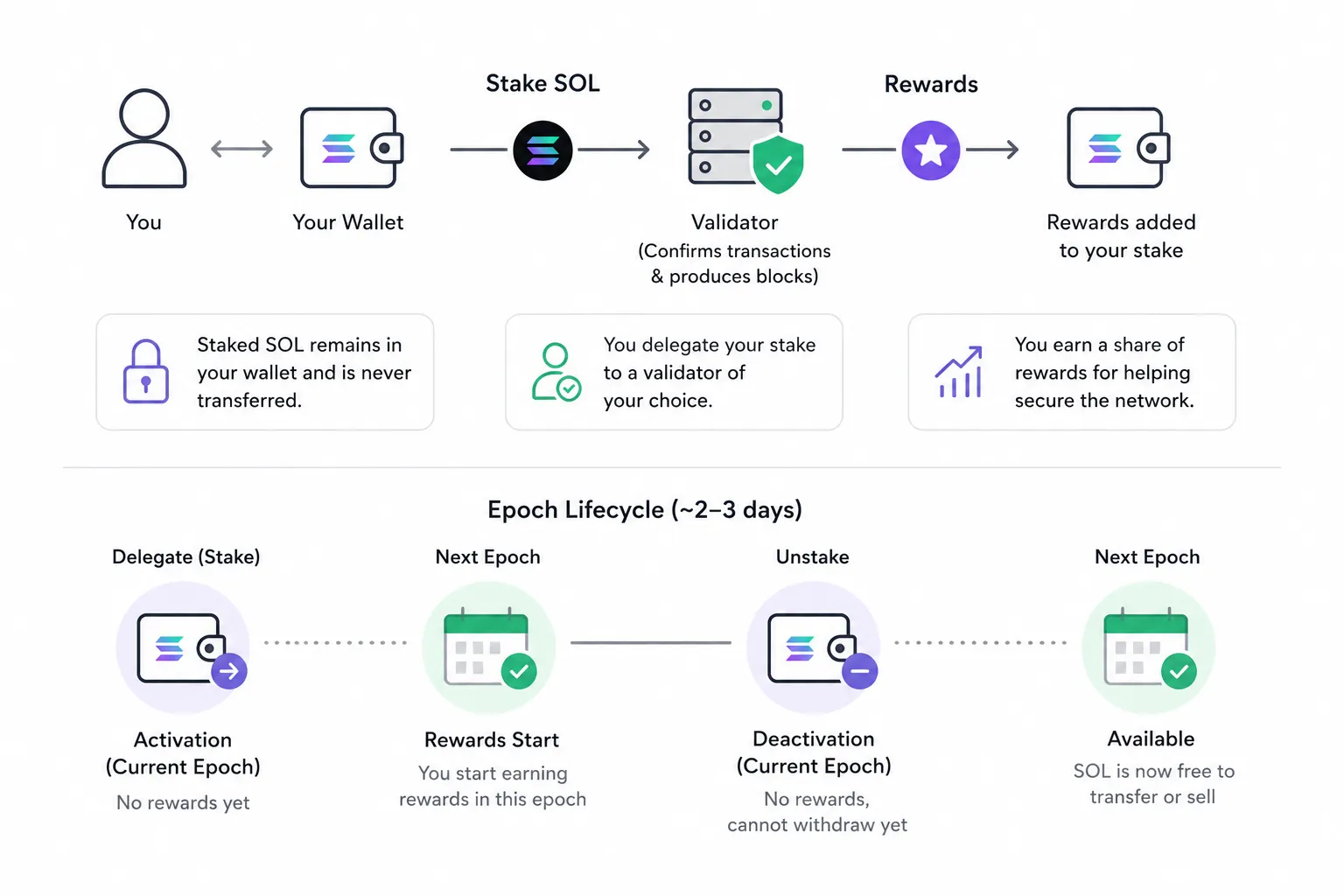
When a regular holder stakes SOL, they aren’t handing over ownership. Instead, they’re delegating their stake weight to a chosen validator. The tokens stay in the holder’s wallet the entire time, just temporarily locked for that purpose. If you want a clearer picture of the mechanics behind the network and why it processes transactions so fast, our breakdown of how Solana actually works covers that in plain terms.
Solana staking rewards are calculated on the level of an epoch, a period that lasts roughly two to three days. When you delegate SOL, your stake first goes through an activation phase and only starts earning in the epoch that follows. The same applies in reverse. When you decide to unstake, your position enters a deactivation phase and only becomes available to transfer or sell once that epoch ends.
Where Solana Staking Rewards Come From
The rewards you collect as a staker come from three separate sources, and the mix between them shifts depending on how active the network is at any given moment.
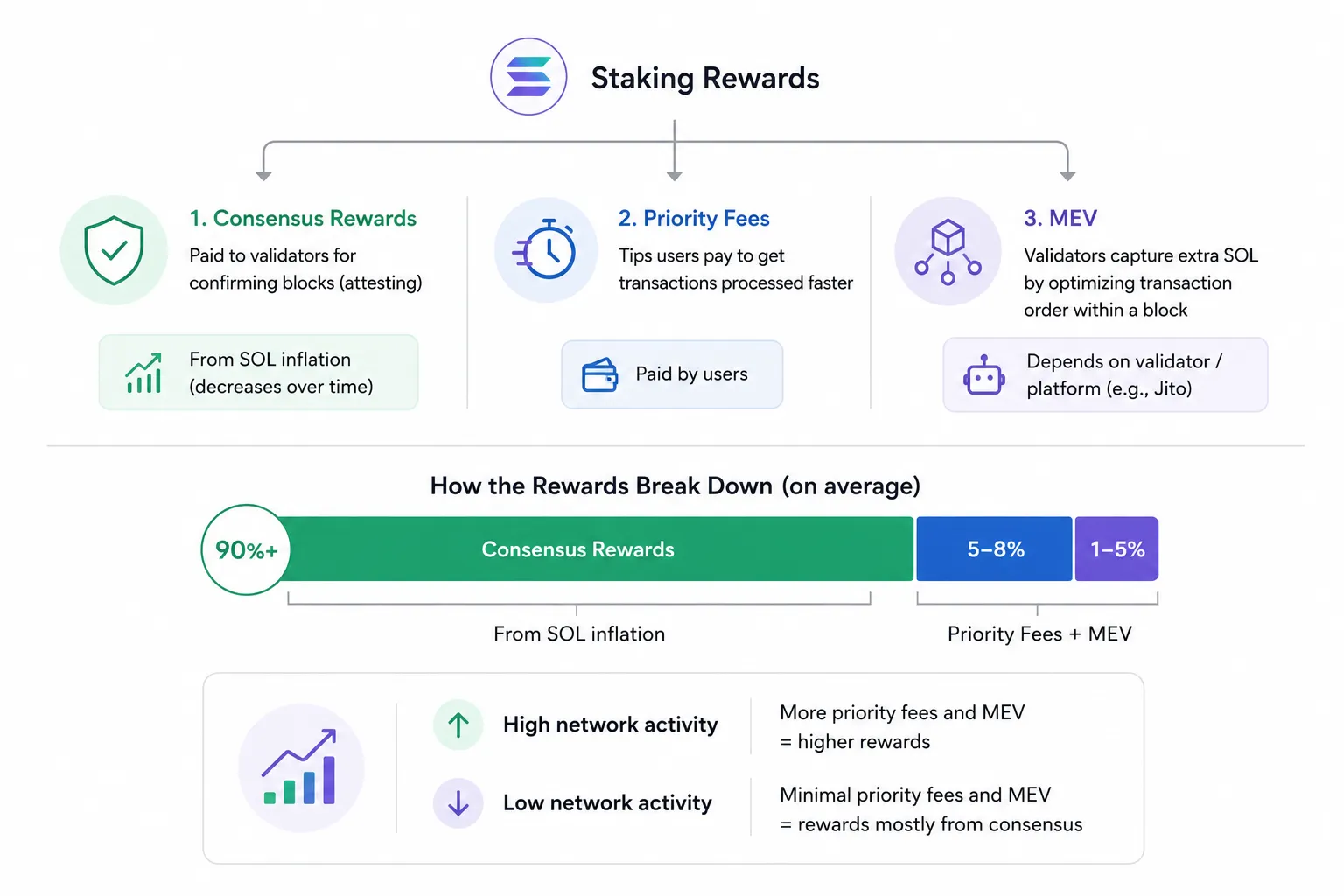
The biggest source is consensus rewards, paid to validators for confirming blocks, a process known as attesting. These come from SOL inflation, which is programmed to gradually decrease each year until it settles at a fixed long-term rate. The second source is priority fees, basically tips users pay when they want a transaction processed faster. The third is MEV, short for maximal extractable value. Validators can capture extra SOL by ordering transactions within a block in a way that squeezes out additional value. For an average staker, MEV isn’t guaranteed and depends on whether the validator or platform you’re using participates in MEV programs such as Jito.
These three sources aren’t split evenly. On average, more than ninety percent of your Solana staking rewards will come from consensus rewards alone, while priority fees and MEV act more like a bonus that fluctuates with network activity. During busy stretches, like a sharp price rally or heavy demand for a specific app, that extra yield can be noticeably higher. In quieter periods, the difference is barely worth mentioning.
How Solana Staking APY Is Calculated
Solana staking rewards are expressed as APY, or annual percentage yield. The formula itself is simple: your annual reward equals the amount you staked multiplied by the current APY rate. That rate isn’t fixed. It depends on a handful of moving parts.
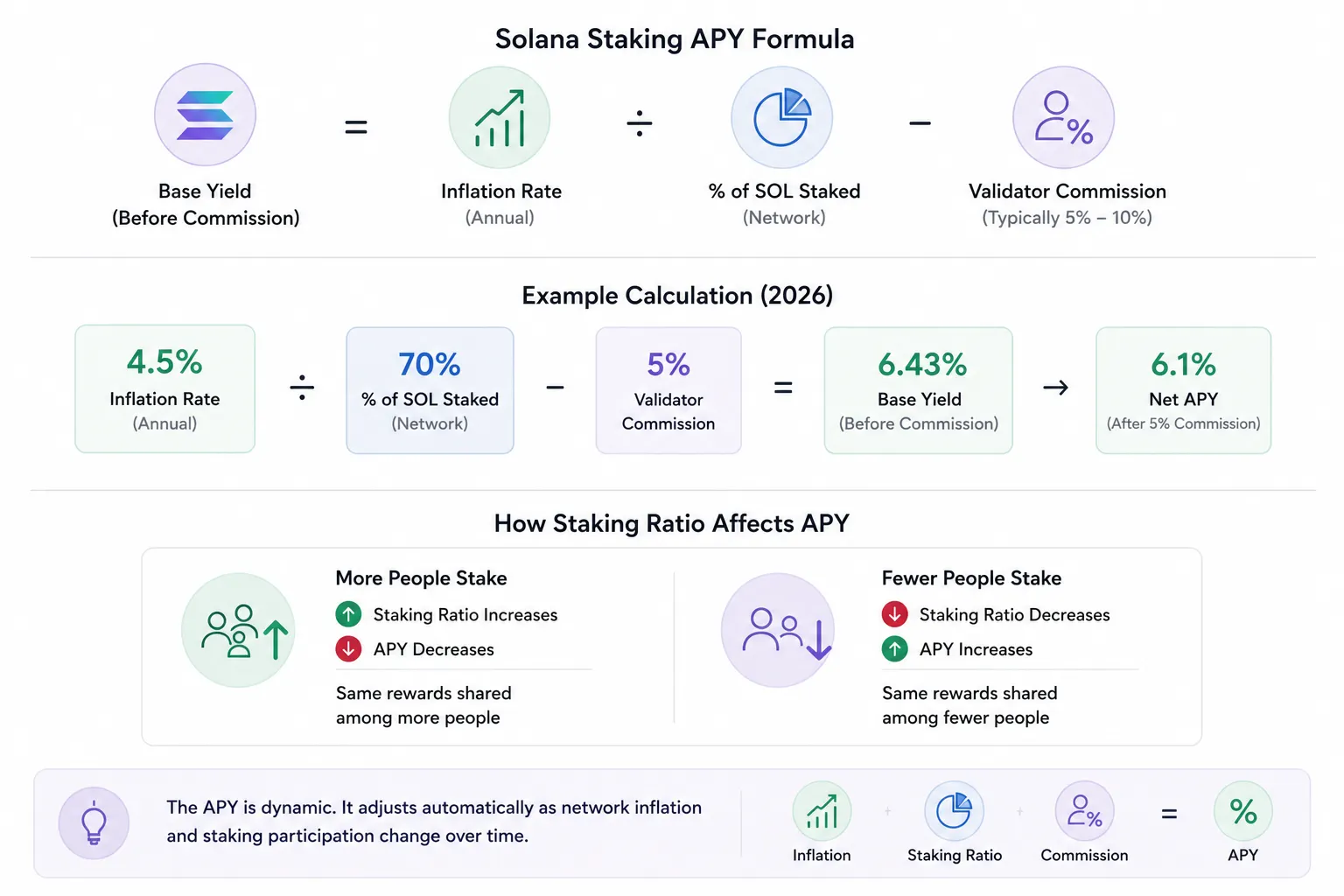
The first factor is the network’s inflation rate, which in 2026 sits somewhere between four and five percent annually. The second is the percentage of total SOL currently staked across the whole network, roughly sixty five to seventy percent today. The third is the validator’s commission, typically between five and ten percent of earned rewards.
Put together, the Solana staking APY formula looks like this: base yield equals the inflation rate divided by the percentage of SOL staked, minus the validator’s commission. Using inflation of 4.5 percent, a staking ratio of 70 percent, and a 5 percent commission, you land on a base yield of roughly 6.4 percent, which drops to about 6.1 percent net APY after commission. For the full technical breakdown of how inflation and staking interact, Solana’s official documentation covers it in detail.
There’s an interesting relationship worth understanding here. When a large number of holders decide to stake at once, the total staking ratio rises, and the individual APY for everyone drops, since the same pool of new tokens now gets split among more participants. The opposite is true too: if fewer people stake, the rate per person climbs. The network is designed to automatically balance interest in staking this way, so there’s no fixed rate that holds forever. It shifts slightly week to week based on how everyone else behaves.
How Much Can You Earn Staking Solana in 2026
To make this concrete, here’s roughly what a holder staking SOL at an average rate of 6 percent annually would earn, not accounting for any change in token price.
| Amount Staked | Annual Reward (SOL) | Monthly Reward (SOL) |
|---|---|---|
| 10 SOL | 0.6 SOL | 0.05 SOL |
| 100 SOL | 6 SOL | 0.5 SOL |
| 1,000 SOL | 60 SOL | 5 SOL |
Those numbers move around depending on the total amount staked network-wide and the performance of whichever validator you pick, so treat them as a starting point rather than a promise. If you’d rather run your own numbers with live data, most staking platforms include a Solana staking calculator where you plug in an amount and get a real-time estimate based on current network conditions, which is more accurate than any static table since the rate shifts week to week. For live network statistics and average staking rates, Solana Compass keeps a running public dashboard. If you’re still new to this asset and haven’t figured out exactly what SOL represents, our beginner explainer on what the SOL token actually is is worth reading first.
Native vs Liquid Staking Solana
There are two main approaches to earning Solana staking rewards, and which one fits you depends on how much flexibility you want.
Native Staking
Native staking means locking SOL directly into a stake account tied to your wallet, typically through Phantom or Solflare. Your tokens stay fully under your control, don’t get converted into anything else, and rewards get added straight into your stake account. It’s the simplest and safest way to earn Solana staking rewards, but while your SOL is locked, you can’t use it in other apps or sell it quickly. If you haven’t set up a wallet for this yet, our guide on setting up a Phantom wallet walks through it step by step.
Liquid Staking
With liquid staking, you stake SOL through a protocol like Marinade or Jito and receive a liquid staking token in return, such as mSOL or JitoSOL. The value of that token climbs as rewards accumulate, so there’s nothing to manually claim. The real upside is that you can use that token elsewhere at the same time, for lending or as collateral, while still earning your staking yield. The trade off is added smart contract risk on top of standard staking risk. A handful of exchanges offer similar liquid tokens too, like bbSOL on Bybit or BNSOL on Binance.
Best Solana Staking Platforms 2026
After Binance suspended services for EU users over MiCA compliance, a large chunk of European stakers had to look for alternatives. Here are the four best Solana staking platforms worth considering right now.
Bybit (bbSOL)
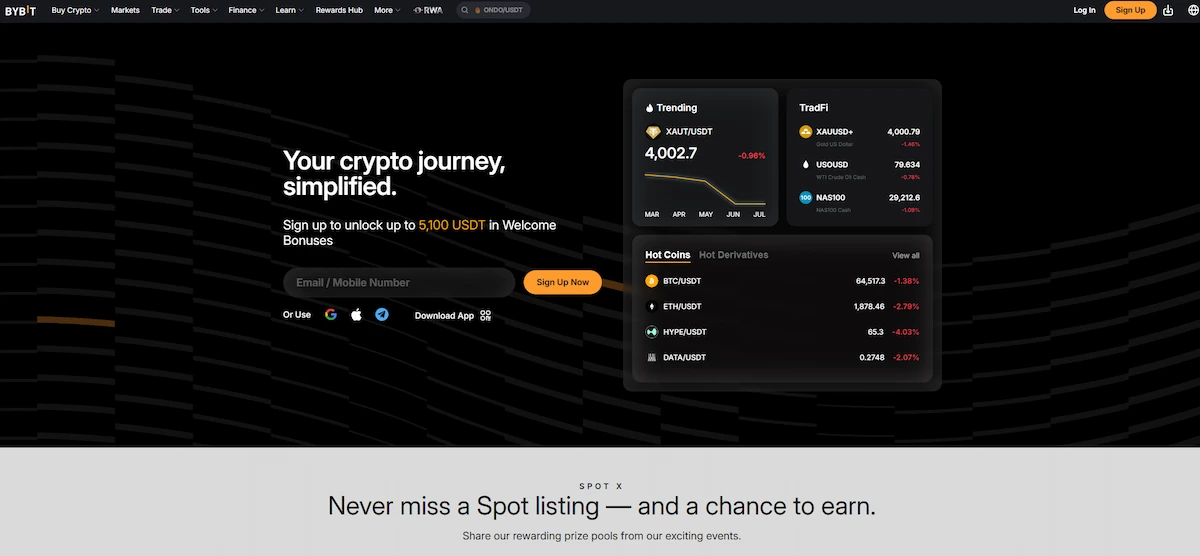
Bybit is currently one of the few major exchanges holding full MiCA authorization in the EU along with a VARA license in Dubai, which makes it a solid pick for users who lost access to Binance staking. Its liquid staking token is called bbSOL, and its value rises against SOL as rewards accrue, rather than paying rewards out directly.
| Founded | 2018 |
| Regulation | MiCA (EU), VARA (Dubai) |
| Minimum staking deposit | 0.5 SOL |
| Demo account | Yes, available for trading |
| Support | 24/7 live chat |
| Deposit methods | Card, bank transfer, crypto deposit |
| App rating | 4.5 out of 5 |
Pros:
- Regulated in the EU, a solid fallback after the Binance suspension
- Low minimum stake amount
- Monthly proof of reserves reports
- Extra MEV yield through Sanctum’s infrastructure
Cons:
- 0.1 percent fee charged on deposit when staking
- Like any exchange, you don’t control the private keys
Marinade Finance (mSOL)
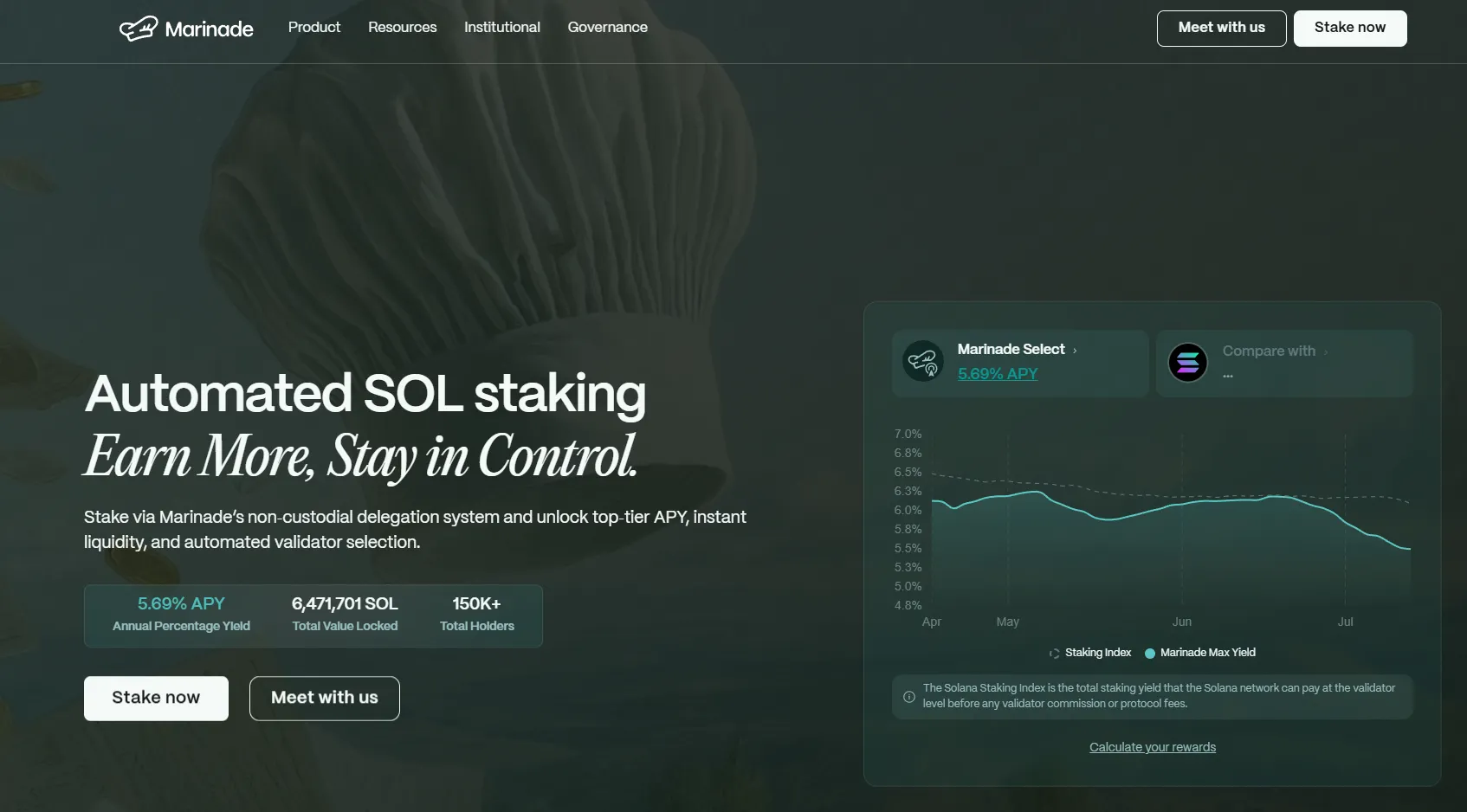
Marinade is one of the oldest liquid staking protocols on Solana and automatically spreads your stake across more than a hundred different validators, reducing the risk of relying on just one. Unlike Bybit, this is a fully decentralized protocol with no central company holding your funds.
Pros:
- Diversification across a large validator set
- mSOL can be used across a wide range of DeFi apps
- Long track record and high transparency
Cons:
- Requires a self-custody wallet and basic familiarity with DeFi tools
- Yield tends to run slightly lower than platforms offering an extra MEV bonus
Jito Network (JitoSOL)
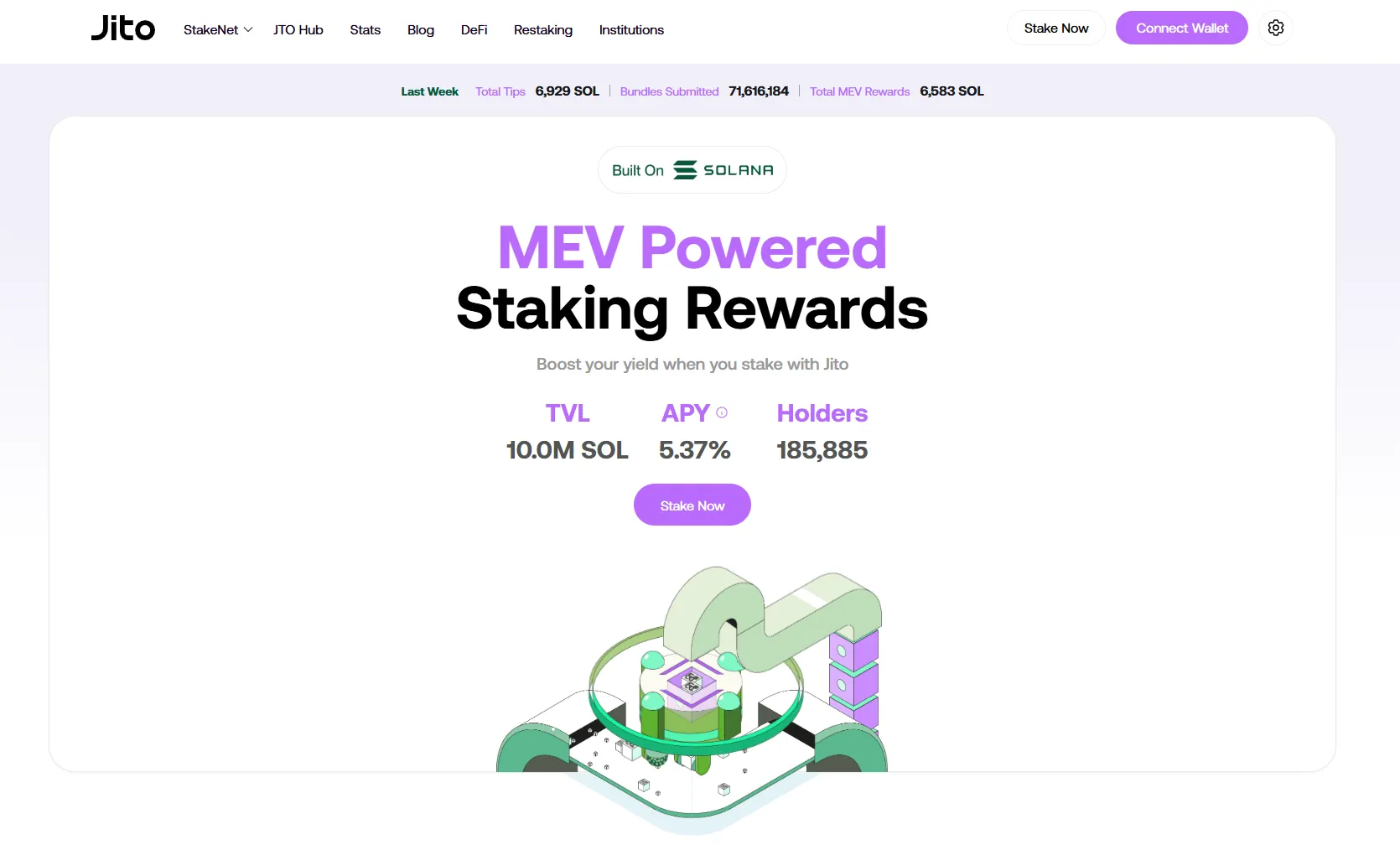
Jito currently holds the largest market share in Solana liquid staking, mainly because it passes on a portion of MEV rewards on top of standard staking rewards. That’s what makes JitoSOL attractive to users chasing maximum yield.
Pros:
- Extra MEV yield that lifts overall APY
- Largest market share among Solana liquid staking protocols
- JitoSOL is widely integrated across DeFi
Cons:
- MEV yield isn’t guaranteed and fluctuates with network activity
- Carries the same smart contract risk as any liquid staking option
Coinbase
Coinbase is one of the most recognizable regulated exchanges out there and offers staking with a very low barrier to entry: as little as one dollar gets you started. The yield runs lower than dedicated staking protocols, but for newcomers who want maximum simplicity, it’s still a solid option.
| Founded | 2012 |
| Regulation | Licensed exchange across multiple jurisdictions, including the US and EU |
| Minimum staking deposit | $1 |
| Demo account | No |
| Support | Email and chat support |
| Deposit methods | Card, bank transfer, crypto deposit |
| App rating | 4.7 out of 5 |
Pros:
- Very low minimum, accessible to beginners
- Long standing reputation and strong security track record
- Simple interface, no DeFi knowledge required
Cons:
- Lower yield compared to Bybit, Marinade, and Jito
- Less flexibility than liquid staking through DeFi protocols
Marinade vs Jito vs Bybit: Which Solana Staking Platform Wins
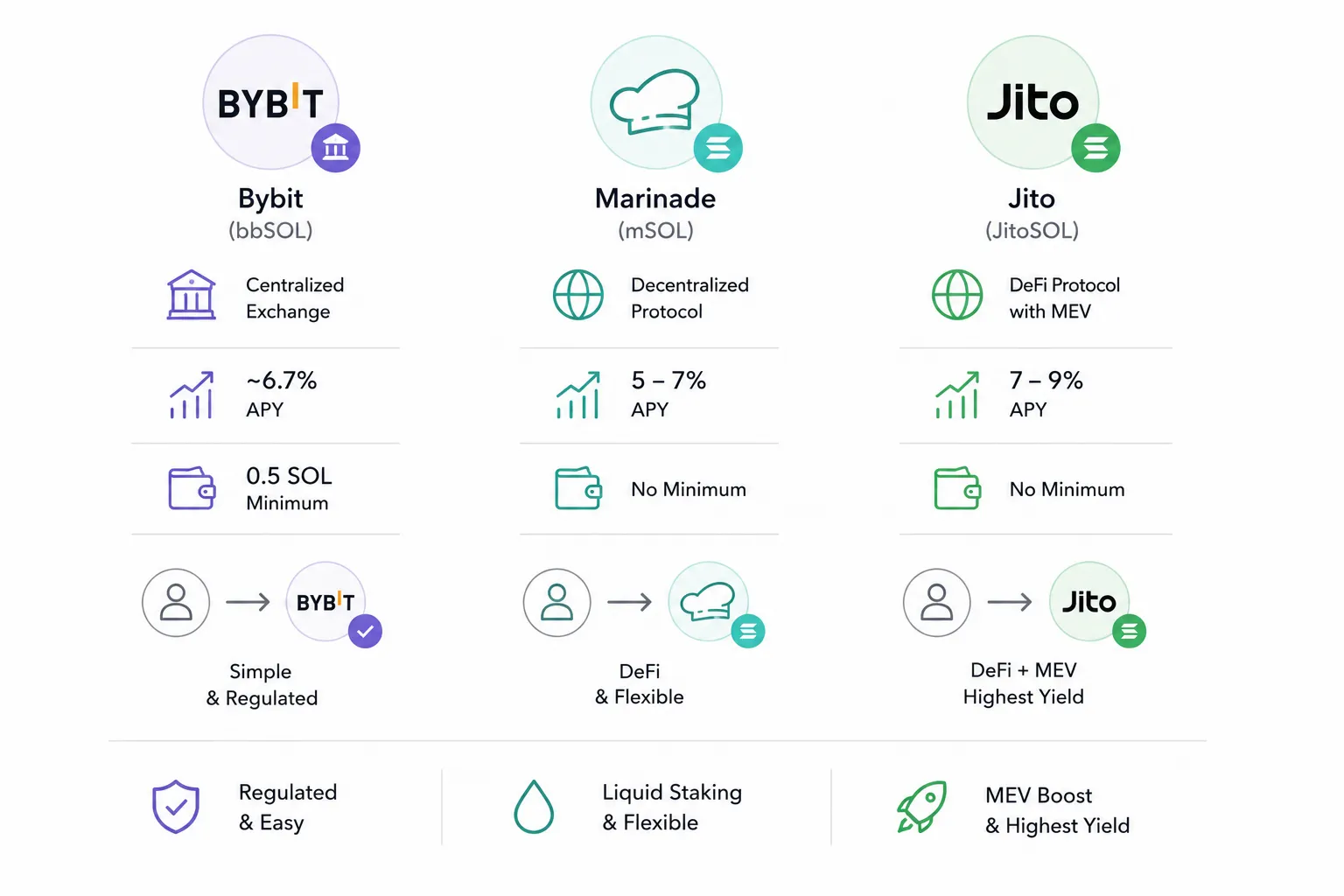
If you’re still deciding, here’s a quick side by side of the three most commonly used Solana staking platforms in 2026.
| Platform | Type | Average APY | Minimum Amount |
|---|---|---|---|
| Bybit (bbSOL) | Centralized exchange | around 6.7 percent | 0.5 SOL |
| Marinade (mSOL) | Decentralized protocol | 5 to 7 percent | no minimum |
| Jito (JitoSOL) | Decentralized protocol with MEV | 7 to 9 percent | no minimum |
For users who want a regulated, low friction option, Bybit is currently the most straightforward pick in the EU. For those already comfortable in DeFi and chasing the highest possible yield, Marinade and Jito remain excellent choices. For a deeper side by side of these two protocols specifically, our full Marinade vs Jito comparison breaks down the differences in more detail.
Risks of Staking Solana
Slashing Risk
Slashing is a penalty applied when a validator acts maliciously or makes a serious technical error, such as signing two conflicting blocks. On Solana, slashing isn’t actively enforced in practice today, though proposals like SIMD-0204 and SIMD-0212 are working toward a clearer detection and penalty framework. That means the real risk right now isn’t losing your principal: it’s missing out on rewards because of a poorly performing validator, which is a meaningful difference compared to Ethereum, where slashing has been live since the Beacon Chain launched.
Liquidity Risk and the Cooldown Period
While your SOL is staked, it isn’t instantly available to sell or transfer. Once you start the unstaking process, you have to wait for the current epoch to end, which in practice means two to three days without access to your funds. This is less of an issue for liquid staking users, since they can simply sell their mSOL or JitoSOL on the open market instead of waiting for deactivation.
How to Pick a Reliable Validator
If you go with native staking and choose your own validator, a few things are worth checking. First, look at uptime, meaning how consistently the validator stays online and confirms blocks, since every outage directly cuts into your rewards. Second, check the commission rate, since some validators charge over ten percent, which meaningfully eats into your net yield. Third, avoid validators that already hold an unusually large share of total stake, since heavy concentration weakens network decentralization and can signal added risk if that validator runs into a technical problem.
Security Risks
Beyond the risks tied directly to the staking mechanism itself, there are broader security threats present across crypto generally, from fake staking apps to phishing attacks targeting holders with large SOL balances. Before staking anything, it’s worth reviewing our rundown of the most common Solana scams so you know what to watch for. It’s also worth sticking to basic best practices for keeping your SOL secure, especially if you’re using a self-custody wallet for native or liquid staking.
How to Stake Solana on Bybit Step by Step
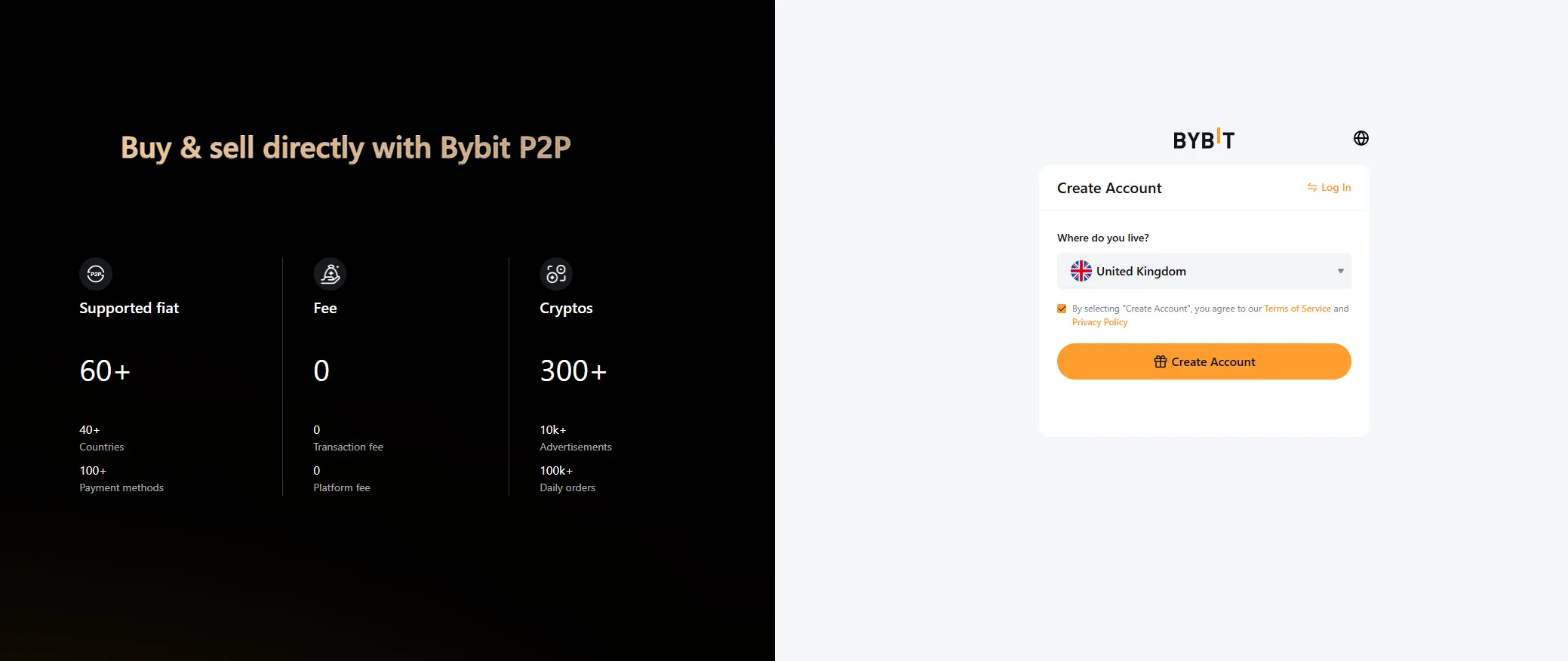
Step 1: Create an Account
Head to Bybit, enter your email and set a password, then complete basic identity verification. The whole process usually takes just a few minutes.
Step 2: Get Some SOL
If you don’t already hold SOL, you’ll need to buy it or transfer it in from another wallet first. Our guide on how to buy Solana covers this if it’s your first time getting into the asset.
Step 3: Find the Staking Section
Inside the Bybit platform, look for the staking or Web3 staking section and select Solana from the list of available tokens.
Step 4: Choose an Amount and Confirm
Enter how much SOL you want to stake, review the current estimated yield, and confirm the transaction. Your SOL will be converted into bbSOL, representing your share of the staking pool.
Step 5: Track Your Rewards
The value of your bbSOL will gradually rise against SOL as rewards come in. You can track your position directly from the staking section of the app at any time.
Solana Staking Taxes: What You Need to Know
In most jurisdictions, including the US, staking rewards you receive count as taxable income at the moment you receive them, based on fair market value that day. If you later sell those tokens at a higher price, the gain gets taxed separately as a capital gain. Solana staking tax rules vary quite a bit from country to country and change fairly often, so it’s best to check with a tax professional familiar with crypto regulation in your jurisdiction for anything specific to your situation.
It’s worth keeping a record of every individual reward payout from the start, including the date received and its market value that day, since staking rewards typically arrive in small amounts every epoch rather than in one lump sum. Tracking that manually gets messy fast, so many stakers rely on dedicated crypto tax tools that sync with a wallet and automatically calculate total staking income at year end.
Is Solana Staking Worth It in 2026
For long-term SOL holders, earning Solana staking rewards remains one of the easiest ways to put an otherwise idle asset to work. Yields between five and nine percent annually, depending on the platform, aren’t trivial, especially compared to traditional savings options. The main trade off is reduced liquidity while your tokens are staked, but that’s easily solved by going with liquid staking if quick access to funds matters to you. For EU users who lost access to Binance staking, Bybit currently stands out as the safest, most regulated alternative.
Before making a final call, it’s worth thinking through your time horizon. If you plan to hold SOL for longer than a year and don’t need fast access to your funds, native staking through a reliable validator or staking through a regulated exchange like Bybit is a simple, sensible option. If you’re already active in DeFi and want your assets working in more than one way at once, liquid staking through Marinade or Jito gives you that extra flexibility without giving up your base staking yield.
Frequently Asked Questions
How much SOL do I need to stake?
There’s no required minimum at the protocol level. Technically, you can stake any amount above zero. On platforms like Bybit the minimum is 0.5 SOL, while protocols like Marinade and Jito have virtually no minimum at all.
Can I lose SOL while staking?
Your principal stays safe, since slashing isn’t currently active on Solana. What you can lose is potential Solana staking rewards if you pick a validator with poor uptime or a high commission rate.
How often do Solana staking rewards get paid out?
Rewards are calculated at the end of every epoch, which in practice means roughly every two to three days. With native staking, rewards get added directly to your stake account, while with liquid staking they show up as a rise in the value of tokens like mSOL or bbSOL.
Which is better, native or liquid staking?
It depends on what you need. Native staking is simpler with fewer moving parts, while liquid staking gives you more flexibility since you can use your token elsewhere while still earning rewards.
Is Bybit available worldwide?
Bybit is available to users across most regions, including the EU following its MiCA authorization. It’s always worth double-checking current availability directly on the platform before signing up, since regulatory requirements shift from time to time.
Do Solana staking rewards compound automatically?
With native staking, rewards get added to your stake account but don’t automatically compound into the staked amount itself, so you’ll need to periodically redelegate manually if you want the full compounding effect. With liquid staking through mSOL, JitoSOL, or bbSOL, this happens automatically since the token’s value rises against SOL on its own.
Can I stake SOL across multiple validators at once?
Yes, and it’s actually recommended for larger amounts. A single stake account can only be delegated to one validator, but you can open multiple stake accounts and split your SOL across different validators, reducing the risk of all your rewards depending on just one validator’s performance.