If you’re trying to figure out what kind of return SOL staking actually pays right now, the honest answer is: it depends on where you look. Solana staking APY numbers you’ll find across different platforms range anywhere from 3.4% to over 8%, and that spread isn’t a mistake. It comes down to how each source measures the rate, which validator or liquid staking token you’re comparing, and how much of the yield includes MEV on top of base inflation. This guide breaks down where those numbers come from, what’s currently pushing rates up or down, and what you can actually do to squeeze more out of your stake without taking on reckless risk.
What Is Solana Staking APY
APY stands for annual percentage yield, and for Solana staking it represents the return you’d earn over a year if you delegated your SOL to a validator and left it there. The number reflects three things layered together: inflation rewards paid out from newly minted SOL, a share of transaction fees, and sometimes MEV, short for maximal extractable value, which some validators capture and pass along to stakers. None of these are fixed. They shift with network conditions, so the APY you see today won’t necessarily be the APY you see next month.
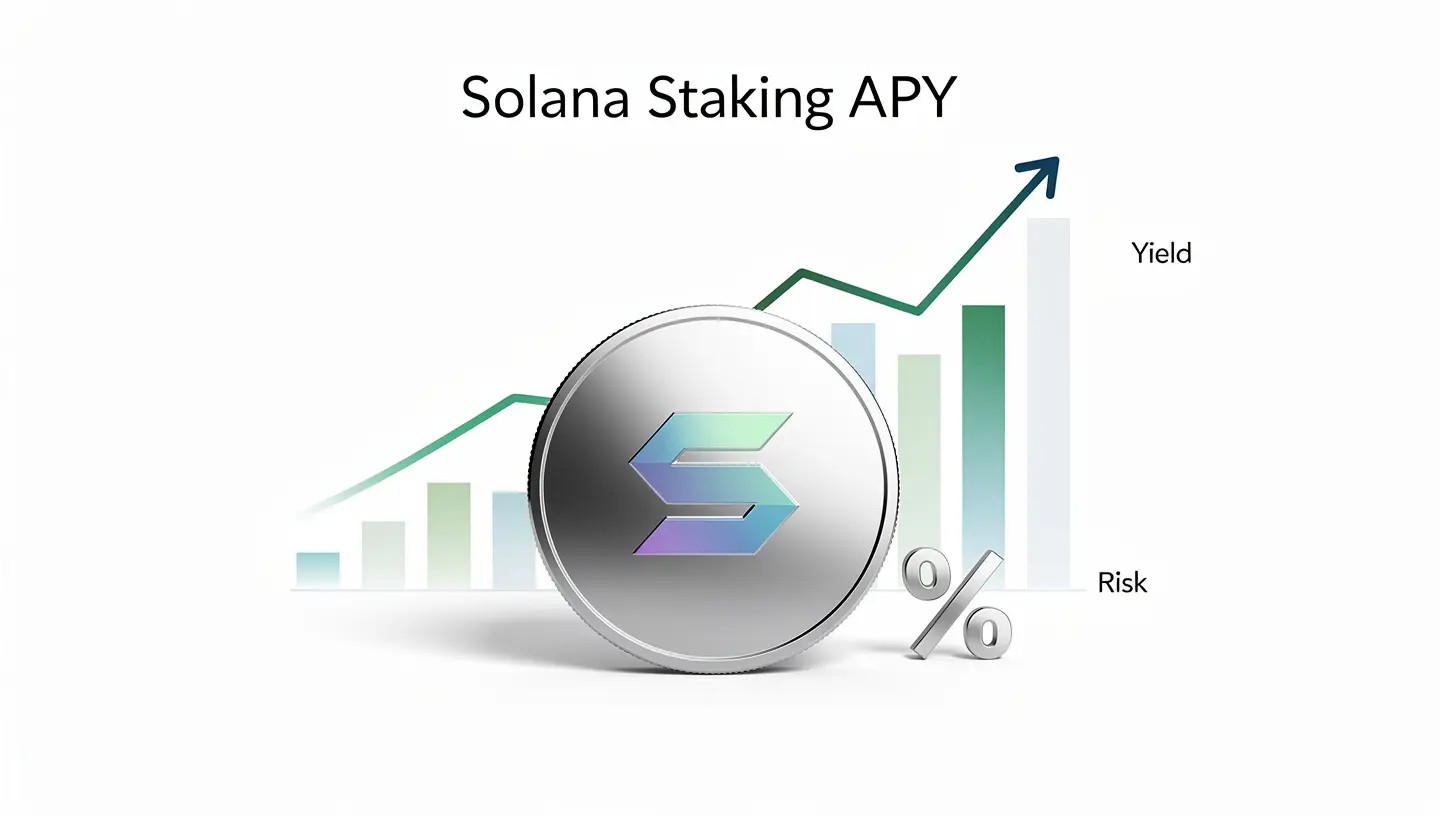
Rewards get distributed once per epoch, a cycle that runs roughly two to three days. Each epoch, the protocol issues new SOL according to its inflation schedule and hands it out to validators based on their stake weight and how well they voted. Your share of that gets passed down to you, minus whatever commission your validator charges. For the full technical rundown of how the reward cycle and delegation process work at the protocol level, Solana’s official staking documentation is the most reliable primary source.
It’s worth pointing out that Solana staking APY isn’t the same thing as a savings account interest rate, even though people often compare it that way. A bank rate is set by an institution and stays fixed until they choose to change it. Solana’s rate emerges from network activity itself, meaning thousands of independent variables, from how many people are staking to how busy the network is on any given day, all feed into the number you eventually see. That’s part of why two people staking the exact same amount on the exact same day can end up with slightly different returns depending on which validator or platform they picked.
Current Solana Staking APY Rates in 2026
Pulling from several tracking sources right now, native SOL delegation is generally landing somewhere between 5.9% and 8%, while liquid staking tokens that capture MEV tend to sit a bit higher. Coinbase reports a much lower estimated reward rate around 3.4%, which reflects their specific calculation method rather than a network-wide drop, so treat single platform numbers as one data point rather than the full picture.
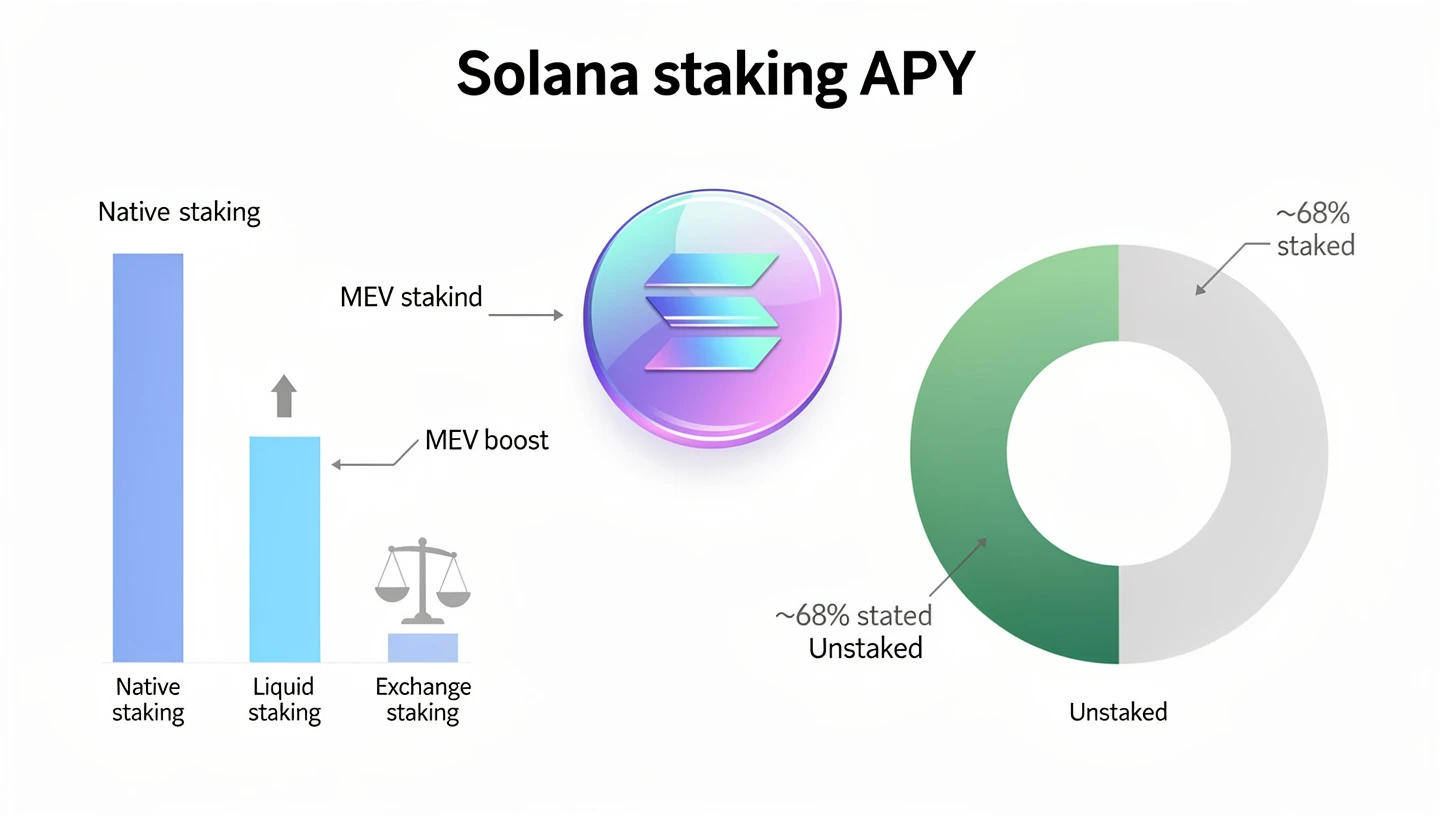
To put that range in context, roughly 68% of all circulating SOL, somewhere around 425 to 432 million tokens, is currently staked. That’s a fairly high participation rate compared to many other proof of stake networks, and it directly affects the math behind every APY figure you’ll come across. The more SOL that’s staked network-wide, the more the same pool of inflation rewards gets divided among participants, which naturally compresses the rate per staker.
Native Staking APY
Native staking, where you delegate directly to a validator through a wallet like Phantom or Solflare, typically yields between 5.9% and 7.5% right now. This is the base rate before any MEV bonus, and it moves inversely with how much total SOL is staked across the network. Roughly 68% of circulating SOL is currently staked, which puts the staking ratio on the higher end and keeps individual yields somewhat compressed compared to earlier periods when fewer holders were staking.
Liquid Staking APY
Liquid staking tokens generally outperform plain native staking because several of them capture MEV rewards on top of the base rate. Here’s roughly where things stand:
| Liquid Staking Token | Approximate APY | Notes |
|---|---|---|
| Sanctum INF | ~8.5% | Exposure to a basket of LSTs rather than one validator |
| JitoSOL | ~6.3-7.9% | Yield has been compressing as more stake joins the pool |
| JupSOL | ~6.3-7.9% | 0% validator commission, delegates only to Jupiter’s validator |
| mSOL (Marinade) | ~5-7% | Spread across more than 100 validators |
| hSOL (Helius) | Base rate + MEV | 0% commission validator, rewards auto-compound |
These figures move constantly, so treat them as a snapshot rather than a promise. If you want a deeper explanation of where staking rewards actually originate and how the reward cycle works from the ground up, our guide on Solana staking rewards covers that in more detail.
Core APY vs Total APY: Why the Numbers Don’t Match
One reason APY figures vary so much between sources comes down to methodology. Coinbase, for instance, tracks two separate numbers for its validators: core APY, which only counts inflation rewards, and total APY, which adds in the validator’s share of transaction fees and MEV on top. A platform quoting core APY alone will always look lower than one quoting total APY, even if the underlying validator performance is identical.
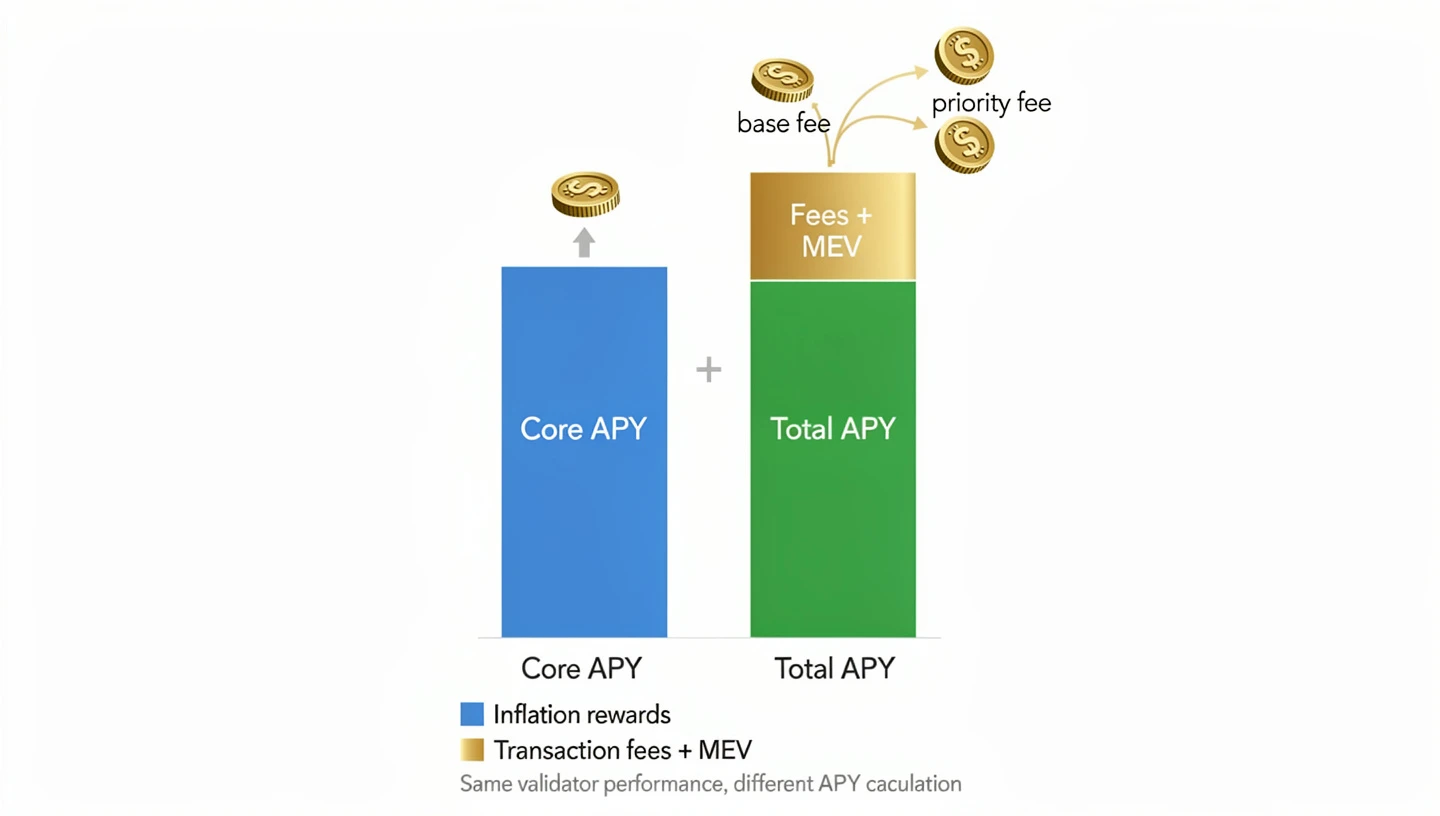
It helps to understand how the fee side actually works. When someone submits a transaction, they pay a base fee and can optionally attach a priority fee to get processed faster. Of the base fee, half gets burned and half goes to the validator producing that block. The priority fee, on the other hand, goes entirely to the validator and isn’t shared with delegators at the protocol level. That’s part of why a validator with heavy MEV activity can post a noticeably higher total APY than one relying purely on inflation.
How Solana Staking APY Is Calculated
Where the Yield Actually Comes From
Every epoch, validators earn vote credits for successfully confirming blocks on time. Your inflation reward is proportional to your validator’s stake weight, scaled by how many of those vote credits it actually earned relative to what was possible that epoch. A validator with strong uptime and fast voting captures close to its full stake-weighted share, while one that lags or misses votes gets docked, and so do the people delegating to it. This is why two validators with identical commission rates can still hand you noticeably different rewards.
APR vs APY: What’s the Difference
These two terms get used interchangeably, but they’re not quite the same thing. APR is the simple annual rate with no compounding factored in. APY accounts for what happens when your rewards get reinvested and start earning on themselves. A 6% APR can turn into something closer to 6.1% APY once you factor in frequent compounding, which is one reason platforms that support auto-compounding often advertise the APY figure rather than APR.
SIMD-0550: How a New Proposal Could Change Future APY
There’s a governance proposal moving through Solana’s process right now that’s worth understanding if you’re staking for the long haul. SIMD-0550, submitted in early June 2026 by Helius engineers, proposes doubling the network’s annual disinflation rate from 15% to 30%. In plain terms, Solana’s inflation already shrinks every year on a set schedule, and this proposal would speed up that shrinking without changing the starting point or the eventual floor of 1.5%.
If it passes, the terminal inflation rate would be reached in roughly 2.8 years instead of the current 5.7 year timeline. Early projections suggest staking yields tied to inflation could decline to around 4.34% in year one after implementation, 3.00% in year two, and 2.25% in year three, before leveling off near the terminal rate. That’s a meaningful drop from where native APY sits today. For the full technical writeup and current status of the vote, Solana Compass has a detailed breakdown of the proposal and its background.
This isn’t the first attempt at something like this. Two earlier versions failed or stalled, but this one has drawn public backing from Solana co-founder Anatoly Yakovenko and reportedly has a strong chance of passing. If you’re staking specifically for yield rather than just to support the network, this is worth keeping an eye on, since it directly affects how much inflation reward validators and delegators will be splitting going forward.
How to Maximize Your Solana Staking APY
Choose a Low Commission Validator, But Not Blindly
Commission is the cut a validator takes before passing rewards to you, typically somewhere between 0% and 10%. Lower commission sounds better on paper, but it isn’t the whole story. What actually matters is what industry trackers call true APY, the real return after accounting for both commission and performance. A validator charging 0% but missing votes constantly can hand you less than a validator charging 5% with excellent uptime. Before delegating, check commission alongside uptime and vote performance rather than commission alone. Public validator directories usually show all three figures side by side, so there’s rarely a reason to guess.
Use Auto-Compounding
Some platforms automatically reinvest your rewards back into your stake, which lets you capture the APY effect rather than the flatter APR. If your rewards just sit there uncompounded, you’re effectively earning simple interest instead of compound interest, and over a year or more that difference adds up.
Consider Liquid Staking for MEV Exposure
Native staking through a plain validator typically only captures base inflation rewards. Liquid staking tokens like JitoSOL or Sanctum INF often add MEV revenue on top, which is part of why their advertised APY tends to run higher. The tradeoff is added smart contract risk, so this only makes sense if you’re comfortable holding a liquid staking token rather than a native stake account. For more on how two of the biggest liquid staking options actually compare, our breakdown of Marinade vs Jito goes through the differences in more depth.
Diversify Across Validators or LSTs
Spreading your stake across multiple validators, or choosing a pooled LST like Marinade or Sanctum INF that already does this for you, reduces the impact of any single validator having a bad month. It also protects you somewhat if one validator’s technical issues drag its vote credits down for an extended stretch.
Best Solana Validators and Staking Platforms by APY
Here’s a rough side-by-side comparison of where things stand across the most commonly used options right now.
| Platform | Type | Approximate APY | Commission |
|---|---|---|---|
| Helius validator | Native, custodial option available | Base + MEV | 0% |
| Sanctum INF | Liquid staking pool | ~8.5% | Varies by underlying LST |
| JupSOL | Liquid staking token | ~6.3-7.9% | 0% |
| Marinade (mSOL) | Liquid staking protocol | ~5-7% | Varies, spread across validators |
| Coinbase | Custodial exchange | ~3.4% | Built into quoted rate |
The gap between the highest and lowest numbers here is mostly about methodology and MEV exposure rather than one platform being objectively better. If you’re new to buying SOL in the first place before you can stake any of it, our step-by-step guide on how to buy Solana walks through that first.
Beyond raw APY, a few practical factors are worth weighing when picking between these. Custodial platforms like Bybit and Coinbase handle validator selection and technical maintenance for you, which suits anyone who doesn’t want to manage a self-custody wallet. Decentralized options like Marinade or Sanctum INF put you in direct control of a liquid staking token you can move between apps freely, but they assume you’re comfortable navigating wallets and DeFi interfaces on your own.
Native vs Liquid Staking APY: Which Earns More
On paper, liquid staking usually wins on raw APY because of the added MEV layer. But native staking through a well-run validator with strong uptime can come surprisingly close, especially once you account for the fact that liquid staking protocols sometimes take their own cut on top of the underlying validator’s commission. If maximum yield is your only priority, liquid staking through a token like Sanctum INF or JitoSOL is generally the stronger pick. If you’d rather keep things simple and avoid an extra layer of smart contract exposure, native staking through a low-commission, high-uptime validator is still very competitive.
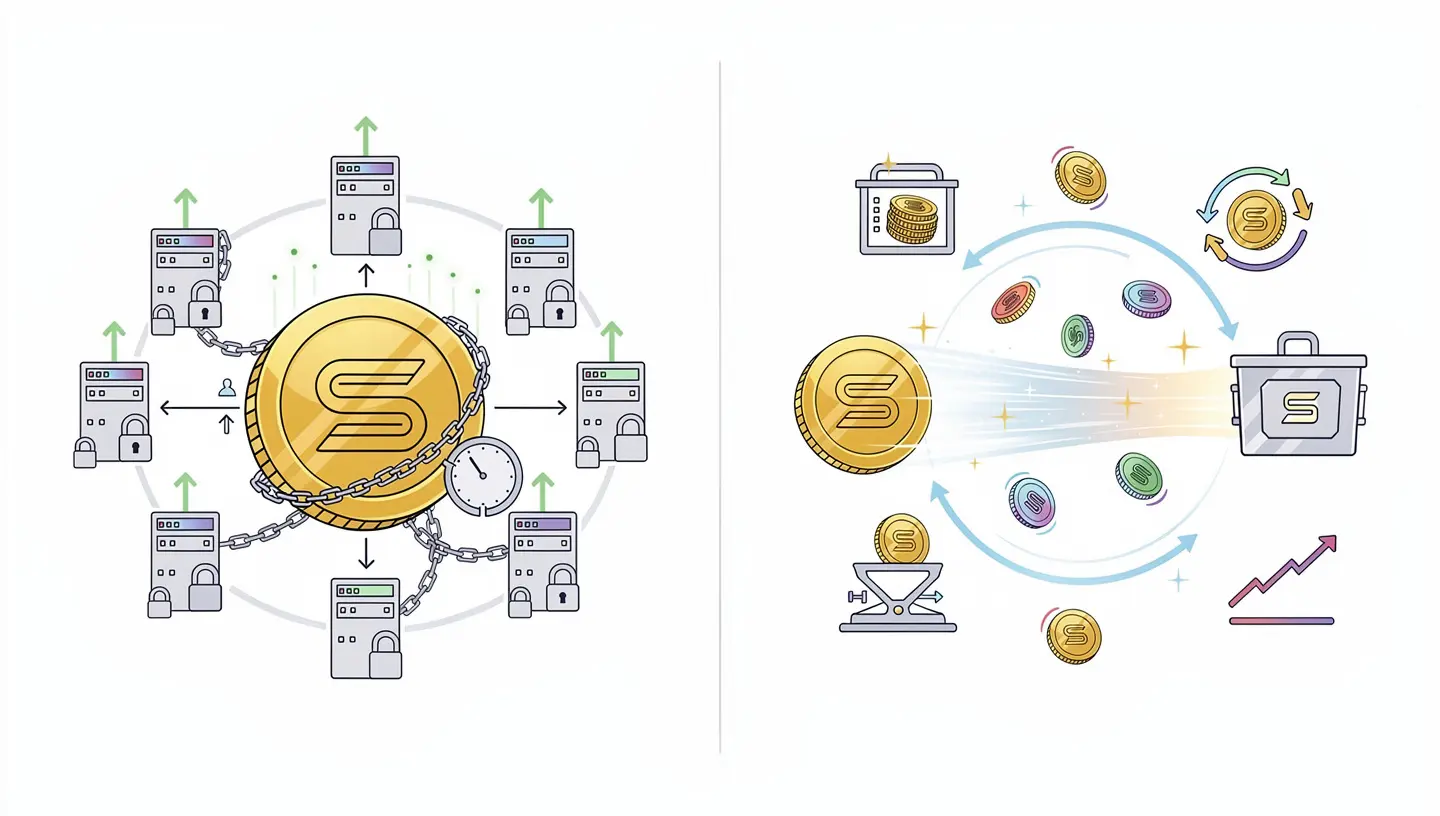
There’s also a practical middle ground worth mentioning. Some stakers split their SOL between both approaches, keeping a portion in native staking for simplicity and moving the rest into a liquid staking token to stay active in DeFi. This isn’t about chasing the absolute highest number. It’s about matching your staking method to how you actually plan to use your SOL over the next year.
Risks That Can Eat Into Your APY
Validator Downtime and Vote Credits
Since your reward share is tied to your validator’s vote credits, any downtime or missed votes directly reduces what you earn, even if the commission rate looks great. This is the most common way stakers end up disappointed with their actual return compared to the advertised APY. Checking a validator’s historical uptime before delegating takes a few minutes and can meaningfully change your outcome over a year.
It’s also worth remembering that Solana doesn’t currently enforce slashing penalties on principal the way some other proof of stake networks do. A poorly performing validator won’t cause you to lose your staked SOL outright. The damage shows up purely as lower rewards over time. That makes validator selection more about optimizing your return than protecting your principal, which is a meaningfully lower-stakes decision than it would be on a network with active slashing.
Smart Contract Risk on Liquid Staking
Liquid staking tokens depend on smart contracts to mint, track, and redeem your position. That adds a layer of risk that native staking simply doesn’t have, since native staking only relies on the base Solana protocol rather than a third-party contract. It’s not a reason to avoid liquid staking altogether, but it’s worth factoring in when you’re chasing an extra percentage point or two of APY. Before staking anything through an unfamiliar protocol, it’s worth reviewing common Solana scams so you know what red flags to watch for, and sticking to the basics of keeping your SOL secure regardless of which staking method you choose.
How to Start Staking Solana at the Best Rate
If you want a straightforward, regulated starting point, Bybit currently offers one of the more accessible routes into Solana staking, especially for EU-based users following Binance’s MiCA-related suspension.
Step 1: Set Up Your Account
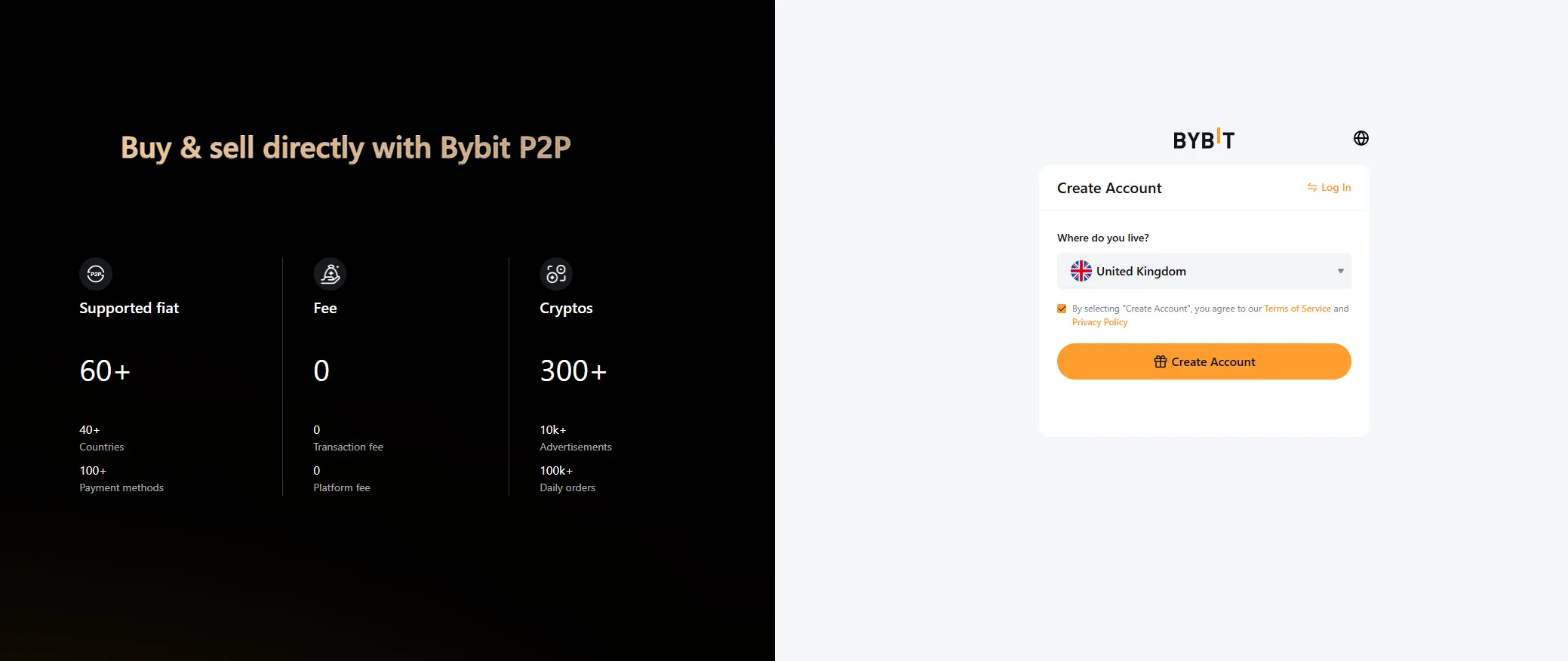
Register on Bybit with your email, set a password, and complete basic identity verification. This usually takes just a few minutes.
Step 2: Fund Your Account
Deposit or buy SOL directly on the platform. If you’re staking through a self-custody wallet instead, make sure it’s properly set up first. Our guide on setting up a Phantom wallet covers that process.
Step 3: Compare Available Rates
Check the current advertised APY before confirming anything. Rates shift regularly, so what was competitive last week might not be this week.
Step 4: Stake Your SOL
Choose your amount and confirm. Your SOL gets converted into the platform’s liquid staking token, and your position starts earning from the next epoch onward.
Step 5: Monitor and Adjust
Keep an eye on your yield over time. If a better rate becomes available elsewhere, or your current validator’s performance drops, moving your stake is usually straightforward. Setting a reminder to check your validator’s uptime every month or two is a simple habit that keeps your actual return closer to whatever number first convinced you to stake in the first place.
Solana Staking APY FAQ
Why do different websites show different Solana staking APY numbers?
Mostly methodology. Some track core APY, which only counts inflation, while others track total APY, which adds in MEV and fee revenue. The specific validator or LST being measured also matters, since performance and commission vary a lot between them.
What’s a realistic Solana staking APY right now?
Most current sources put native staking somewhere between 5.9% and 7.5%, with liquid staking tokens that capture MEV running a bit higher, sometimes up to 8.5%. Numbers below that, like Coinbase’s estimate around 3.4%, usually reflect a more conservative calculation rather than a different network rate.
Does a 0% commission validator always give the highest return?
Not necessarily. Commission is only part of the equation. A validator with poor uptime or missed votes can underperform a validator charging a small commission but running reliably. Always check performance alongside commission.
How would SIMD-0550 affect my staking rewards if it passes?
It would gradually reduce the inflation portion of your rewards over the following few years as Solana reaches its terminal inflation rate faster. MEV and fee income wouldn’t be directly affected, so validators and stakers relying heavily on MEV would feel less of an impact than those depending mostly on inflation.
Is liquid staking APY always better than native staking APY?
Usually higher on paper because of MEV exposure, but not automatically better once you factor in smart contract risk and any additional fees the liquid staking protocol charges on top of the base validator commission.
How often does Solana staking APY change?
It shifts continuously since it depends on the total amount staked network wide, current MEV activity, and individual validator performance. Checking rates weekly rather than assuming a fixed number is worthwhile if you’re actively managing your stake.
Can I switch validators if I find a better APY elsewhere?
Yes. You can redelegate your stake to a different validator at any time, though the change only takes effect at the start of the next epoch. There’s no penalty for switching, just the standard activation delay.
Does staking more SOL increase my APY rate?
No, the percentage rate itself stays the same regardless of how much you stake, since APY is a rate, not a fixed reward. What changes is the total amount of SOL you earn, since a larger stake earns a proportionally larger reward at the same rate.
Is Solana staking APY taxable?
In most jurisdictions, including the US, staking rewards count as taxable income at the moment you receive them, based on their market value that day. Rules vary by country, so it’s worth checking with a tax professional familiar with crypto regulation where you live.