Solana was created by Anatoly Yakovenko in November 2017, when he published a whitepaper introducing Proof of History, a consensus mechanism that uses cryptographic timestamps to order transactions. Yakovenko co-founded Solana Labs in 2018 with Greg Fitzgerald, Raj Gokal, Stephen Akridge, and Eric Williams. The Solana blockchain launched its mainnet beta on March 16, 2020, and has since processed over 400 billion transactions.
Anatoly Yakovenko: the engineer who invented Proof of History
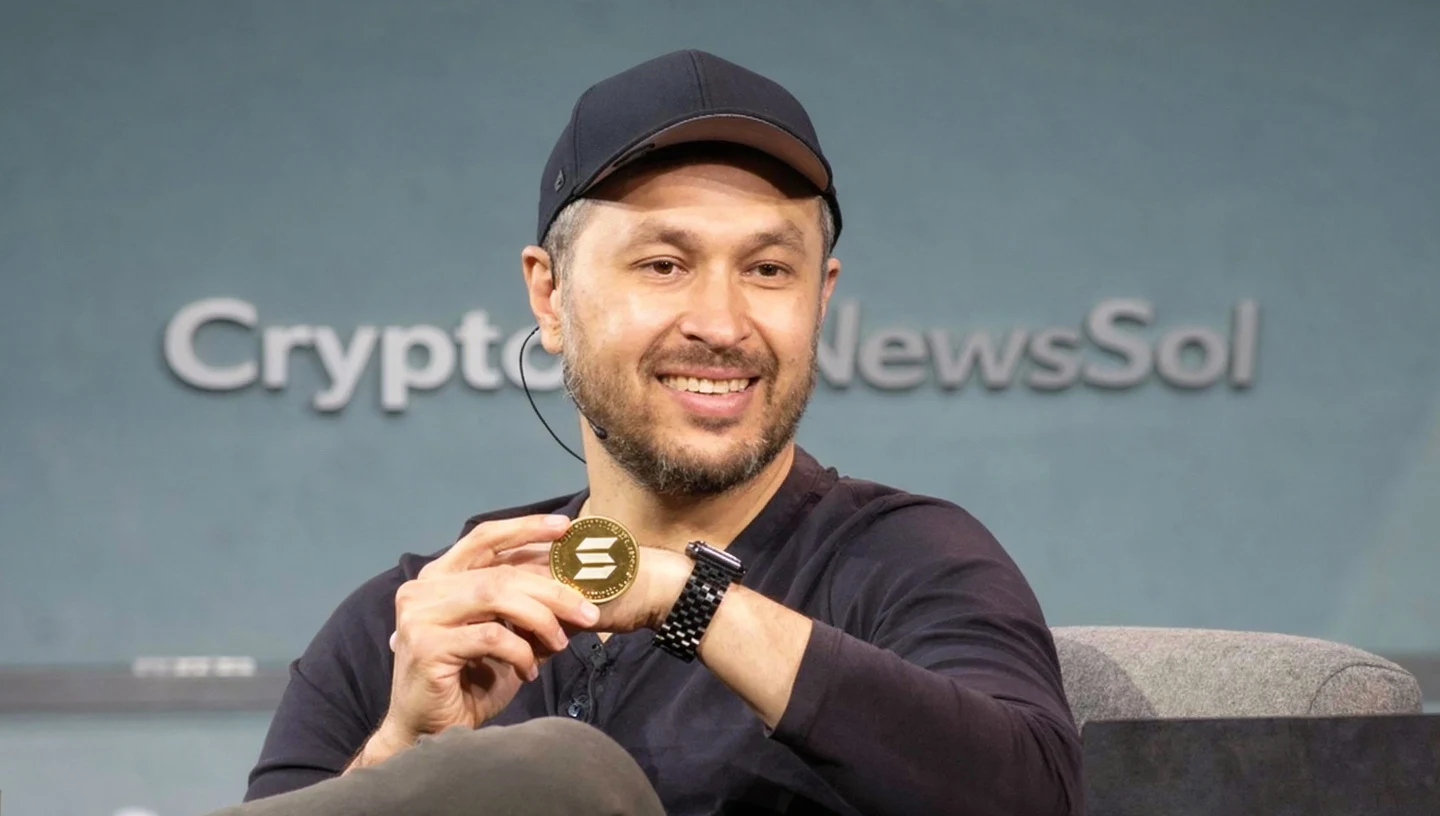
Anatoly Yakovenko is the Solana founder. He wrote the original whitepaper, conceived Proof of History, and serves as CEO of Solana Labs. His path to blockchain ran through Ukraine, Illinois, San Diego, and San Francisco, and it took him 13 years at Qualcomm before a sleepless night in a San Francisco café changed the course of his career.
From Ukraine to Silicon Valley: the Solana origin story
Yakovenko was born in Ukraine in 1981 and moved to the United States with his family in the early 1990s, part of the wave of Eastern European immigrants who arrived during America’s technology boom. As a teenager, he gravitated toward the C programming language. He later described those early years in a Fortune interview: “There was this magical possibility of writing a piece of code that just solves some incredible problem for the world.”
At the University of Illinois Urbana-Champaign, Yakovenko studied computer science. While still a student, he co-founded Alescere, a Voice over Internet Protocol system built for small businesses. The company failed, but it gave him hands-on experience with real-time networking protocols and distributed systems, experience that would matter far more than the failure itself.
In 2003, Yakovenko joined Qualcomm in San Diego. What started as a standard engineering role grew into a 13-year career through some of the company’s hardest technical problems. He worked on QChat’s Push-to-Talk servers, the BREW mobile operating system, and eventually became Senior Staff Engineer Manager. His patent portfolio from that period includes work on “exposing host operating system services to an auxiliary processor” and “extending protection domains to co-processors.” The through-line was always the same: how do you make distributed components coordinate without slowing each other down?
The cellular tower technology Qualcomm worked on used time division multiple access, a method for coordinating multiple signals by managing timing precisely. That concept would resurface years later in a very different context. After leaving Qualcomm in 2016, Yakovenko spent a short period at Mesosphere before joining Dropbox in 2017, where he worked on compression and distributed systems. His day job was not blockchain. His side project was.
He and Stephen Akridge, a GPU lead at Qualcomm, had been building hardware for deep learning and mining cryptocurrency on the side to offset costs. It was supposed to be about machine learning. It did not stay that way.
The night at Café Soleil: how Proof of History was born
In 2017, the Bitcoin conference stopped accepting Bitcoin payments because transaction fees had spiked to $60-70 per transaction. The world’s largest cryptocurrency gathering could not actually use cryptocurrency. For Yakovenko, that was the breaking point.
He went to Café Soleil in San Francisco, ordered two coffees and a beer, and stayed until 4 AM working through the problem. Bitcoin creates a new block every 10 minutes, a deliberate design choice that balances security against speed. That 10-minute cycle limits Bitcoin to roughly 7 transactions per second. Visa handles around 24,000. The gap was not a minor technical inconvenience. It was a structural barrier to any mainstream use.
The deeper problem was time itself. In a distributed network with thousands of computers spread across the world, there is no central clock. Each machine runs slightly differently. Network messages take time to travel. The same sequence of events can appear to happen in a different order depending on where in the network you are sitting. Bitcoin validators spend enormous amounts of time and computational effort arguing about basic questions: which transaction came first? which version of the chain is correct?
Yakovenko’s idea was to stop arguing and start computing. What if the blockchain had its own built-in clock that no one could manipulate? Every transaction would carry a verifiable timestamp that any node could check independently, without messaging other nodes first. No coordination overhead. Just a cryptographic record of when something happened.
He called it Proof of History. The mechanism uses a sequential SHA-256 hash chain, where each output becomes the input of the next computation. The chain itself becomes a record of elapsed time. Any validator can verify the sequence without trusting anyone else’s clock.
Yakovenko did not know this concept had a name. The academic term is Verifiable Delay Function. Because he could not look it up, he spent that night working through the mathematics from first principles. He published the Solana whitepaper in November 2017. The original document is available at the Solana Proof of History whitepaper.
The Solana co-founders: who else built the blockchain
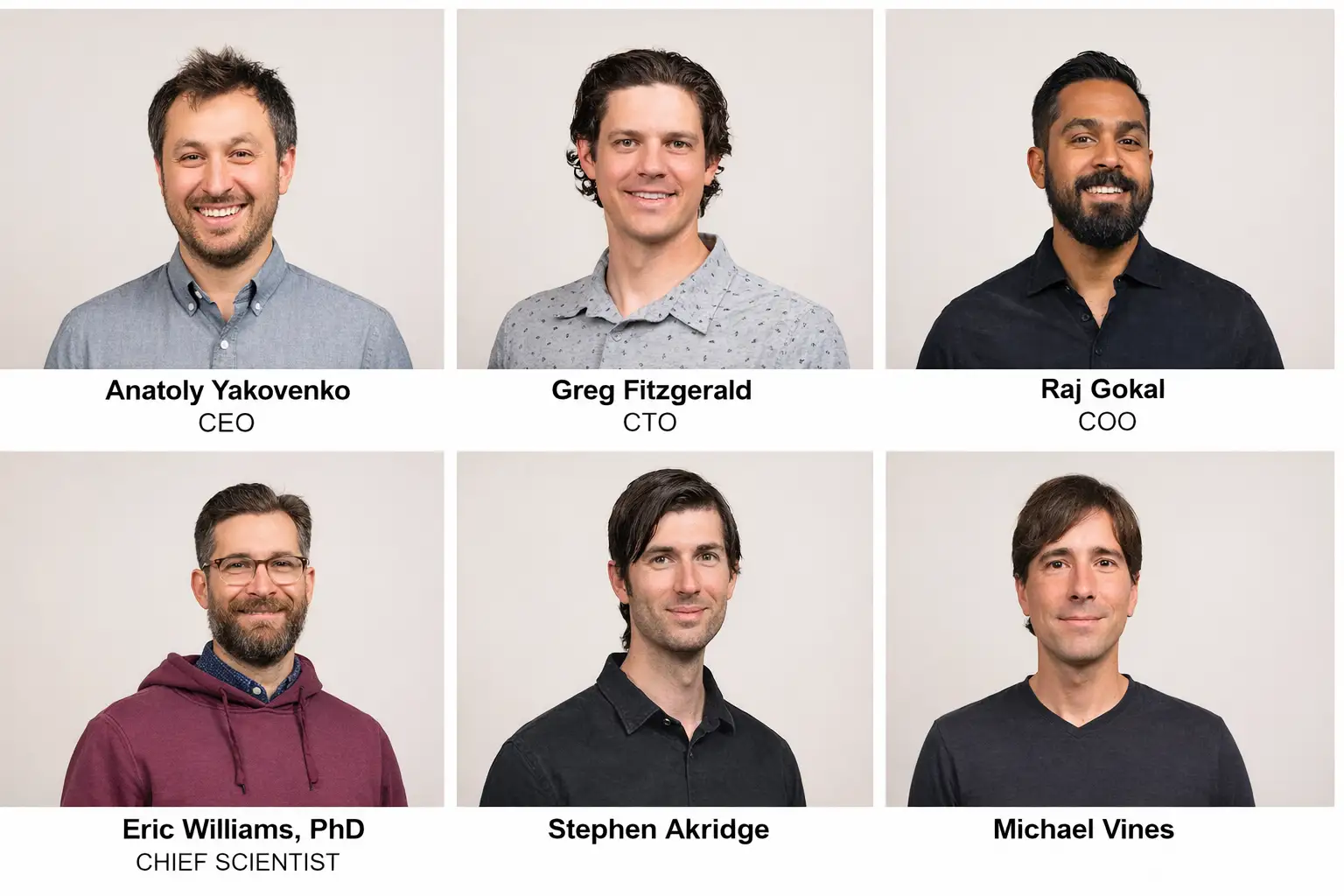
Proof of History was one person’s idea. Who made Solana into a network required four more people alongside Yakovenko. The Solana founding team came together over late 2017 and 2018, and each member brought something the others lacked. Three came from Qualcomm. One came from venture capital and healthcare. One came from data modelling and network design.
Greg Fitzgerald: the engineer who wrote the code in Rust
Greg Fitzgerald was Yakovenko’s first call after the whitepaper was done. The two had worked together at Qualcomm, and Yakovenko sent the document directly to Fitzgerald on Slack. Fitzgerald read it and joined immediately.
In February 2018, Fitzgerald built the first working prototype. He named it “Loom”, a reference to the weaving tool that makes fabric from individual threads. The prototype demonstrated that 10,000 transactions could be processed in half a second. The concept worked.
Fitzgerald wrote the early Solana codebase in Rust, a programming language chosen for two specific reasons. First, Rust runs at speeds comparable to C and C++ without a garbage collector, which means no unpredictable pauses during execution. Second, Rust enforces memory safety at compile time, eliminating entire categories of bugs that have caused critical failures in other systems software. For a blockchain designed to process thousands of transactions per second without downtime, both properties mattered. Fitzgerald serves as Chief Technology Officer of Solana Labs today.
Stephen Akridge: the GPU breakthrough that made speed possible
Stephen Akridge had been the GPU lead at Qualcomm and was already working on the machine learning side project with Yakovenko when the Proof of History idea surfaced. He joined the founding team and contributed the technical breakthrough that turned a fast concept into a genuinely fast network.
Transaction processing on a blockchain requires signature verification, checking that each transaction was actually signed by the wallet that claims to have sent it. On Bitcoin and Ethereum, this verification runs on general-purpose CPUs and becomes a bottleneck as transaction volume increases.
Akridge proposed offloading signature verification to GPUs. A GPU contains thousands of smaller cores designed for parallel computation. Where a CPU verifies signatures sequentially, a GPU can verify hundreds simultaneously. Without this optimization, Solana’s theoretical ceiling of 65,000 transactions per second would not have been reachable. Akridge’s contribution was less visible than Yakovenko’s whitepaper but just as load-bearing.
Raj Gokal: the Wharton man who built the business
Raj Gokal did not come from Qualcomm. He came from finance, venture capital, and healthcare, and he joined Solana as co-founder and Chief Operating Officer to handle everything the engineers did not want to deal with.
Gokal studied economics at the Wharton School at the University of Pennsylvania, graduating in 2010. He worked as a financial analyst at Financo and KBW before moving into venture capital at General Catalyst Partners in Boston. In 2011, he co-founded Sano, a wearable glucose monitor company that raised $20 million before he moved on. He then served as Director of Product at Omada Health from 2014 to 2016, where the company grew tenfold during his tenure. He spent time as an Entrepreneur in Residence at Rock Health before closing the healthcare chapter entirely in 2017.
When Yakovenko needed someone to handle fundraising, partnerships, and ecosystem development, Gokal was the right fit. His work during the 2018-2019 crypto winter, when getting a meeting with investors was hard and getting a check was harder, was what kept Solana Labs funded. Gokal serves as President of Solana Labs and holds a board seat at the Solana Foundation.
In 2025, Gokal’s personal data was exposed when hackers accessed rapper Migos’ Instagram account. Attackers used the data to attempt a 40 BTC extortion. Gokal refused to pay.
Eric Williams: the co-founder most articles forget
Eric Williams is the fifth co-founder of Solana and the least discussed. He joined the founding team as Chief Scientist of Solana Labs, bringing a background in data modelling, network design, and tokenomics. His work focused on the economic architecture of the network, how the inflation schedule was structured, how staking rewards were calculated, and how the token supply should behave over time. While Fitzgerald built the code and Akridge optimised the hardware layer, Williams worked on the incentive layer that would determine whether validators actually wanted to run the network. His relative obscurity in public coverage reflects his preference for technical work over visibility, not a smaller role.
Why the blockchain is named Solana, not Loom
When Fitzgerald built the first prototype in February 2018, he called it Loom. The name fit the metaphor: just as a loom weaves individual threads into fabric, the blockchain would weave individual transactions into a shared ledger.
The problem was that Loom Network already existed. It was a separate blockchain project built on Ethereum, operating under that name, with its own community and token. Using the same name would cause confusion at best and a trademark dispute at worst. The name needed to change.
The replacement came from geography. Yakovenko, Fitzgerald, and Akridge had all lived near Solana Beach, a coastal town in San Diego County in Southern California. The three of them had spent weekends surfing there. During the Solana Labs founding period in 2018, the morning routine was surf, bike to work, code, then return to the beach in the afternoon. The name had been part of daily life for years before it became a brand.
Yakovenko posted the name change to Slack. It was accepted without debate.
Building Solana during the crypto winter: 2018 and 2019
Solana Labs was formally incorporated in San Francisco in 2018. The timing was bad by most measures. Bitcoin fell from $20,000 in December 2017 to below $3,500 by November 2018. Investor appetite for new blockchain projects had dried up. Many teams that had raised money on the strength of a whitepaper during the 2017 bull market dissolved when the market turned.
Solana Labs did not dissolve, but it was not comfortable either. Yakovenko later described the period directly: “We were always somewhat conservative, we never raised a ton of money, we only had about two years of runway, so we were always like ‘we gotta build this thing as fast as we can and really focus on the key product that we think is gonna make a difference.'”
The team had 12 engineers. The fundraising process produced one notable near-miss: Haseeb Qureshi at DragonFly Capital turned down the investment, calling the 710,000 TPS claim “complete bullshit.” He later described it as one of the worst investment decisions of his career. Multicoin Capital, led by Kyle Samani, took a different view. Multicoin led the $20 million Series A in July 2019, joined by several other investors who had been watching the technical progress.
What Solana built beyond Proof of History
Proof of History solved the timing problem. Getting to 65,000 transactions per second required solving several other bottlenecks at the same time. The Solana Labs team built four additional innovations alongside the core consensus mechanism.
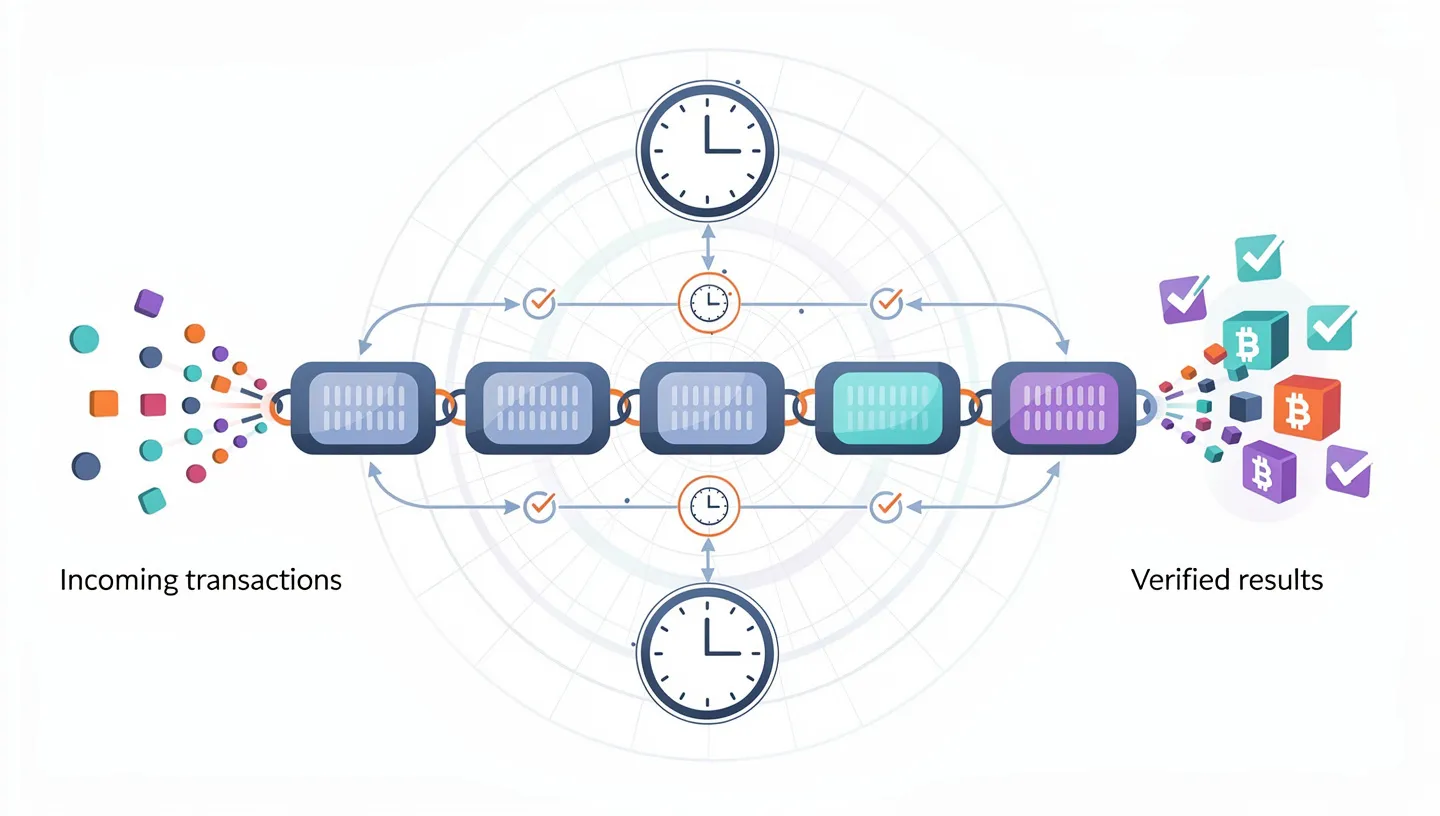
Sealevel is a parallel smart contract runtime. Most blockchains execute transactions one at a time. Sealevel lets Solana run thousands of smart contracts simultaneously by requiring each transaction to declare in advance which accounts it will read or modify. Transactions that touch different accounts can run in parallel without conflict.
Turbine is a block propagation protocol inspired by BitTorrent. Rather than sending full blocks from one validator to every other validator, Turbine breaks blocks into smaller packets and distributes them across the network using stake-weighted trees and erasure coding. Validators reassemble the full block from the pieces they receive.
Gulf Stream eliminates the mempool. In most blockchains, unconfirmed transactions wait in a shared pool until a validator picks them up. Gulf Stream forwards transactions directly to validators who are scheduled to lead the next several blocks. By the time a validator’s turn arrives, it has already received and cached the transactions it needs to process.
Cloudbreak is a horizontal account storage system designed for high-concurrency access. It allows simultaneous reads and writes across accounts, which is necessary to support the parallel execution that Sealevel enables.
In February 2020, Solana launched Tour de SOL, an incentivized testnet program that let validators run the network under real conditions and earn SOL for their participation. The program stress-tested the infrastructure before the mainnet launch and helped grow the initial validator set.
The mainnet launch on March 16, 2020, and what happened next
Solana’s mainnet beta launched on March 16, 2020. The date is worth noting. Global markets had just recorded some of their largest single-day drops in history. Countries were entering lockdowns. Solana Labs launched anyway.
The public token sale had run through CoinList, raising $1.76 million. The beta label was deliberate: the network was live and processing real transactions, but the team was still gathering data and making adjustments. Early traction was quiet.
The network’s first major stress test came from an unexpected source. In the summer of 2020, Kyle Samani at Multicoin Capital introduced Yakovenko to Sam Bankman-Fried. The two talked for three hours in the early morning. The next day, Bankman-Fried started sending transactions to Solana repeatedly, flooding the network to test whether the performance claims held under load. The network handled it. Bankman-Fried invested the same day. The Serum decentralised exchange, built on Solana by FTX, launched in August 2020.
By the end of 2020, Solana had processed 8.3 billion transactions, produced 54 million blocks, and attracted over 100 project integrations across DeFi, gaming, and Web3. The validator set had grown to over 300 nodes. In June 2021, Solana raised $314 million in a private token sale led by Andreessen Horowitz and Polychain Capital. SOL reached an all-time high of $248 in November 2021.
The Solana network outages that tested the design
Solana’s high throughput made it a target for the kind of adversarial traffic that exposed weaknesses. Between 2021 and 2023, the network suffered a series of outages that critics used to question whether the architecture had traded reliability for speed.
On September 14, 2021, a surge of transactions during a Grape Protocol IDO caused the network to fork. Validators could not reach consensus. The outage lasted 17 hours. It was the first major incident and the one that drew the most attention.
On May 1, 2022, automated NFT “blind mint” bots sent a surge of transactions that overwhelmed the consensus mechanism. The network went offline for 7 to 8 hours.
On May 31, 2022, a bug in offline transaction processing caused a 4.5-hour outage. On October 1, 2022, a misconfiguration in the consensus code took the network down for 6 hours. In February 2023, a separate bug caused 20 hours of degraded performance without a full outage.
Each incident produced a detailed post-mortem from the Solana Labs team. The responses included better transaction deduplication, improved nonce handling, fixes for fork-choice bugs, and the adoption of the QUIC protocol for network transport. Jump Crypto announced work on Firedancer in 2022, an independent validator client written in C that would give the network a second implementation and reduce its dependence on the single codebase that had been involved in most of the outages.
The outages were real. They were also, in each case, software failures in a young network rather than architectural failures in the underlying design. The network has not experienced a full consensus outage since early 2023.
The FTX collapse and Solana’s survival
Sam Bankman-Fried had been one of Solana’s most prominent public supporters. When FTX collapsed in November 2022 and Bankman-Fried was arrested, the fallout hit Solana directly. The SOL price fell 57% in a single week and dropped to $12.28, its lowest point since February 2021.
The Solana Foundation disclosed that it held over $180 million in assets on FTX at the time of the collapse, including 3.24 million FTX shares, 3.43 million FTT tokens, and 134.54 million SRM tokens. Alameda Research and FTX had together purchased 58 million SOL from the Foundation, a position worth $814 million at the 2021 peak.
The more immediate operational problem was Serum. Serum was the central order book DEX that much of Solana’s DeFi ecosystem had been built on top of. FTX controlled the upgrade key to Serum’s smart contract. With FTX insolvent and Bankman-Fried under arrest, that key was compromised. Any contract that could be upgraded by a hostile actor was a security risk.
Within five days of the FTX collapse, the Solana developer community forked Serum’s code and deployed a new version called OpenBook on November 15, 2022. The fork stripped FTX’s control entirely. OpenBook was community-owned from its first block.
Throughout the entire crisis, Solana’s blockchain never stopped processing transactions. No downtime. No consensus failure. The price collapsed and the ecosystem lost a major backer, but the network itself continued to run. Yakovenko described the OpenBook fork as decentralisation working as intended: a community that did not need to wait for permission to fix its own infrastructure.
Recovery was gradual. The memecoin trading activity of 2023 and 2024 brought high transaction volumes back to the network. By October 2025, regulators approved a Solana spot ETF, a development that carried implicit recognition of SOL as a commodity-like asset.
Who controls Solana today?
Solana is not controlled by any single person or company. Two separate organisations share responsibility for the network’s development and governance, and neither fully controls the other.
Solana Labs is the for-profit development company based in San Francisco. Yakovenko is CEO, Fitzgerald is CTO, and Gokal is President. Solana Labs writes and maintains the core protocol code, runs the Solana validator client, and funds core development. It holds equity and token positions in the network.
The Solana Foundation is a non-profit organisation based in Geneva, Switzerland. It manages grants to developers and projects, funds decentralisation initiatives, supports the validator programme, and stewards the broader Solana community. Williams holds a role in the Foundation’s technical direction. The Foundation holds a separate SOL treasury and operates independently of Solana Labs.
Network security is maintained by over 1,300 independent validators who stake SOL, produce blocks, and vote on chain upgrades. No single validator controls a majority of stake. The largest validator sets are operated by exchanges, staking services, and independent operators across dozens of countries.
The Firedancer client, being developed by Jump Crypto, will eventually give the network a second independent validator implementation. When both clients are running at scale, no single codebase failure can take down the entire network. That is the architecture Solana Labs has been working toward since the outage years.
Solana history: key milestones and a complete timeline
The history of Solana runs from a whitepaper drafted at 4 AM in a San Francisco café to a blockchain processing 400 billion transactions. These are the key dates.
November 2017: Anatoly Yakovenko publishes the Proof of History whitepaper.
February 2018: Greg Fitzgerald builds the first working prototype, initially named “Loom.” Solana Labs is incorporated in San Francisco. Stephen Akridge, Raj Gokal, and Eric Williams join as co-founders.
2018-2019: Crypto winter. The team operates on two years of runway with 12 engineers. Multicoin Capital leads engagement. Haseeb Qureshi at DragonFly declines to invest.
July 2019: Solana Labs closes a $20 million Series A led by Multicoin Capital.
February 2020: Tour de SOL incentivized testnet launches.
March 16, 2020: Solana mainnet beta goes live. $1.76 million raised via CoinList.
August 2020: Sam Bankman-Fried invests after stress-testing the network. Serum DEX launches on Solana.
End of 2020: 8.3 billion transactions processed. 300+ validators. 100+ project integrations.
June 2021: $314 million private token sale, led by Andreessen Horowitz and Polychain Capital.
November 2021: SOL reaches all-time high of $248.
September 14, 2021: First major outage. 17 hours offline following Grape Protocol IDO.
2022: Jump Crypto announces Firedancer. Three further outages (May, May, October).
November 2022: FTX collapses. SOL drops to $12.28. OpenBook forks Serum within five days.
2023-2024: Memecoin trading volumes recover the network’s activity metrics. Solana Saga phone ships. February 2023 degradation is the last major performance incident.
October 2025: Solana spot ETF approved.
2026: Over 400 billion transactions processed. 1,300+ active validators. Four public companies hold over $591 million in SOL in corporate treasuries.
Frequently asked questions
Who created Solana?
Solana was created by Anatoly Yakovenko, who published the Proof of History whitepaper in November 2017. He co-founded Solana Labs in 2018 with Greg Fitzgerald, Stephen Akridge, Raj Gokal, and Eric Williams.
What is Anatoly Yakovenko’s background?
Yakovenko was born in Ukraine in 1981 and studied computer science at the University of Illinois Urbana-Champaign. He spent 13 years at Qualcomm as Senior Staff Engineer Manager, working on distributed systems, the BREW mobile OS, and Push-to-Talk servers. He briefly worked at Mesosphere and Dropbox before founding Solana Labs.
What is Proof of History?
Proof of History is a consensus mechanism that creates a cryptographic record of time by running a sequential SHA-256 hash chain. Each output becomes the input for the next computation, producing a verifiable sequence that proves how much time has elapsed between events. Validators can check this record without communicating with other nodes, removing the coordination overhead that slows down most blockchains.
Why is the blockchain named Solana?
The first working prototype was named “Loom” by Greg Fitzgerald in February 2018. The name was changed because Loom Network already existed as a separate Ethereum-based project. Yakovenko, Fitzgerald, and Akridge had all lived near Solana Beach in San Diego County and surfed there regularly. Yakovenko proposed the name on Slack and it was adopted.
What was Solana originally called?
The first prototype was called Loom. The name was changed to Solana before Solana Labs was formally incorporated, to avoid confusion with the existing Loom Network project on Ethereum.
Who are the Solana co-founders?
The Solana co-founders are Anatoly Yakovenko (CEO), Greg Fitzgerald (CTO), Raj Gokal (President/COO), Stephen Akridge (GPU optimisation), and Eric Williams (Chief Scientist). All five are co-founders of Solana Labs.
When was Solana created?
The Proof of History whitepaper was published in November 2017. Solana Labs was incorporated in 2018. The mainnet beta launched on March 16, 2020.
When did Solana launch its mainnet?
Solana’s mainnet beta launched on March 16, 2020. The beta label indicated the network was live and processing real transactions while the team continued refining the software.
What was Solana’s connection to FTX?
Sam Bankman-Fried invested in Solana in 2020 after stress-testing the network. FTX and Alameda Research purchased 58 million SOL from the Solana Foundation, worth $814 million at the 2021 peak. FTX also built Serum, the central DEX in the Solana ecosystem, and held the upgrade key to its smart contract. When FTX collapsed in November 2022, the Solana community forked Serum into OpenBook within five days to remove FTX’s control.
Who controls Solana today?
No single entity controls Solana. Solana Labs (San Francisco, for-profit) develops the core protocol. The Solana Foundation (Geneva, non-profit) manages grants and decentralisation. Over 1,300 independent validators secure the network. SOL token holders participate in governance through staking and on-chain voting.
What is the difference between Solana Labs and the Solana Foundation?
Solana Labs is the for-profit company that builds and maintains the Solana protocol software. The Solana Foundation is a non-profit in Switzerland that funds ecosystem development, supports validators, and works toward decentralisation. The two organisations operate independently, with separate treasuries and separate leadership structures, though both share the goal of growing the Solana network.