Solana is a Layer 1 blockchain built to handle a large volume of transactions quickly and cheaply. Where most blockchains slow down under demand, Solana was designed from the start to stay fast as the network grows. It processes thousands of transactions per second, charges fees that cost a fraction of a cent, and confirms those transactions in well under a second.
That combination of speed and low cost has made Solana one of the most active blockchains in the world. Developers build trading platforms, payment systems, digital asset marketplaces, and consumer applications on it. Ordinary users buy, sell, stake, and transact on it daily without needing to understand the engineering underneath.
This guide explains what Solana is, how it works, what SOL does, and what has changed heading into 2026 with the launch of Firedancer and the arrival of Alpenglow.
What is Solana?
Solana is an open-source, programmable blockchain. Anyone can build applications on it, and anyone can use those applications without asking permission from a central authority. The rules of the network are enforced by software running on thousands of computers around the world, not by a company or a government.
Launched as a mainnet beta in March 2020, Solana was built to address a problem that older blockchains had not solved: the blockchain trilemma. Most networks struggle to be fast, cheap, and decentralized at the same time. Ethereum, for example, is decentralized and secure, but its transaction fees can reach tens of dollars during busy periods, and it processes roughly 15 transactions per second. Bitcoin manages around 7.
Solana takes a different approach. Its architecture is monolithic, meaning everything happens on a single chain without splitting the network into separate layers or shards. By combining several custom-built technologies, it achieves throughput that other Layer 1 blockchains cannot match at the base layer. In practice, the network processes between 2,000 and 4,000 transactions per second during normal usage, with a theoretical ceiling far higher. Transaction fees sit below $0.01 in almost every case.
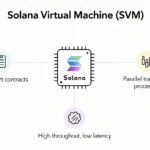
Solana supports smart contracts, which the network calls programs. These are pieces of code that run automatically when certain conditions are met, without any human needed to carry them out. Programs are what make decentralized finance, NFT marketplaces, and other on-chain applications possible.
What is SOL, the native token?
SOL is the native currency of the Solana blockchain. Every activity on the network involves SOL in some way.
SOL serves three main functions. First, it pays transaction fees. Every time someone sends a transfer, runs a program, or interacts with a decentralized application, a small fee is charged in SOL. Half of that fee is burned, meaning it is permanently removed from supply. The other half goes to the validator that processed the transaction.
Second, SOL is used for staking. Validators lock up SOL as collateral to take part in the consensus process. This is delegated proof of stake: regular holders can assign their SOL to a validator of their choice without giving up ownership of it. The validator uses that delegated stake to participate in block production and earns rewards, a portion of which flow back to the delegator. Staking rewards currently sit around 5 to 6% annually, though the exact figure depends on which validator you choose and the current network inflation rate.
Third, SOL plays a role in network governance. Validators and large stakers can vote on protocol changes. The Alpenglow upgrade, discussed later in this guide, passed with 98.27% of participating stake voting in favour in September 2025.
As of March 2026, there are approximately 570 million SOL in circulation, out of a total supply of around 621 million. Solana has no hard cap on supply. The network issues new SOL to reward validators at a rate that decreases over time. The current annual inflation rate sits at roughly 4.5%, down from the original 8%, falling by 15% each year until it stabilises at a long-term floor of 1.5%.
Who created Solana?
Anatoly Yakovenko is the founder most associated with Solana. He spent years as a software engineer at Qualcomm, working on distributed systems and compression algorithms. That background pushed him toward the problem of how a blockchain could agree on the order of events without slowing everything down through constant validator communication.

In November 2017, Yakovenko published a whitepaper introducing a concept he called Proof of History. The core idea was that a blockchain could use a cryptographic function to create a verifiable record of when events occurred, cutting out the back-and-forth that eats time in other consensus systems.
He built the first prototype himself, initially in C, then rewrote it in Rust for better performance and memory safety. In early 2018, he brought in Greg Fitzgerald, a former Qualcomm colleague, and the two ran the first internal testnet together. It processed 10,000 transactions in under half a second.
Raj Gokal joined shortly after as co-founder, along with Stephen Akridge, another Qualcomm engineer. Nearly the entire founding team came from the same company, which meant fast early coordination but also raised questions about how tightly the project was controlled by a small insider group.
The project was originally called Loom, but had to rename itself when an Ethereum project of the same name launched around the same time. The team chose Solana, named after Solana Beach in California, where several of them had lived during their Qualcomm years. Solana Labs, the San Francisco-based company that develops the core protocol, was formally incorporated in 2019. The Solana Foundation, a separate non-profit that supports the broader ecosystem, is based in Geneva, Switzerland.
A brief history of Solana
The story of Solana runs from a whitepaper drafted in late 2017 to one of the most used blockchains in the world by 2026, with a collapse and a full rebuild in between.
After the first testnet in early 2018 and the formal founding of Solana Labs in 2019, the mainnet beta went live in March 2020. Early traction was limited. The blockchain world was still focused on Ethereum, and Solana had almost no ecosystem at the time.
That changed sharply in 2021. Ethereum’s gas fees climbed to record levels, regularly costing $50 to $200 for a single transaction. Developers and users began moving to alternatives, and Solana, with its near-zero fees and high throughput, absorbed a large portion of that migration. The NFT market on Solana grew fast. Decentralized exchanges went live. Total value locked in Solana DeFi grew from near zero to several billion dollars within months.
Sam Bankman-Fried and the FTX exchange became major backers during this period, funding Solana projects and building Serum, a high-speed decentralised order book on the network. That connection would later cause serious damage.
In November 2022, FTX collapsed. SOL’s price dropped more than 60% within days. Projects built on Serum had to abandon their code and start over. Large parts of the Solana ecosystem were tied closely to FTX, and the collapse pulled many of them under with it. Many observers declared Solana finished.
The rebuild took two years. Through 2023 and 2024, new teams launched projects without any FTX connection. The memecoin cycle brought a wave of new users. Pump.fun, which lets anyone launch a token in seconds for minimal cost, became one of the highest-activity applications on any blockchain. Daily transaction counts reached all-time highs.
By late 2025, spot Solana ETFs had launched in the United States. Firedancer, a second independent validator client built by Jump Crypto, went live on mainnet in December 2025. The Alpenglow consensus upgrade passed governance with 98.27% support in September 2025 and is expected on mainnet in the first half of 2026. Solana entered 2026 technically stronger than at any previous point, though SOL’s price, around $80 to $86 in late February and early March 2026, sat roughly 70% below its all-time high of $293 reached in January 2025.
How does Solana work?
Solana processes everything on a single chain. There is no Layer 2, no sharding, no rollup. That monolithic design means one consistent execution environment for every application. Users do not need to bridge assets between layers or manage different fee markets depending on which network they happen to be on.
The trade-off is that the base layer must be highly capable on its own. Solana achieves that through eight technologies working together.
Proof of History: how Solana keeps time
The central problem Solana solves differently from other blockchains is time. To agree on the order of transactions, validators normally communicate with each other constantly. That communication takes time and puts a ceiling on how fast the network can move.
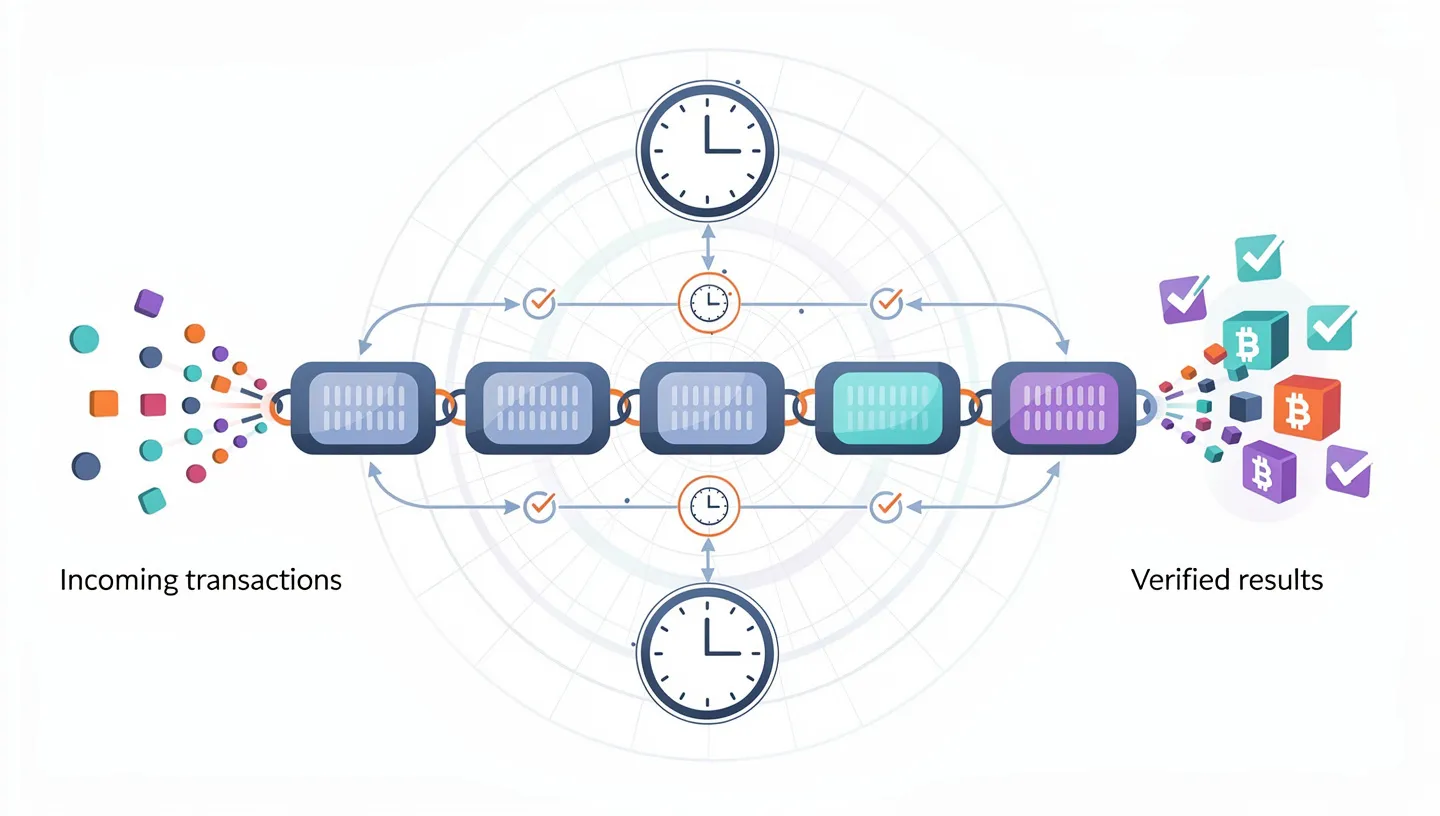
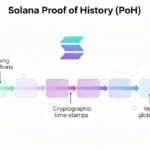
Proof of History removes that ceiling by creating a verifiable timeline before consensus even begins. It works through a Verifiable Delay Function: a cryptographic process that takes a fixed amount of real time to run and cannot be shortened. Solana’s version runs the SHA-256 hash function in a continuous loop, with each output fed back in as the next input. Every step in that chain is recorded. The result is a sequence that cannot be faked, reordered, or skipped.
When data is inserted into that sequence, its position proves when it existed relative to every other piece of data in the chain. Picture a tick-by-tick metronome that writes down everything that happens on each beat. You cannot claim a beat occurred earlier or later than the record shows. Validators use this to verify the order of transactions without coordinating with each other in real time, which is what makes Solana fast.
Proof of History is not a consensus mechanism. It is a clock. The consensus mechanism built on top of it is called Tower BFT.
Proof of stake and how validators confirm transactions
Solana uses delegated proof of stake for consensus. Validators lock up SOL to take part. The more stake assigned to a validator, the more often it gets selected as the block producer for a given slot.
Tower BFT is Solana’s take on Byzantine Fault Tolerance, tuned to work with the Proof of History clock. In a standard BFT setup, validators must exchange many rounds of messages before reaching agreement. Tower BFT cuts that down by using the PoH timeline as a shared reference. Validators vote on blocks, and each vote carries a lockout period that doubles with each additional vote on the same chain. Reversing an earlier vote becomes progressively more costly, which is how the network reaches finality: the point at which a confirmed transaction cannot be undone.
A leader node is chosen for each slot based on stake weight. The leader bundles incoming transactions, timestamps them using the Proof of History sequence, and sends the block out to the rest of the network. Other validators verify and vote on it using the same shared clock.
Deterministic finality currently takes around 12 to 13 seconds. That figure will change significantly when Alpenglow arrives.
The other technologies that make Solana fast
Turbine handles block distribution. Sending a full block to every validator at once would create a bandwidth problem at scale. Turbine slices each block into small fragments called shreds and sends different fragments to different validator groups in a layered relay structure. Each group passes its shreds along to the next. The block spreads across the network without any single node carrying the full load.
Gulf Stream removes the need for a mempool. Most blockchains hold unprocessed transactions in a queue until a validator selects them. Solana knows the leader schedule in advance, so transactions go straight to the current and next scheduled leaders before their slots begin. Validators start processing before their turn officially arrives, cutting the gap between submission and confirmation.
Sealevel is a parallel execution engine. Most blockchains run programs one after another in sequence. Sealevel checks which programs access which accounts and runs non-conflicting ones simultaneously. Multiple transactions execute at the same moment rather than waiting in a single queue. This is one of the main reasons Solana sustains high throughput without fees climbing.
Pipelining applies assembly-line logic to transaction validation. The Transaction Processing Unit breaks validation into stages: fetching, signature verification, execution, and commitment. Different batches of transactions move through different stages at the same time. No stage sits idle waiting for the previous one to complete.
Cloudbreak handles account storage. As a blockchain grows, holding all account data in one place becomes a bottleneck. Cloudbreak splits account data across multiple storage units and distributes reads and writes, keeping access times consistent as the number of accounts grows.
Archivers store Solana’s full transaction history. Validators do not need to carry the entire ledger themselves. Archiver nodes take that responsibility, using cryptographic proofs to demonstrate they are actually holding the data they claim to store.
How fast is Solana and how much do transactions cost?
Two TPS figures come up in most discussions of Solana, and the difference between them matters.
The first is 65,000 transactions per second, the theoretical ceiling of the Agave validator client under benchmark conditions. The second is 710,000 TPS, achieved in stress tests run over a gigabit network connection. Neither reflects what the live network processes in normal operation.
In practice, Solana handles between 3,000 and 4,000 transactions per second during regular usage in early 2026. During high-activity periods that figure rises. The gap between benchmark numbers and live output is not specific to Solana. Every blockchain performs differently under controlled conditions than under production load.
For comparison, Ethereum processes around 15 transactions per second at its base layer. Bitcoin handles roughly 7. Ethereum’s Layer 2 networks push settlement throughput higher, but users must bridge funds and manage separate environments to access them.
Block time on Solana is approximately 400 milliseconds. Optimistic confirmation, where a transaction is considered effectively settled before full finality, typically happens within one to two seconds. Full deterministic finality currently takes 12 to 13 seconds, a figure Alpenglow will reduce to under 150 milliseconds.
A standard SOL transfer costs a base fee of 0.000005 SOL, well under a cent at current prices. More complex program interactions cost slightly more based on compute units consumed, but rarely reach a few cents. Solana uses localized fee markets, so congestion in one application does not raise fees across the whole network. A busy NFT mint does not make a simple wallet transfer more expensive.
What is SOL used for?
Solana supports most of the same use cases as Ethereum, usually with lower fees and faster settlement.
Decentralized finance is the largest sector by value locked. Marinade Finance and Jito run the two biggest liquid staking platforms. Kamino Finance handles lending and leveraged yield strategies. Raydium and Orca are the main automated market makers. Jupiter aggregates liquidity across every Solana DEX and routes trades through the most efficient available path. Solana also has a payments framework called Solana Pay, which lets merchants accept stablecoin payments directly from customers with no payment processor involved. The only cost is the base network fee.
NFTs and digital collectibles have been part of Solana since 2021. Magic Eden and Tensor are the two main NFT marketplaces. Metaplex provides the token standards and minting infrastructure that most Solana NFT projects use.
Memecoins generated a large share of Solana’s on-chain activity through 2024 and into 2025. Pump.fun allows anyone to launch a token in seconds for a few cents. Most tokens launched on the platform lose value quickly, but the volume of activity contributes significantly to network fee revenue and transaction counts.
Stablecoins and payments represent a growing part of the ecosystem. USDC and PYUSD both have substantial circulation on Solana. Visa, PayPal, and Worldpay have all built stablecoin settlement infrastructure on the network, drawn by the low fees and fast confirmation times.
Real-world assets are newer but growing. BlackRock’s BUIDL fund and several tokenized Treasury products from other institutions operate on Solana. According to rwa.xyz, Solana holds the second-largest amount of tokenized real-world assets of any blockchain as of early 2026, though the gap between it and Ethereum remains wide.
Gaming and consumer applications use Solana’s low per-transaction cost to run experiences where every user action generates an on-chain event. The Solana Mobile hardware line, including the Saga phone and the newer Seeker device, is an attempt to bring blockchain-native apps to a mainstream mobile audience.
Firedancer and Alpenglow: what is changing in 2026
Two of the most significant changes in Solana’s history are either live now or arriving in the first half of 2026.
What is Firedancer?
Until late 2024, almost every Solana validator ran the same software: the Agave client. A critical bug in that single codebase could bring the whole network down at once. This is exactly what happened during Solana’s worst outages. Every validator ran identical code, so a flaw that hit one hit all of them simultaneously.
Firedancer is a second, independent validator client built by Jump Crypto. Development started in 2022. It is written in C and C++, not Rust, and structured as a set of isolated, single-purpose tiles rather than one large application. Each tile handles one job: networking, signature verification, execution, storage. They communicate through shared memory. The design is built to push modern hardware to its limits.
A hybrid version called Frankendancer, which pairs Firedancer’s networking layer with Agave’s consensus code, began running on mainnet in late 2024 and held roughly 21% of staked SOL by October 2025. The full Firedancer client went live on Solana mainnet on December 12, 2025, following 100 days of controlled production testing and over 50,000 blocks produced without significant incidents.
In benchmarks, Firedancer processed over one million transactions per second. That figure reflects what the client can handle in isolation, not what the live network currently processes. The bigger consequence of Firedancer is not raw speed. It is client diversity. A bug that crashes Agave leaves Firedancer validators running. Both clients would need to share the same flaw for the network to halt the way it did in 2021 and 2022.
As of early 2026, most validators still run Agave or Jito-Agave. Moving to Firedancer requires different hardware configuration and operational adjustments. Adoption is expected to grow through 2026 as validators build confidence in the new client’s track record.
What is Alpenglow?
Alpenglow replaces both Proof of History and Tower BFT. It is the most significant protocol change since Solana launched.
The new system has two components. Votor handles block voting and finalization. Unlike Tower BFT, which publishes validator votes as transactions on-chain, Votor moves votes off-chain into compact certificates. This removes an entire category of transactions from the ledger, cuts storage requirements, and eliminates vote transaction fees for validators. Votor can finalize a block in one round if at least 80% of staked SOL participates, or in two rounds if participation is between 60% and 80%. Either way, finality arrives in 100 to 150 milliseconds, against the current 12 to 13 seconds.
Rotor replaces the gossip protocol validators currently use to share data. It distributes information across the network in a more structured way than the existing system.
The Alpenglow proposal, designated SIMD-0326, passed governance in September 2025 with 98.27% of participating stake in favour, with roughly 52% of all staked SOL taking part. That participation level is unusually high for blockchain governance votes.
Moving votes off-chain does introduce one new consideration. The current system throttles vote traffic through fees. Off-chain voting channels carry no equivalent cost, which means they could in theory be flooded without financial penalty. The Anza development team is working through countermeasures during the testnet phase. As of March 2026, mainnet deployment is expected in the first half of 2026.
For regular users, 150-millisecond finality means transactions feel immediate. For institutions settling financial contracts on-chain, that latency sits within range of traditional payment infrastructure.
Solana vs. Ethereum: the key differences
Solana and Ethereum are the two most active programmable blockchains. They are built on different assumptions about how a blockchain should work.
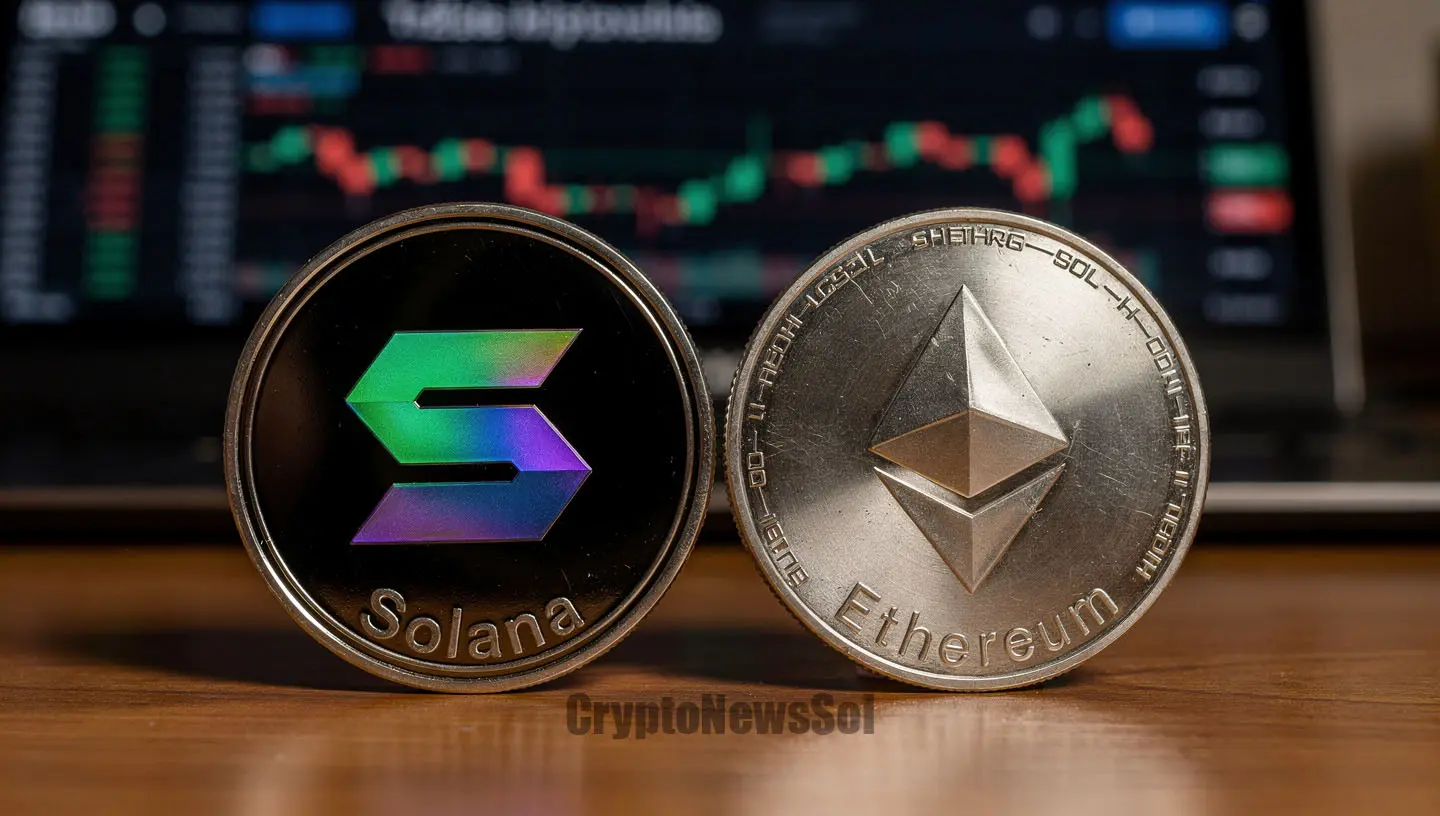
Speed and fees favour Solana clearly. Thousands of transactions per second at under a cent each, versus Ethereum’s 15 TPS at the base layer with fees that can reach several dollars. Ethereum’s Layer 2 networks narrow that gap but require users to bridge funds and deal with separate environments.
Architecture reflects a philosophical difference. Solana does everything on one chain. Ethereum is moving toward a modular design where execution, data availability, and settlement are handled by separate layers. Solana is simpler to use but demands more from its base infrastructure. Ethereum’s approach is more flexible but more complicated for ordinary users to navigate.
Decentralization favours Ethereum. Running an Ethereum node requires modest consumer hardware. Running a Solana validator requires a significantly more powerful machine, with high-bandwidth network connections, enterprise-grade SSDs, and substantial RAM. Those hardware requirements create a higher barrier to entry and push the validator set toward professional operators. Firedancer addresses client diversity, but hardware accessibility remains a meaningful gap between the two networks.
Ecosystem size still favours Ethereum. Total value locked, developer count, and institutional infrastructure are all larger on Ethereum. Solana has closed the gap considerably since 2022 but has not overtaken it.
Solana ETFs: a new way to get exposure to SOL
Until late 2025, holding SOL meant buying it on a crypto exchange and managing a wallet. That changed when the first spot Solana ETFs launched in the United States.
Bitwise’s BSOL and Fidelity’s FSOL have attracted significant inflows since launch. 21Shares’ TSOL passes staking yield through to shareholders, meaning the fund accumulates SOL over time from network rewards on top of any price movement. Morgan Stanley has filed for its own Solana product. By early 2026, assets across Solana ETFs have passed $1 billion.
The ETF structure lets investors hold SOL exposure through a standard brokerage or retirement account without managing private keys or exchange accounts. The trade-off is that an ETF holder does not own SOL directly and cannot use it on the network for transactions, DeFi, or direct staking.
For investment exposure within a traditional account, the ETF route works. For anyone who actually wants to use Solana applications, buying SOL directly and holding it in Phantom or Solflare is the appropriate approach.
What are the risks of Solana?
Solana has a strong technical record and a growing ecosystem, but it also has a history worth understanding before putting money into it.
Network outages have been Solana’s most persistent problem. A 17-hour outage in September 2021 halted the entire network. Several more followed in 2022, triggered by bot floods, software bugs, and consensus failures. Solana went through most of 2025 without a major incident, and Firedancer reduces the single-client risk. But the history exists, and Solana has not matched Ethereum’s consistency over its operational lifetime.
Validator centralization is a structural concern. Running a Solana validator requires hardware that costs considerably more than what Ethereum requires, which limits participation to professional operators. Beyond the hardware barrier, a large portion of staked SOL sits with a small number of large validators. The Jito-modified Agave client alone held over 70% of validator stake at points through 2025. A flaw in widely-used software could affect the majority of the network’s consensus power at once.
Token distribution drew criticism from the start. Research from Messari found that roughly 48% of Solana’s initial token supply went to insiders: the founding team, early investors, and the Solana Foundation. That concentration gave a small group outsized influence over the network and significant financial upside compared to participants who came later.
The FTX connection left a lasting mark. The network survived the FTX collapse in November 2022, but the reputational damage took years to repair. Several important Solana applications depended on infrastructure FTX had built, particularly Serum, and had to be rebuilt from scratch after the exchange failed.
Price volatility is not unique to Solana but is worth stating plainly. SOL reached an all-time high of $293 in January 2025. By March 2026, it was trading around $80 to $86, roughly 70% below that peak. That kind of drawdown has happened before and will happen again.
Is Solana a good investment?
There is no clean answer to this question, and anyone who gives you one with confidence is either guessing or has something to sell.
The case for Solana as a long-term asset rests on genuine usage. The network processes real transactions from real users and has been doing so for several years. Firedancer is live. Alpenglow is close to mainnet. Spot ETFs launched in late 2025 and crossed $1 billion in assets within months. Forward Industries, a NASDAQ-listed company, has converted a large portion of its treasury into SOL. These are meaningful signals that the network has moved past its post-FTX recovery phase.
The case against is just as clear. SOL is down more than 70% from its peak. The memecoin activity that drove large transaction volumes in 2024 and early 2025 has cooled. Ethereum’s Layer 2 ecosystem and newer Layer 1 blockchains continue to compete for developers and users. Technical upgrades, however well designed, do not guarantee price recovery.
How to buy Solana
The most common route is to open an account on a major crypto exchange, complete identity verification, deposit funds, and place a buy order for SOL.
Coinbase, Kraken, and Binance all list SOL and are available in most countries. Once you have SOL on an exchange, you can leave it there or move it to a self-custody wallet. Phantom and Solflare are the two most widely used Solana wallets. Self-custody means you hold your own private keys. For larger amounts, a hardware wallet like Ledger keeps those keys offline and reduces exposure to software vulnerabilities.
If you want SOL exposure within a traditional brokerage account, the spot ETFs described above are an option.
Frequently asked questions
Is Solana proof of stake or proof of work?
Solana uses delegated proof of stake for consensus, paired with Proof of History as a timekeeping mechanism. There is no mining on Solana. Validators are selected based on the amount of SOL staked to them, not on computing power. Regular holders can delegate their SOL to a validator without running any hardware themselves.
How many transactions per second can Solana handle?
The Agave client has a benchmark ceiling of around 65,000 TPS under controlled conditions. Stress tests over gigabit connections have produced figures above 710,000 TPS. In normal production, the network handles 3,000 to 4,000 transactions per second. Firedancer demonstrated over one million TPS in controlled testing, though that reflects client capability rather than live network output.
What is the difference between Solana and Ethereum?
Solana is a single-chain, monolithic blockchain built for high throughput and low fees. Ethereum is evolving toward a modular architecture where different layers handle different functions. Solana is faster and cheaper at the base layer. Ethereum has a larger ecosystem, a longer reliability track record, and lower hardware requirements for running a node.
What is Proof of History?
Proof of History is a cryptographic timekeeping mechanism. It runs the SHA-256 hash function in a continuous loop, with each output feeding into the next, creating a sequence that records the passage of time in a way that cannot be altered or faked. Validators use this record to agree on the order of transactions without needing to communicate about timing in real time. It is not a consensus mechanism on its own. It is a clock that makes Tower BFT faster. Alpenglow replaces it in 2026.
What is Firedancer?
Firedancer is a second validator client for Solana, built by Jump Crypto and written in C and C++. It went live on Solana mainnet on December 12, 2025. Before Firedancer, almost every validator ran Agave, meaning a single software flaw could bring down the whole network. Firedancer gives Solana genuine client diversity. A bug that crashes Agave does not affect Firedancer validators. In benchmarks it has processed over one million transactions per second.